 how-to
How to Plan EV Charger Installation for Small Business
Table of Contents
- Step 1: Assess Your Charging Demand and Business Needs
- Step 2: Complete an EV Charger Electrical Capacity Assessment
- Step 3: Choose the Right Charger Types and Charging Speeds
- Step 4: Plan Site Suitability, Charger Location and Cable Routing
- Step 5: Understand EV Charger Installation Cost for Business
- Step 6: Map Out Your EV Charger Installation Timeline
- Step 7: Decide on EV Charging Business Models and Funding
- Frequently Asked Questions
Last Updated: October 19, 2026
Step 1: Assess Your Charging Demand and Business Needs
Planning ev charger installation for a small business starts with one question: who will actually plug in? Get this wrong and you either overspend on hardware you never use or install too little and annoy everyone.
Counting Vehicles, Parking Spaces and Usage Patterns
Count three things before anything else:
- Electric vehicles today: how many staff, visitors or fleet vans already plug in?
- Electric vehicles in 12 months: ask your team directly. Fleet replacement cycles are the best signal.
- Dwell time: how long does a vehicle sit parked? A van parked all day needs a different charger from a visitor stopping 20 minutes.
A common approach is to size for current demand plus one spare bay. Most small sites need one or two charge points to start.
Step 2: Complete an EV Charger Electrical Capacity Assessment
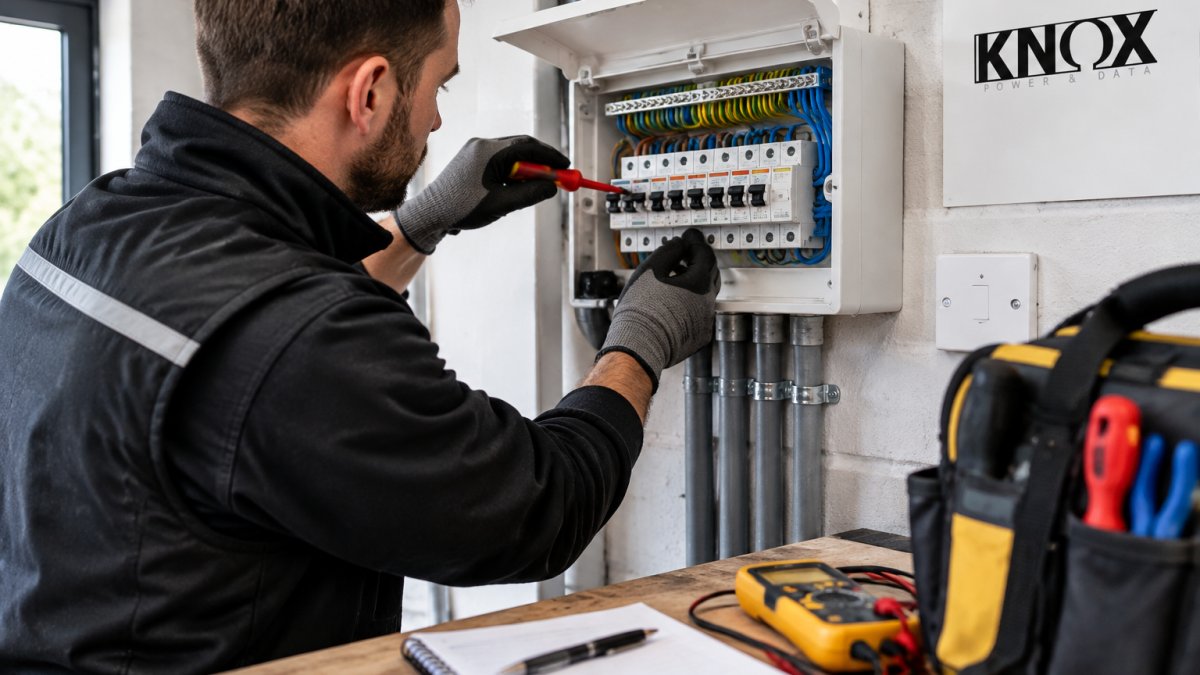
An EV charger electrical capacity assessment is a check of whether your existing supply, consumer unit and distribution board can carry the extra load. It is the step most small businesses skip, and it is the one that decides your budget.
Checking Your Supply, Consumer Unit and Load Management Options
Your installer will review:
- The size of your incoming electrical supply
- Spare ways in the consumer unit or distribution board
- Earthing arrangements and protective devices
- Whether load management can share existing capacity
Load management lets chargers slow down when the building is busy. That often avoids an expensive supply upgrade. It is not always the answer, but it is worth asking about early.
For the safety rules that govern this work, installers follow BS 7671 wiring regulations guidance and the IET guidance on electric vehicle charging installations.
Step 3: Choose the Right Charger Types and Charging Speeds
Match the charger to the dwell time, not to the brochure. That single rule solves most charger-type decisions.
| Charger type | Typical power | Best for | Notes |
|---|---|---|---|
| AC charging (single-phase) | Up to 7 kW | Staff parking all day | Cheapest hardware, slowest top-up |
| AC charging (three-phase) | Up to 22 kW | Fleet vans, longer stays | Needs three-phase supply |
| Rapid charging (DC) | 50 kW and above | Customer charging, short stops | Highest hardware and supply cost |
For most small businesses, 7 kW AC charging is enough. Rapid charging only makes sense if drivers stay under an hour.
Step 4: Plan Site Suitability, Charger Location and Cable Routing
Site suitability decides how much the job really costs. A charger on the wrong wall can double the cable run and the disruption.
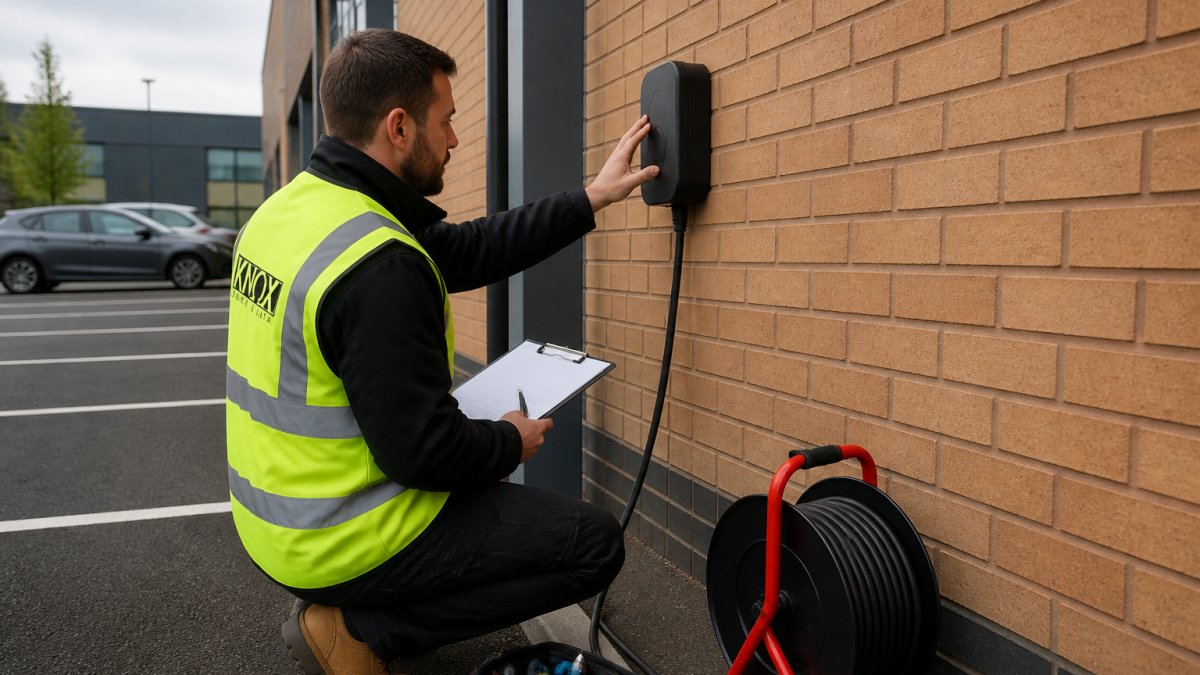
Parking layout and bay readiness
- Bay dimensions: check the bay is wide enough for doors to open fully with a charging cable connected. Cable and connector add clearance you may not have allowed for.
- Surface and drainage: the bay should be level and drained. Standing water around a charge point is both a safety and a warranty issue.
- Vehicle strike zones: mark where van doors, tailgates and tow bars swing. Mount the charger outside those arcs, or use a post set back from the bay.
- Accessibility: if you want an accessible bay, allow extra space for a wheelchair user to handle the cable and connector, and keep the charge point reachable without stepping into traffic.
Cable routing and containment
- Shortest safe path: trace the route from each proposed charger back to the distribution board. Note walls, ceilings, ducts and any fire compartments the cable must cross.
- Containment: decide whether cable runs in tray, conduit or trunking, and whether that containment already exists or must be added.
- Groundworks: if the route crosses a car park or soft ground, allow for trenching, ducting and reinstatement. This is often the largest hidden cost on external sites.
- Segregation: keep power and data cabling separated as the installer advises, and avoid routes that block fire exits or access for maintenance.
Electrical readiness before you request quotes
This is the check most small businesses skip, and it is the one that determines whether your budget holds:
- Incoming supply size: ask your installer to confirm the rating of your existing supply and whether it can carry the additional load.
- Spare capacity at the board: count spare ways in the consumer unit or distribution board. A full board means board changes before any charger is fitted.
- Earthing and protective devices: confirm earthing arrangements and that protective devices are suitable for EV charging. This is a safety requirement, not an optional extra.
- Load management potential: ask whether load management can share existing capacity and avoid a supply upgrade. It often can, but not always.
A pre-quote readiness checklist
Work through this before you invite installers to survey:
- Count the bays you want to serve and note which are staff, visitor or fleet.
- Mark the proposed charger positions on a site plan.
- Trace the likely cable route to the distribution board and note obstacles.
- Photograph the distribution board, meter and incoming supply.
- Note any groundworks the cable route will need.
- Confirm who owns the car park and whether consent is needed.
- Check whether planning permission is likely to be required for the works or for any new signage and lighting.
Taking this checklist to each installer means every quote is based on the same facts, so you can compare them fairly and spot the one that has missed the electrical upgrade.
Step 5: Understand EV Charger Installation Cost for Business
EV charger installation cost for business is not a single number. It is the sum of five separate budgets, and small businesses get caught out because they only budget for the first two. Ask every installer to quote against all five lines so you can compare like for like.
The five cost lines to budget for
- Hardware: the charge point itself, mounting posts or wall brackets, and any load management controller or current clamp kit.
- Electrical upgrades: a new or upgraded supply, distribution board changes, additional ways, earthing improvements, and protective devices.
- Installation labour and materials: cable, containment, trenching or ducting, groundworks, commissioning and certification.
- Software and networking: back-office subscriptions, SIM or network connectivity, payment terminal fees, and any per-session charges.
Example budget shapes for a small site
We do not publish fixed prices because supply capacity, cable runs and groundworks vary enormously between sites. What we can do is show the shape of a budget so you can sanity-check quotes. Use these as proportional guides, not quotes:
- One 7 kW AC charger on an existing wall, short cable run, spare capacity available: hardware is the largest single line, installation is modest, and electrical upgrades should be near zero. Software is a small annual cost. This is the cheapest realistic starting point.
- Two 7 kW AC chargers with load management, short runs, no supply upgrade: hardware and load management kit dominate; installation rises with the second unit; electrical upgrades stay low if load management avoids a supply change.
- Two 22 kW three-phase chargers where three-phase supply already exists: hardware costs more per unit, installation is similar, but confirm the existing supply can carry the load before committing.
- Any project needing a new or upgraded supply: the electrical upgrade line can rival or exceed the hardware line, and the distribution network operator connection can add both cost and weeks of lead time. This is the scenario that blows small budgets, which is why the capacity assessment in Step 2 comes first.
A practical rule for small businesses: get the electrical capacity assessment done, then ask for two quotes, one with load management and no supply upgrade, one with the upgrade, and compare the totals. The difference tells you whether load management is genuinely cheaper for your site.
What a good itemised quote should show
Ask for the quote broken down by the five lines above, plus:
- Whether the price includes commissioning, certification and handover documentation
- Whether software subscription is included for year one and what it costs thereafter
- Warranty length on hardware and on installation work separately
- Whether groundworks, ducting and reinstatement are included or excluded
Funding and grant offset
The Workplace Charging Scheme can offset part of the hardware and installation cost for eligible businesses. Check the current eligibility rules and grant amount on the official Workplace Charging Scheme guidance page before you budget, because the terms and per-socket caps change. Treat any grant as a reduction to the hardware and installation lines, not to the electrical upgrade line, which is usually excluded.
Step 6: Map Out Your EV Charger Installation Timeline
Your EV charger installation timeline usually runs in stages, not days:
- Site survey and electrical capacity check
- Quote and hardware selection
- Any supply or distribution board upgrade
- Charger mounting, cable routing and commissioning
- Certification and handover
Supply upgrades and distribution network operator connections are the usual cause of delay. Build slack into the plan.
Step 7: Decide on EV Charging Business Models and Funding
EV charging business models for small firms are simpler than they look. Most choose one of these:
- Free for staff: a benefit, with costs absorbed by the business
- Paid per kWh: recovers electricity costs, needs metering and clear signage
- Visitor charging: a small charge for customers, often run by a third party
On funding, the government's Workplace Charging Scheme guidance sets out eligibility for the workplace grant. Check the current rules and amounts on the official page before you budget, as terms change.
Frequently Asked Questions
How much does it cost to install an electric car charger at a business?
Costs vary widely depending on charger type, cable run length, and whether your electrical supply needs upgrading. A single AC charge point on an existing supply is the simplest case, while multiple chargers or a new three-phase connection add significantly to the total. Get an itemised quote that separates hardware, installation labour, electrical upgrades, and commissioning. Knox Power & Data can survey your site and give a transparent breakdown before you commit.
How many EV chargers does a small business need?
Start with your current and near-future demand. Count how many employees or fleet vehicles could realistically charge at once, then add a buffer for visitors. Many small businesses begin with two to four AC charge points and design the electrical infrastructure so more can be added later. Over-provisioning hardware upfront ties up capital, but under-sizing the supply and cable routes makes expansion expensive. A phased plan balances both.
What electrical capacity is needed for workplace EV chargers?
A single 7kW AC charger draws roughly 7kW continuously, so four running together need about 28kW of available capacity plus headroom for your building's existing load. An EV charger electrical capacity assessment checks your supply fuse rating, consumer unit spare ways, and earthing arrangements. Where capacity is tight, load management can share power between chargers and the building instead of triggering a costly supply upgrade.
How long does commercial EV charger installation take?
A straightforward single-charger install on an existing supply can be completed in a day. Multi-charger projects typically take several days of on-site work, but the full EV charger installation timeline includes the site survey, DNO notification where required, equipment lead times, and commissioning. Allow several weeks from initial enquiry to handover for a typical small business project, and longer if a new grid connection is needed.
A well-planned installation protects your budget and your parking layout. If you want the capacity check, site survey and certified installation handled by one NAPIT-registered team, Knox Power & Data can guide you from assessment through to handover. We are BS 7671 18th Edition qualified, fully insured for commercial sites, and we test and certify every installation. Get a quote and start with a site assessment.