 ultimate-guide
Workplace EV Charger Installation Requirements: UK Guide
Table of Contents
- The Core Workplace EV Charger Installation Requirements
- Workplace Charging Scheme Eligibility Explained
- BS 7671 EV Charging Regulations and What They Demand
- EV Charger Load Management Systems Explained
- Site Survey, Electrical Capacity and Choosing an Installer
- Operational Costs, Energy Management and Future-Proofing
- Frequently Asked Questions
Last Updated: September 21, 2026
The Core Workplace EV Charger Installation Requirements
Workplace EV charger installation requirements in the UK centre on four things: a compliant electrical supply, correct protection devices, a qualified installer, and evidence that the work meets BS 7671. Get any one of those wrong and the installation fails inspection, voids insurance cover, or simply will not charge vehicles reliably.
Workplace Charging Scheme Eligibility Explained
The Workplace Charging Scheme (WCS) is a government voucher scheme administered through the Office for Zero Emission Vehicles (OZEV). It reduces the upfront cost of purchasing and installing chargepoint sockets at commercial premises. The scheme is deliberately structured around sockets rather than chargers: a voucher is issued per socket, and the installation must be completed and certified before the voucher expires.
Who can apply
- Registered businesses, charities and public sector organisations
- Organisations registered with Companies House or an equivalent body (for example, the Charity Commission)
- Businesses that can demonstrate a genuine need for staff or fleet charging, rather than speculative installation
What the site must have
- Designated off-street parking owned or leased by the organisation
- Parking that is clearly associated with the premises, not shared public bays
- A supply and distribution arrangement capable of supporting the proposed sockets
How the voucher works
- Vouchers are issued per socket, up to a capped number of sockets per organisation
- Each voucher carries a validity period, and the installation must be completed and certified within it
- The voucher is redeemed against the cost of the socket and its installation, not against the vehicle or the electricity
- You must use an OZEV-authorised installer for the work to qualify
Evidence you must retain
- The installation certificate confirming the work meets BS 7671
- Proof of the completed installation at the stated address
- Records linking each installed socket to its voucher
- Invoices and payment evidence for the installation
BS 7671 EV Charging Regulations and What They Demand
BS 7671, the wiring regulations for electrical installations, sets the technical baseline for every EV chargepoint in the UK. Compliance is not optional: it is the standard an inspector, insurer, or buyer will measure the work against. The 18th Edition and its subsequent amendments govern how EVSE (electric vehicle supply equipment) must be supplied, protected, and earthed.
RCD Protection and Dedicated Circuits
EV chargepoints require RCD protection appropriate to the installation, with dedicated circuits running from the distribution board to each unit. Where the charger includes integrated DC fault protection, the upstream protection must still satisfy BS 7671 requirements for the circuit.
EV Charger Load Management Systems Explained
Load management systems control how much power chargepoints draw, preventing the site's total electrical demand from exceeding its supply capacity. For commercial premises, load management is often the difference between installing multiple chargers and being told the supply cannot support them.
Load Balancing Across Multiple Chargepoints
Load balancing distributes available power across several chargepoints so that the combined demand stays within the site's capacity. A site with a limited supply can run multiple chargers by sharing power dynamically rather than each unit drawing its maximum simultaneously.
Site Survey, Electrical Capacity and Choosing an Installer
A site survey is the step that determines whether your electrical capacity can support the planned chargepoints, and it should happen before any equipment is ordered. The survey confirms supply capacity, earthing arrangement, cable routes, and the protection needed for each circuit.
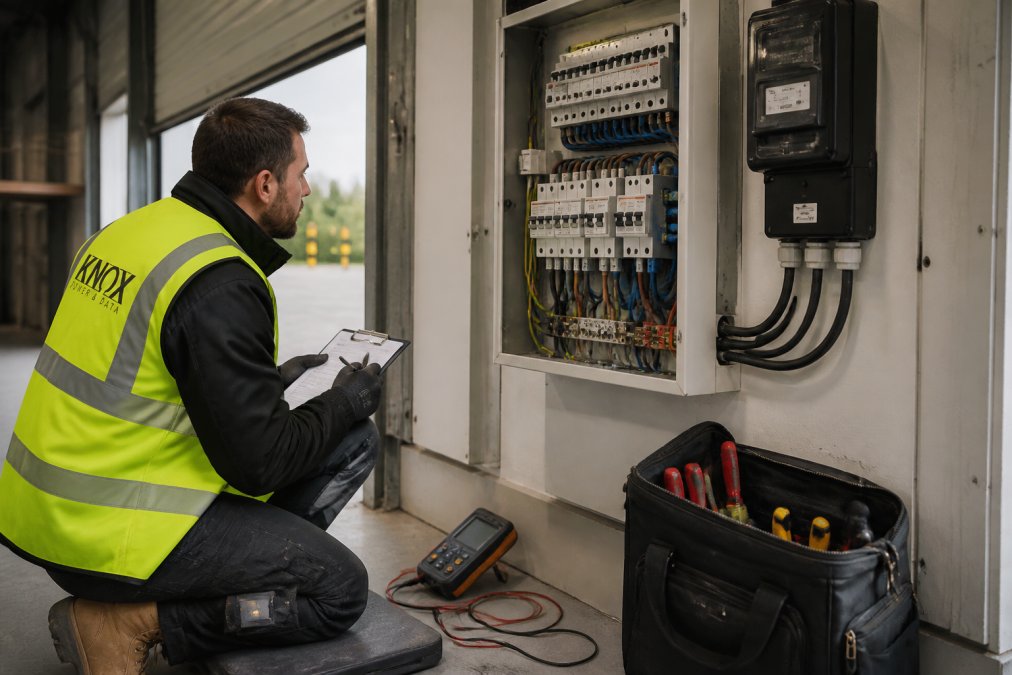
What the survey should establish:
- Available capacity at the supply and whether an upgrade is needed
- Spare ways in the distribution board for dedicated circuits
- Cable routing and charging cable length from each proposed bay
- Minimum distance requirements between chargepoints and any hazards
- Whether load management is required to stay within capacity
Operational Costs, Energy Management and Future-Proofing
Most guides stop at the install. The costs that decide whether workplace charging is a success or a drain sit after commissioning: energy, access, maintenance and the question of what the infrastructure must be ready for.
What actually drives ongoing cost
- Energy unit cost and time of use. Charging in the early afternoon or overnight typically sits on a cheaper tariff band than a 5pm peak. Scheduling matters more than the headline rate.
- Maximum demand charges. If your supply is billed on maximum demand, several chargers starting together can spike the site's peak and raise the standing charge for the whole month. Load management prevents that.
- Standing charges and capacity. A supply upgrade to support more bays increases fixed costs, so it should be justified against actual utilisation.
- Maintenance and warranty. Commercial chargepoints need periodic inspection, firmware updates and cable/connector checks. Confirm what the warranty covers and what it excludes before purchase.
- Back-office software. Most commercial units rely on a subscription for access control, reporting and billing. That is a recurring line item, not a one-off.
Energy management in practice
An energy management system (EMS) sits above the chargepoints and decides when and how fast each one draws power. The mechanisms worth specifying are:
- Static load balancing, a fixed cap per chargepoint, simple but inflexible.
- Dynamic load balancing, the cap adjusts in real time based on the site's total demand, so chargers use spare capacity without tripping the supply.
- Scheduled charging, sessions are shifted into cheaper or lower-carbon windows.
- Employee billing and reimbursement, the system records kWh per user so you can recharge staff for private mileage or reimburse business mileage cleanly.
Integrating on-site generation
Where a site has solar PV or battery storage, the EMS can prioritise self-generated electricity for charging before importing from the grid. The practical benefit is a lower effective cost per kWh and reduced exposure to peak tariffs. The technical requirement is that the inverter, battery and chargepoints can communicate, usually through a shared protocol or a manufacturer-agnostic controller. Plan this at design stage; retrofitting communication between incompatible systems is expensive.
Future-proofing for bidirectional charging
Vehicle-to-Grid (V2G) and Vehicle-to-Building (V2B) allow vehicles to return power to the site. Very few installation guides address readiness for this. The infrastructure implications are:
- Capacity headroom at the supply and distribution board for export as well as import
- Bidirectional-capable chargepoints and a control system that can manage export
- Earthing and protection designed for two-way power flow
- Agreement with the network operator before any export capability is energised
Accessibility and inclusive design
Accessibility is a design requirement, not an afterthought. Bays should be planned so that a wheelchair user can exit the vehicle and reach the connector and payment or authentication point. That means adequate bay width, a level surface, a dropped kerb where needed, and equipment mounted at a reachable height. Planning these details at the survey stage costs little; retrofitting them later is disruptive and expensive.
| Planning Area | What to Decide | Why It Matters |
|---|---|---|
| Energy management | Off-peak scheduling, dynamic demand caps, employee billing | Controls running costs and avoids demand spikes |
| On-site generation | Solar PV and battery integration, shared protocol | Reduces grid reliance and effective cost per kWh |
| Future capacity | Headroom for V2G, export protection, network agreement | Avoids a later rewire |
| Accessibility | Bay width, level surface, reachable equipment | Keeps bays usable for all drivers |
| Maintenance | Inspection interval, warranty scope, software subscription | Prevents surprise downtime and cost |
Frequently Asked Questions
What qualifications are required for EV charger installation?
Your installer should hold BS 7671 18th Edition qualification and an inspection and testing certificate, plus specific EV chargepoint installation training. Registration with a competent person scheme such as NAPIT matters because it means the work is assessed against current standards and you receive proper certification. Ask to see the registration number and confirm it covers commercial work at your premises. An authorised installer will also confirm the chargepoint meets BS EN 61851 and that the installation is notified correctly.
What is the Workplace Charging Scheme and who is eligible for it?
The Workplace Charging Scheme is an OZEV grant that reduces the upfront cost of buying and installing chargepoints at commercial premises. Eligibility covers registered businesses, charities and public sector organisations that can show a genuine need for charging, such as staff or fleet vehicles. You apply for a voucher before work starts, and it must be used within its validity period. Speak to an authorised installer early, because the application and the installation have to be sequenced correctly to avoid losing the voucher.
Do I need planning permission for commercial EV charger installation?
Most workplace chargepoints fall under permitted development, so planning permission is often not needed. There are exceptions: listed buildings, sites in conservation areas, and some locations where the chargepoint would sit close to a highway or public footpath. If your premises are leased, check the lease terms as well, since you may need landlord consent. A site survey will flag whether your specific location needs a planning application before any installation begins.
How does load management affect workplace EV charger installation requirements?
Load management is often the factor that decides how many chargepoints your existing supply can support. Without it, several vehicles charging at once can exceed your agreed capacity and trip the supply. A load management system monitors demand and reduces charging power when the building needs the electricity elsewhere. This can let you install more chargepoints on the same grid connection, avoiding an expensive supply upgrade. The site survey establishes your electrical capacity and whether load balancing is required.
What are the cybersecurity requirements for commercial chargepoints?
Commercial chargepoints connected to a network must meet cybersecurity regulations covering access control, software updates and data protection. The chargepoint should support secure authentication, encrypted communication and remote firmware updates so vulnerabilities can be patched without a site visit. For workplace installations, this matters because chargers sit on your network and handle payment or user data. Confirm with your installer that the chosen model complies and that access control is configured before handover.
What warranty and maintenance requirements apply to workplace chargepoints?
Grant-funded installations typically require a minimum three-year warranty on the chargepoint, so check this before choosing a model. Ongoing maintenance keeps the unit compliant and reliable: annual inspections, testing of RCD protection, and checking cables and connectors for wear. Many commercial chargepoints also need software updates and back-office subscription renewals. Budget for these running costs alongside the installation, and confirm what the warranty actually covers, since labour and parts are sometimes treated separately.
Can I future-proof a workplace installation for V2G and solar?
Yes, with the right groundwork. Bidirectional charging, or V2G, lets vehicles send power back to the building or grid, and it needs chargepoints and software that support it. If you plan to add solar PV or battery storage later, tell your installer at the survey stage so the power distribution and dedicated circuits can be sized accordingly. Cabling and capacity decisions made now are far cheaper than retrofitting them. Infrastructure readiness avoids a second round of disruptive work.