 how-to
How to Integrate EV Charging Into Office Parking
Table of Contents
- Why Office Parking Needs EV Charging Infrastructure
- EV Charger Electrical Capacity Assessment
- EV Charger Parking Layout and Site Survey
- Choosing Charger Types and Estimating Demand
- EV Charging Load Management and Smart Controls
- Workplace Charging Point Grants and Funding
- Access, Payments and Employee Reimbursement
- Installation Timeline and Phased Rollout
- Frequently Asked Questions
Last Updated: October 14, 2026
Why Office Parking Needs EV Charging Infrastructure
How to integrate EV charging stations into existing office parking starts with one uncomfortable truth: your car park is already your most underused asset.
Workplace charging is the practice of installing electric vehicle charging points in a business car park so staff, visitors and fleet vehicles can top up while they work. It turns dead parking hours into useful charging time.
The business case rests on three things:
- Staff retention. Charging is now a benefit candidates ask about.
- Customer experience. Visitors remember a site that makes charging easy.
- Sustainability reporting. Workplace charging supports emissions reduction targets.
Business Case and Staff Retention
Employees who cannot charge at home often rule out a job before the interview. Offering workplace charging signals that you understand modern commuting.
For fleet operators, charging at the depot cuts fuel spend and simplifies scheduling. The UK government guidance on workplace charging sets out how these schemes fit wider transport policy.
The catch? None of this works if the electrical supply cannot cope. That is where most projects stall.
EV Charger Electrical Capacity Assessment
An EV charger electrical capacity assessment is a review of your incoming supply, distribution board and spare capacity to confirm how many chargers the site can support. Skip it and you risk nuisance tripping, or a quote that triples once the truth comes out.
Start with three questions:
- What is the incoming supply rating in amps?
- How much headroom is left on the distribution board?
- What else runs at peak, such as lifts, HVAC or kitchen equipment?
Checking Supply and Distribution Board Headroom
A qualified electrician should measure actual load, not just read the label. Diversity assumptions matter. A car park that looks empty at 2pm may be pulling hard at 8am.
If headroom is tight, options include:
- Load management to cap total draw
- Supply upgrade where the DNO allows it
- Phased rollout to spread the load
EV Charger Parking Layout and Site Survey
A proper EV charger parking layout starts with a site survey, not a catalogue. The survey maps existing bays, cable routes, drainage, lighting and fire access. It also flags what stays and what moves.
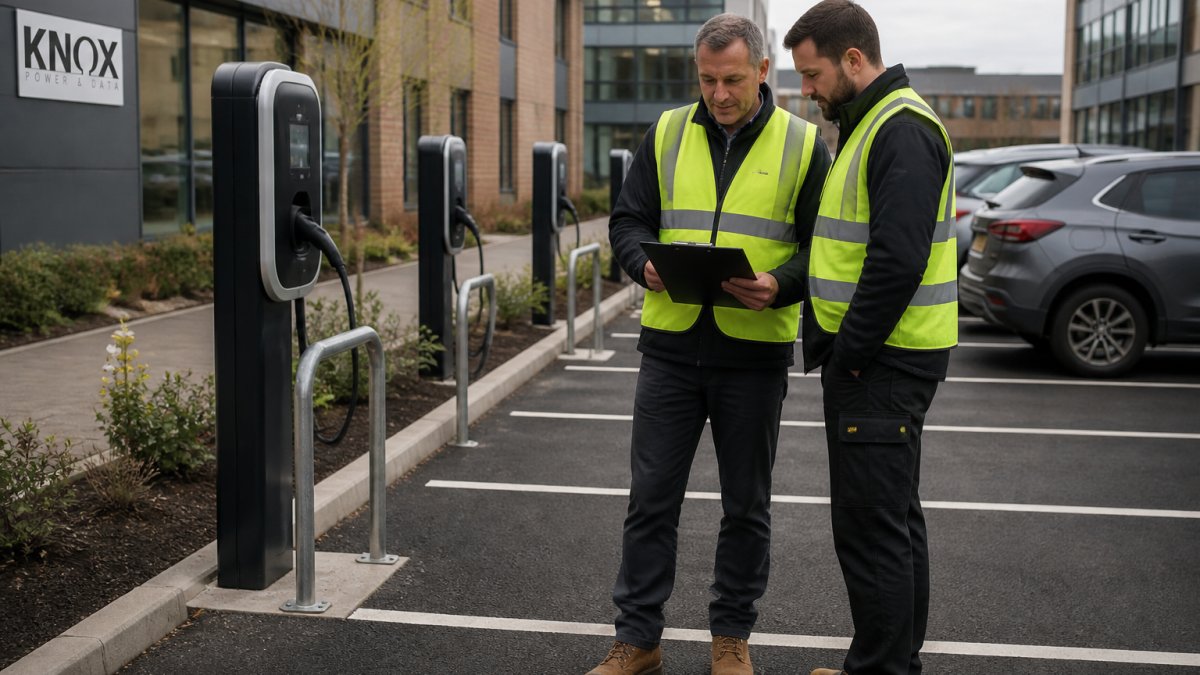
Key layout decisions include:
- Bay size and spacing for cable reach and door clearance
- Accessible location near the building entrance
- Visibility so users can find chargers easily
Cable Routes and Civil Works in Occupied Car Parks
Retrofitting an active car park is the hard part. Ducting, trenching and resurfacing all disrupt parking. The trick is to phase works bay by bay, keep a clear route for deliveries, and schedule noisy work outside peak hours.
Choosing Charger Types and Estimating Demand
Charging speed should match dwell time, not ambition. Staff parked for seven hours do not need rapid charging. Visitors staying twenty minutes might. The table below maps typical office use cases to charger types, but the harder question is how many of each to install.
| Charger type | Typical use | Dwell time | Best for |
|---|---|---|---|
| 7kW AC | Employee charging | 4-8 hours | Office bays |
| 22kW AC | Employee and fleet | 2-4 hours | Larger sites |
| 50kW+ DC | Visitor top-up | 20-40 minutes | Forecourts |
Office-Specific Demand Forecasting
Most workplace charging guides tell you to count how many staff drive EVs today and add a growth margin. That approach under-sizes the installation because it ignores how your car park is actually used. A more reliable method uses four inputs:
- Commute patterns. Survey staff on how they travel to work and whether they can charge at home. A common pattern is that 20-30% of drivers cannot charge off-street, and those are your guaranteed users.
- Vehicle adoption trajectory. Rather than guessing a growth rate, use the current plug-in share of new car registrations as a floor and assume it rises. The DVLA and DfT vehicle licensing statistics publish the data you need.
- Parking turnover. A site where the same 40 cars occupy bays all day needs fewer chargers than a site with high visitor churn, because each charger serves more vehicles per day.
- Dwell time. A 7kW charger delivers roughly 30-40 miles of range per hour. If the average employee parks for seven hours, one charger can serve one car per day. If visitors stay thirty minutes, a 50kW unit can serve several.
A practical starting formula is: (number of regular EV-driving staff who cannot charge at home) ÷ (average dwell time in hours ÷ charge time needed per vehicle). Round up, then add 20-30% headroom for growth. Install that number of active bays in phase one, but duct and cable for double.
Matching Chargers to Zones
Split the car park into zones rather than treating it as one pool:
- Employee long-stay bays, 7kW AC, one charger per two to four bays with sharing, since cars sit all day.
- Fleet and pool vehicle bays, 22kW AC where vehicles return mid-shift and need a top-up before the next journey.
- Visitor and short-stay bays, 50kW+ DC near the entrance, where a twenty-minute top-up is the difference between a usable visit and a missed appointment.
Sizing the Electrical Supply to Match
Demand forecasting and electrical capacity are the same conversation. If your forecast says twelve 7kW chargers, that is 84kW of connected load, but with dynamic load management you may only need to provision 30-40kW of actual supply, because not every vehicle draws full power simultaneously. The Ofgem guidance on smart charging explains how flexible charging reduces the grid connection you need.
EV Charging Load Management and Smart Controls
EV charging load management balances power across active chargers so the site never exceeds its supply. Smart charging shifts demand to cheaper, quieter periods.
Controls worth specifying:
- Dynamic load balancing across the fleet of chargers
- User authentication and access control
- Energy consumption reporting per bay
This is where workplace charging stops being a set of boxes and becomes a managed system. The Ofgem guidance on smart charging explains how flexible charging supports the grid.
Workplace Charging Point Grants and Funding
Workplace charging point grants reduce upfront cost, but schemes change often. Eligibility, caps and application windows are set by government and updated regularly.
Check the current rules on the official workplace charging scheme page before you budget. Do not rely on figures quoted in older articles, including this one.
Access, Payments and Employee Reimbursement
Decide who can charge and how they pay before installation, not after. Retrofitting a policy onto live chargers causes resentment and bay hogging. The decisions below are the ones that generate the most queries from facilities teams.
Eligibility and Fair Allocation
Define who gets access and on what basis. Common models include:
- Open access, any employee or visitor can use any charger. Simple, but leads to bay hogging and no guarantee for staff who genuinely need a charge.
- Registered users, staff opt in via an app or RFID card, with a cap on sessions per week. Fairer, but adds admin.
- Priority tiers, staff without home charging get first call on long-stay bays; visitors use rapid chargers only.
Whichever you choose, publish a fair-use policy: maximum dwell time after charging completes, overstay charges, and a clear process for reporting faulty units. Without an overstay rule, a single fully charged car can block a bay for the rest of the day.
Payment Options and Billing Structures
Payment methods to consider:
- RFID cards, durable, easy for fleet drivers, but require issuing and replacing.
- Mobile apps, no hardware to issue, supports ad-hoc visitors, but relies on signal in the car park.
- Contactless card readers, best for visitor bays where nobody wants to download an app.
Pricing models range from free employee charging (a benefit, but expensive at scale), subsidised rates (employer absorbs part of the cost), to full cost recovery. If you charge staff, the rate should at least cover electricity plus a contribution to maintenance and back-office software. Check the current VAT treatment of charging supplied to employees with your finance team, as it differs from domestic supply.
Employee Reimbursement and Tax
Staff who charge their company or personal EV at home for business mileage can claim back the cost. The HMRC advisory fuel rates and mileage guidance set out the approved rates, and the HMRC guidance on electric vehicle charging as a benefit confirms that workplace charging provided to employees is generally not treated as a taxable benefit.
For fleet and pool vehicles, decide whether charging is billed to the department, the driver, or absorbed centrally. A common pattern is to bill the fleet cost centre for depot charging and give drivers an RFID card that only works on site.
Data Privacy and Reporting
Charging systems collect personal data: who charged, when, where, and how much energy they used. Under the ICO guidance on data protection, you need a lawful basis for processing that data, a retention period, and a privacy notice for users. If you use charging data for performance management or disciplinary purposes, say so in the policy, using it without disclosure is a compliance risk.
Governance and Review
Assign ownership. Someone needs to monitor utilisation, adjust pricing, handle faults, and review the policy annually. Without an owner, chargers drift into disrepair and the business case collapses. Track utilisation per bay, average session length, and uptime, these three metrics tell you whether to expand, reprice, or relocate units.
Installation Timeline and Phased Rollout
A typical retrofit runs in phases: survey, design, DNO application if needed, civils, electrical install, commissioning, then handover. Timelines stretch when supply upgrades are required.
- Site survey and capacity check
- Design and load management plan
- DNO application and grant submission
- Civil works and ducting
- Charger installation and testing
- Commissioning and user onboarding
- Review utilisation and plan expansion
Build in spare ducting and board capacity at phase one. Scalable infrastructure costs far less now than a second dig later.
Frequently Asked Questions
Do you need planning permission to install EV chargers in office parking?
Most wall-mounted and floor-mounted EV chargers in office car parks fall under permitted development, so planning permission is often not required. However, listed buildings, conservation areas, and sites with specific local planning conditions may need approval. Standalone charger units over a certain height or those affecting the street scene can also trigger a planning application. Check with your local planning authority before committing, and ask your installer to confirm whether permitted development rights apply to your specific site.
How do you assess whether an office car park has enough electrical capacity for EV chargers?
An EV charger electrical capacity assessment starts with a review of your existing supply, distribution board capacity, and maximum demand. An electrician will check the incoming supply rating, available spare ways, and whether the current load leaves enough headroom for additional charging points. If capacity is tight, load management or a supply upgrade may be needed. A proper assessment also considers future expansion so you are not caught short when demand grows.
How many EV charging points should an office car park install?
There is no fixed number, but a practical starting point is 5 to 10 percent of total parking spaces for a first phase, then scale based on utilisation data. Factors include staff numbers, average commute distance, whether visitors need charging, and how long vehicles stay parked. Offices with longer dwell times can serve more vehicles per charger per day than retail sites. Review usage after three to six months and add capacity where demand consistently exceeds availability.
Can EV chargers be added to an existing car park without disrupting parking?
Yes, with careful planning. Phased installation lets you keep most bays in use while work happens in sections. Trenching for cable routes can often be scheduled outside peak hours or during quieter periods. Above-ground cable management and wall-mounted units reduce the need for extensive groundworks. A site survey will identify the least disruptive routes, and a good installer will sequence the work so your car park remains operational throughout.
Retrofitting charging into a live car park is fiddly work, and getting the electrical capacity wrong is expensive to fix. That is why we handle survey, design, installation and certification as one job. As a NAPIT-registered team (Member No. 69848) qualified to BS 7671 18th Edition, Knox Power & Data delivers fully tested and certified installations with transparent pricing. Get a quote and we will map your office parking for charging from the ground up.