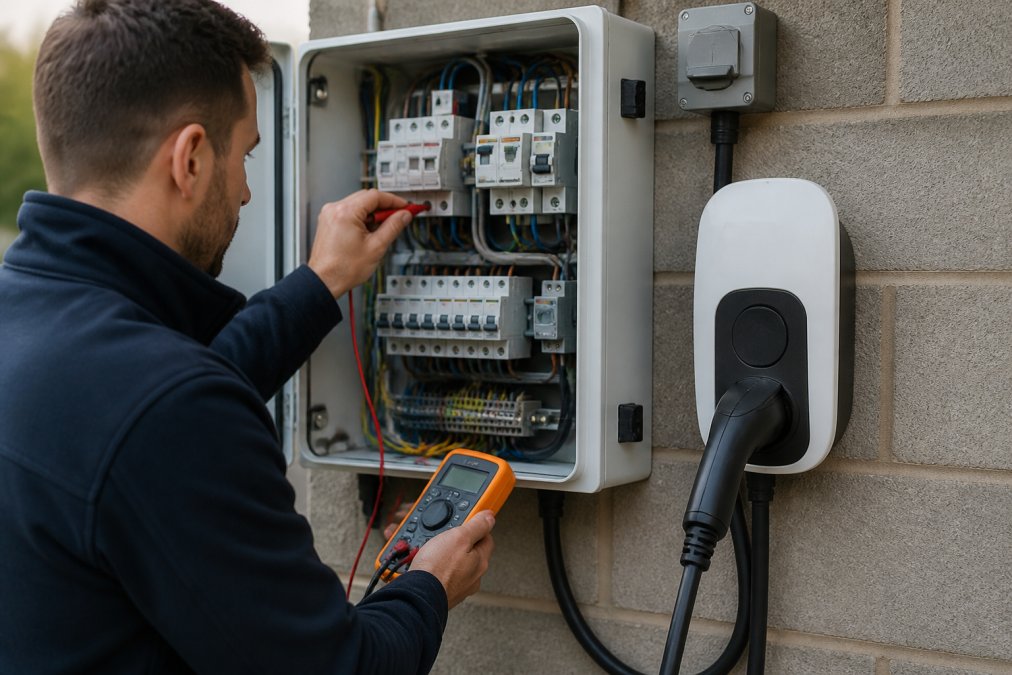
 how-to
EV Charger Load Management Systems Explained
Table of Contents
- What Is an EV Charger Load Management System?
- How Load Management Works: Real-Time Monitoring and Power Allocation
- Dynamic Load Balancing vs Static Load Management
- How to Prevent Main Fuse Overload When Charging an EV
- DNO Notification for EV Chargers: What You Need to Know
- Load Management for Home Charging vs Commercial Depot Charging
- Installation Requirements, Retrofitting Costs, and Solar Integration
- Frequently Asked Questions
Last Updated: September 10, 2026
What Is an EV Charger Load Management System?
Load management systems for EV chargers monitor a property's electrical demand and adjust power to charging points so the supply is never overloaded, the difference between charging safely and tripping the main fuse.
Load management systems are crucial for compliance, ensuring the charger operates safely within the property's electrical capacity.
The difference between hardware-based control and software-based solutions
Hardware-based control uses physical devices, such as current transformers and dedicated controllers, to limit power at the source, and keeps working even if the internet drops.
Software-based solutions rely on communication between the charger and an energy management system, usually over the OCPP protocol, offering more granular control and reporting but depending on a stable connection.
Neither is universally better: homes with a single charger rarely need a networked system, while depots with ten bays almost always do.
How Load Management Works: Real-Time Monitoring and Power Allocation
The system measures the current flowing into the property, compares it against a configured limit, and reduces power to the charger when demand creeps too high, in seconds.
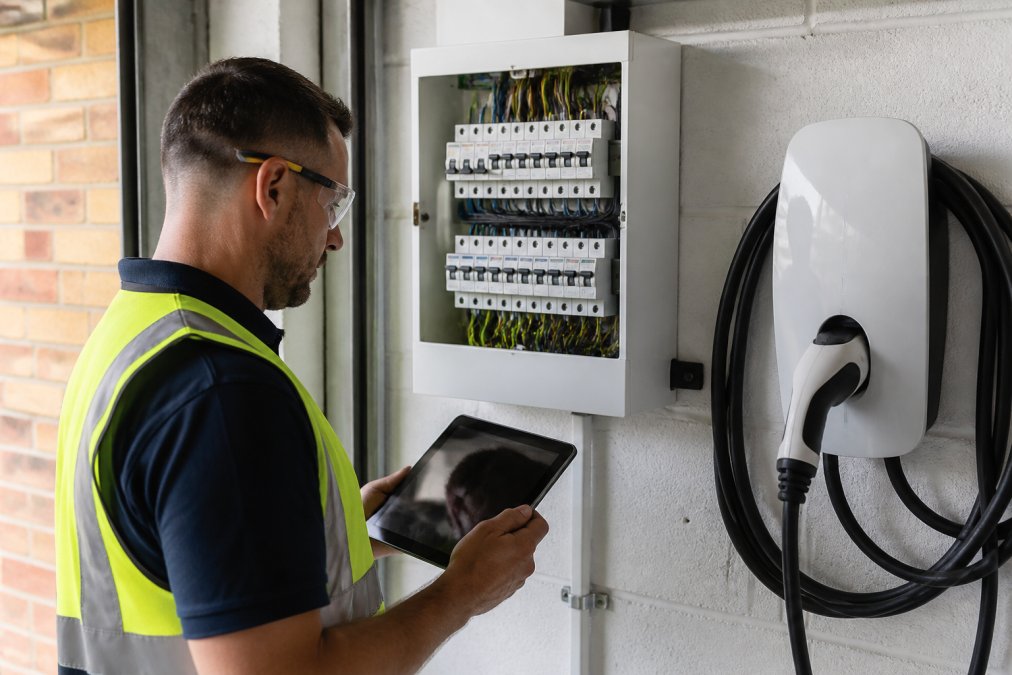
CT clamps, current limiting, and the role of the OCPP protocol
A CT clamp is a sensor that fits around the incoming supply cable and reports current draw without breaking the circuit.
Current limiting then caps the charger's output so the total draw stays within the supply's capacity. The OCPP protocol specification defines how chargers and management software talk to each other, which is what allows smart charging schedules and remote diagnostics to work at all.
What most guides miss is that the CT clamp placement decides everything. Fit it on the wrong side of the supply and the system reads the wrong numbers, which means it either limits unnecessarily or, worse, does not limit at all.
Dynamic Load Balancing vs Static Load Management
Dynamic load balancing adjusts charging current in real time based on total property demand. Static load management sets a fixed limit and leaves it there.
Static is simpler and cheaper, suiting a single home charger with clear headroom. Dynamic suits a heat pump, electric shower, and two chargers competing for the same supply.
Dynamic systems cost more upfront and need correct commissioning, but that buys full-rate charging when the house is quiet and automatic throttling when the oven and tumble dryer are on.
| Feature | Static Load Management | Dynamic Load Balancing |
|---|---|---|
| Control method | Fixed current limit | Real-time adjustment |
| Suits | Single home charger | Homes and depots with variable demand |
| Setup complexity | Low | Moderate to high |
| Best for peak demand | Poor | Strong |
| Reporting and monitoring | Minimal | Detailed |
How to Prevent Main Fuse Overload When Charging an EV
You prevent main fuse overload by installing a load management system that caps charging current before total demand exceeds the supply rating. Without it, a 7kW charger plus normal household load can push a 60A or 80A supply past its limit (gov.uk).
A common mistake is assuming the charger's rating tells you anything about your supply: with nothing telling it otherwise, the charger draws the full amount.
Load shedding and load prioritisation in practice
Load shedding cuts power to lower-priority loads when demand peaks. Load prioritisation decides what keeps running and what waits.
For a home, priority usually sits with lighting, heating controls, and the fridge; for a depot, with the vehicles that must leave first. A well-configured system lets you set that order rather than discovering it when the fuse blows.
DNO Notification for EV Chargers: What You Need to Know
DNO notification is the formal step where your installer tells the local distribution network operator a charge point is being connected, so the network records the additional load. It is a statutory-adjacent requirement under the Electricity Safety, Quality and Continuity Regulations 2002 and the Distribution Code, not optional paperwork. Skipping it leaves an unmetered load the network does not know about, exactly what causes supply problems later.
The process splits into two routes, and knowing which applies is the difference between a two-week install and a three-month one.
Notification versus formal application
A notification is the lighter route, where the new load is small enough that the network operator can reasonably assume the existing supply and local network can absorb it. Most installers treat a single domestic charge point up to around 7kW, on a supply with clear headroom, as a notification: the installer submits details, the DNO acknowledges, and work proceeds.
A formal application is the heavier route, applying where the load is larger, multiple charge points share one supply, or the local network is already constrained. The DNO reviews the request, may ask for a load study, and can impose conditions such as a maximum import limit, phased connection, or active network management. Approval must be granted before work begins.
The threshold is not a single national number: it depends on the existing supply rating, the local transformer size, and how loaded the surrounding network is. A 22kW three-phase charger on a street with several approved installations can trigger a formal application where the same charger on a quieter street would not.
What the installer actually submits
A typical DNO notification or application includes:
- Site address and existing supply details, including main fuse rating and whether the supply is single-phase or three-phase
- The proposed charge point make, model, and rated output
- The load management method being used, and the maximum import the site will be limited to
- Confirmation that the installation will comply with BS 7671 and, where applicable, the IET Code of Practice for Electric Vehicle Charging Equipment Installation
- For commercial sites, the number of bays, diversity assumptions, and proposed charging schedule
That last point matters. A depot that tells the DNO it will run ten 22kW chargers at full rate simultaneously will get a very different answer from one that demonstrates load management capping the site at, say, 100A with staggered scheduling. Load management is often what makes the connection acceptable in the first place.
Timelines and what causes delays
A straightforward domestic notification is commonly turned around in a few working days to a couple of weeks. A formal application on a constrained network can take several weeks to a few months, especially if a load study or network upgrade is required.
The most common causes of delay are:
- Incomplete or inconsistent site data on the application form
- A charger specification that does not match what is actually being installed
- No load management declared, so the DNO assumes worst-case simultaneous demand
- A supply smaller than the installer assumed, requiring a re-application
Your installer should handle this for you, and a competent one will tell you which route applies before you commit. If a quote does not mention DNO notification at all, ask. The Ofgem guidance on connections and network capacity sets out how network operators manage capacity requests, and it is worth understanding before you sign off on a large installation.
Where load management changes the answer
A site that declares a managed maximum import through load management systems is treated differently from one that declares raw charger ratings. This is the practical link between load management and the DNO process: the control system is what allows you to promise the network a ceiling you will not exceed. On constrained networks, that promise is often the only way to get approval without paying for a supply upgrade.
Load Management for Home Charging vs Commercial Depot Charging
Home charging load management prioritises simplicity: one charger, one supply, one household, charging overnight without disturbing anything else.
Depot charging is a different problem: multiple vehicles, staggered shifts, and a supply never designed for simultaneous charging. This is where load prioritisation, scheduling, and proper reporting earn their keep.
A practical split looks like this:
- Home: single CT clamp, dynamic limiting, overnight scheduling
- Small commercial: networked chargers, load groups, simple reporting
- Large depot: full energy management system, OCPP integration, utility demand response capability
The mistake is treating a depot like a bigger home: the control logic, hardware, and installation requirements all change.
Installation Requirements, Retrofitting Costs, and Solar Integration
Retrofitting load management is rarely a single part, it is a small system, and cost is driven by what is already on site, not the controller price.
What actually gets installed
A typical retrofit adds:
- One or more CT clamps on the incoming supply tails, sized to the cable and supply rating
- A controller or energy management gateway that reads the CT data and issues current limits
- A communications link between the controller and the charger, usually over OCPP 1.6J or OCPP 2.0.1, or a hardwired control pair on simpler systems
- In many cases, a consumer unit with spare ways and a dedicated charger circuit, plus RCD protection to the current edition of BS 7671
- For three-phase sites, a three-phase CT set and a controller rated for the supply
If the existing consumer unit is full, old, or has no spare capacity, the retrofit expands into a consumer unit replacement, the biggest cost variable on domestic jobs, and why no honest installer quotes a firm figure before seeing the board.
The cost drivers, not the prices
We do not quote prices without seeing the site, and neither should anyone else. What moves the number:
- Supply headroom. A supply with spare capacity needs less hardware than one already close to its limit.
- Cable routes. A short run from the consumer unit to the charger is cheap; a long run through finished walls, or an external run requiring SWA cable and trenching, is not.
- Single-phase versus three-phase. Three-phase load management needs three CTs and a three-phase controller, a different price bracket.
- Existing charger compatibility. If the charger is already installed and does not support the required control method, it may need replacing, not just reconfiguring.
- DNO outcome. If the network requires a supply upgrade, that cost sits outside the load management system entirely.
Anyone giving you a firm figure over the phone before looking at your consumer unit is guessing.
Hardware compatibility and OCPP: the gap most guides skip
Not every charger works with every management system. Before you buy, check three things:
- Which OCPP version the charger supports. OCPP 1.6J is the common baseline for smart charging and load control. OCPP 2.0.1 adds improved device management and security, but support is still uneven across manufacturers.
- Whether the manufacturer allows third-party control. Some chargers only accept load management commands from their own ecosystem, locking you into one vendor for both charger and controller.
- Whether the controller supports the charger's control method. Some systems use OCPP, some a hardwired interface, some proprietary protocols. They are not interchangeable.
This is where many retrofit projects go wrong: the charger is bought first, the load management specified second, and the two turn out not to talk to each other. Specifying them together, or choosing a charger known to support open protocols, avoids the problem entirely.
Solar PV and battery integration
A load management system that can divert surplus solar generation to the charger is worth far more than one that cannot, because it turns the charger from a cost into a use for power you would otherwise export at a low rate.
Making that work requires more than a CT clamp on the charger circuit. It needs:
- A generation meter or CT on the solar inverter output, so the system knows how much is being produced
- An export meter or CT on the grid connection, so the system knows how much is being exported versus consumed on site
- A controller or HEMS that combines those readings with the charger's demand and decides, in real time, whether to charge from solar, grid, or battery
- A charger that accepts dynamic current limits from that controller, which brings you back to the OCPP and compatibility question above
Without the generation and export metering, the system is guessing. With them, it can prioritise self-consumption, top up a home battery, and only then export. On a domestic site with a 4kWp array and a 7kW charger, that logic is the difference between charging mostly from solar on a sunny day and charging mostly from the grid.
If you are planning solar at the same time as your charger, say so at the quoting stage. Retrofitting the metering and control logic later costs more than building it in now, and may require a different inverter or controller than the one originally fitted.
Frequently Asked Questions
Do I need load balancing on my EV charger?
If your property has a single-phase supply with a 60A or 80A main fuse, a 7kW charger can draw 32A on its own. Add an oven, shower, or heat pump and you risk tripping the main fuse. A load management system monitors total household consumption in real time and reduces the charger's draw when demand peaks elsewhere. For most homes with existing high-power appliances, it is not optional; it is the difference between a compliant installation and one that fails under normal use.
How does dynamic load management work in residential settings?
A current transformer (CT) clamp is fitted around the live tail at your consumer unit. It continuously measures how much power the whole house is drawing. The charger's controller receives this data and adjusts the charging current in real time, typically between 6A and 32A, so the total never exceeds your supply capacity. If you turn on the oven, the charger slows down. When the oven switches off, it speeds back up. The charging session continues without interruption.
Can I install an EV charger without a load management system?
You can, but only if a qualified electrician confirms your supply has enough spare capacity. That usually means a 100A fuse and no other high-draw appliances running simultaneously. Even then, most installers recommend load management as a safeguard. Without it, simultaneous charging and heavy appliance use can overload the main fuse, causing a power cut and a call-out to your distribution network operator to replace the fuse. The cost of adding load management during installation is far lower than dealing with repeated fuse failures.
Does load management affect EV charging speed?
It can reduce charging speed when household demand is high. A 7kW charger running at full output adds roughly 30 miles of range per hour. If load management drops it to 3.6kW because the shower and oven are on, that falls to about 15 miles per hour. In practice, most charging happens overnight when household demand is low, so the charger runs at full speed. Load management only limits output during peak demand periods, which are usually short.