 how-to
Electrical Panel Upgrade for EV Charging: A How-To Guide
Table of Contents
- Do You Actually Need an Electrical Panel Upgrade?
- Calculate Your Electrical Load for EV Charging
- Consumer Unit Upgrade for EV Charger: What's Involved
- EV Charger Load Management Systems as an Alternative
- Electricity Supply Upgrade for EV Charger: When It's Necessary
- EV Charger Installation Cost and Project Timeline
- Step-by-Step: Planning Your Electrical Panel Upgrade
- Frequently Asked Questions
Last Updated: October 5, 2026
Do You Actually Need an Electrical Panel Upgrade?
Not every EV charger installation requires a full electrical panel upgrade EV charging solution. It depends on your service capacity and charger type, many homeowners assume they need a replacement when they don't.
Most homes built after 1980 have 100-amp or 200-amp service. A 100-amp service struggles with modern demand; a 200-amp service handles most EV chargers without upgrades.
How to assess your current panel capacity
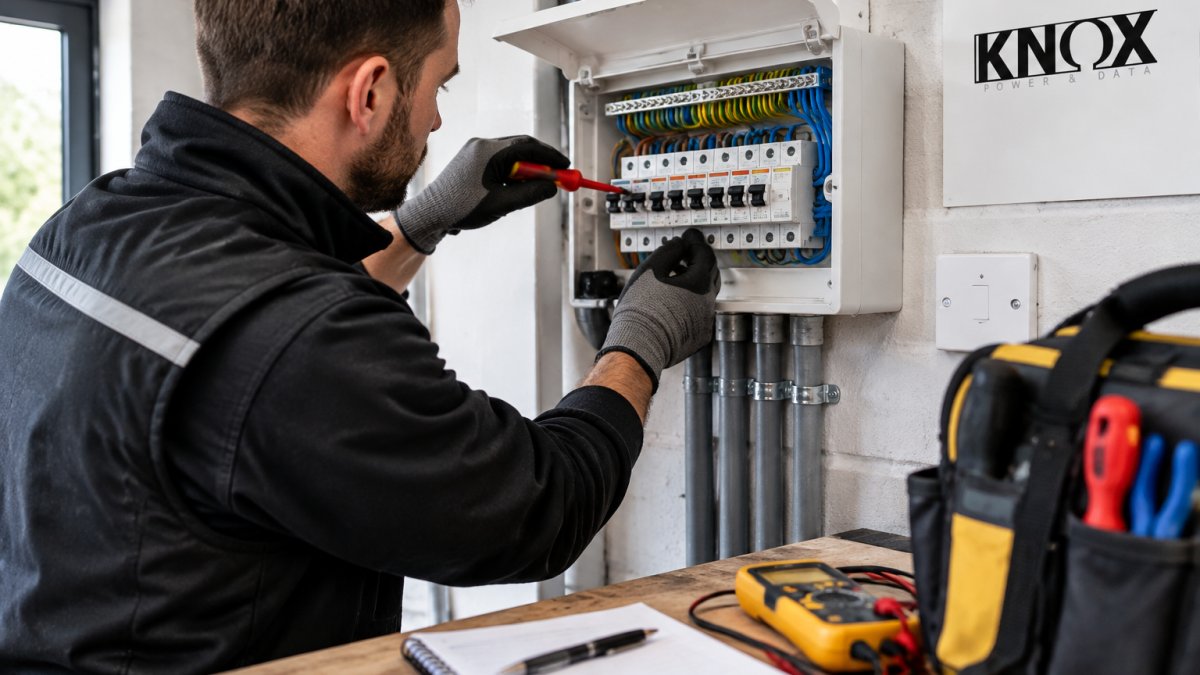
Your consumer unit is your home's main electrical hub, containing the main fuse or isolator switch, circuit breakers, and spare breaker slots.
Find your service size first. Open your consumer unit door and look at the main switch or fuse. It will show either 60, 80, 100, or 200 amps. Write this down.
Next, estimate your household load by adding the amps of major appliances running at once: cooker (30-50 amps), water heater (10-20 amps), heating (5-15 amps).
Finally, check for spare breaker slots in your consumer unit. You'll need at least one free slot for the EV charger circuit.
Understanding 100-amp versus 200-amp electrical service
A 100-amp service supplies 23 kW to your entire home. After essential circuits, you typically have 15-18 kW for new loads, tight, since a 7 kW Level 2 charger takes roughly half your remaining capacity.
A 200-amp service supplies 46 kW total. After essential loads, you have 30-35 kW available. A Level 2 charger uses only 20-25% of your spare capacity. This is comfortable and leaves room for future upgrades.
The practical difference: with 100-amp service, you may need load management or a subpanel. With 200-amp service, you usually don't.
Calculate Your Electrical Load for EV Charging
Load calculation determines whether your panel can handle the charger. Electrical code requires a formal assessment.
Add the nameplate amperage of every appliance that could run simultaneously, cooker, heating, water heater, air conditioning, large motors, then add the EV charger amperage. If the total exceeds your service capacity, you need an upgrade.
Level 2 charger power requirements and household demand
A Level 2 charger draws between 16 and 32 amps at 230V. Most home installations use 16 or 20 amps (3.7 kW or 4.6 kW); higher-spec chargers draw 32 amps (7.4 kW). The charger requires a dedicated 40-amp circuit breaker and appropriate wiring gauge.
Your household demand is the sum of everything running at peak. In practice, not everything runs at once, but electrical code assumes worst-case scenarios.
Here's the key insight: a 16-amp Level 2 charger adds only 3.7 kW to your peak load. If you have a 200-amp service with 35 kW available, you're fine.
Worked examples: older homes versus modern properties
Example 1: 1970s terraced house with 100-amp service
Main service: 100 amps (23 kW available) Current load: 40-amp cooker + 10-amp water heater + 8-amp heating + 6-amp lighting and sockets = 64 amps total Remaining capacity: 36 amps (8.3 kW) EV charger requirement: 20 amps (4.6 kW) Result: Technically possible, but leaves only 16 amps (3.7 kW) spare.
Example 2: 2005 detached house with 200-amp service
Main service: 200 amps (46 kW available) Current load: 50-amp cooker + 15-amp water heater + 12-amp heating + 8-amp lighting and sockets = 85 amps total Remaining capacity: 115 amps (26.4 kW) EV charger requirement: 20 amps (4.6 kW) Result: Leaves 95 amps (21.8 kW) spare.
Consumer Unit Upgrade for EV Charger: What's Involved
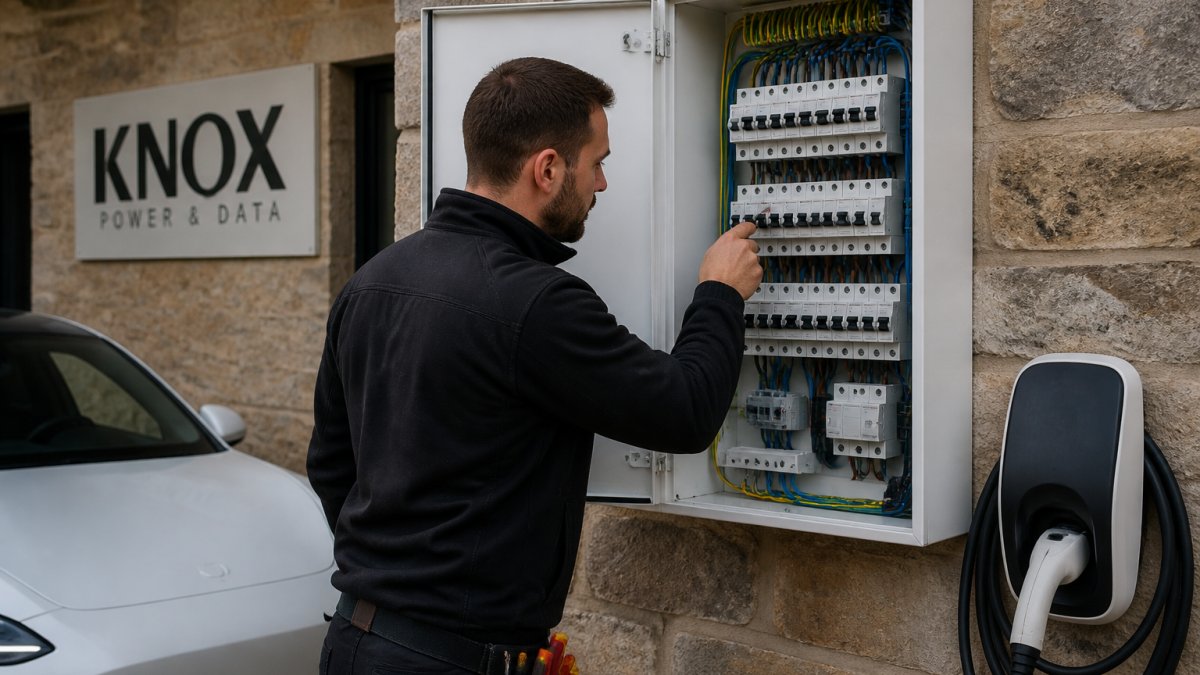
An electrical panel upgrade EV charging involves replacing your consumer unit with a larger one, installing new main wiring from the utility connection, and adding the dedicated EV circuit.
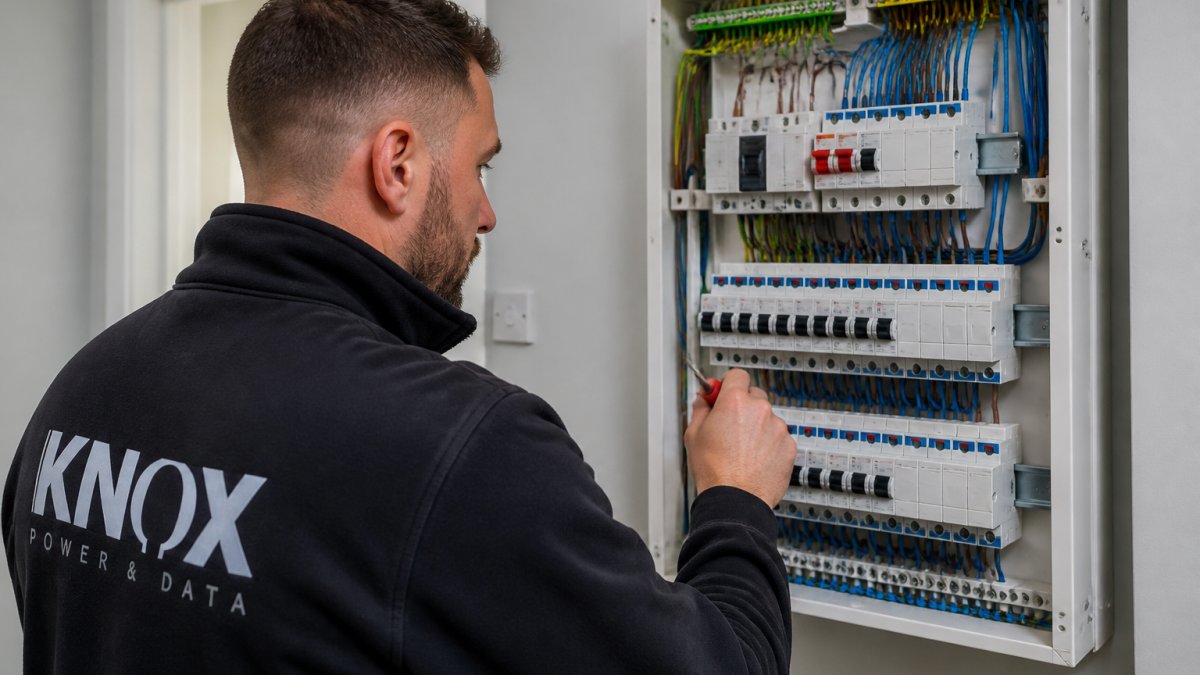
The work breaks down into four stages: utility coordination, main cable upgrade, consumer unit replacement, and final inspection.
Dedicated circuits and breaker requirements
Your EV charger must have a dedicated circuit, a breaker, wiring, and conduit serving only the charger. No other appliance shares it.
Breaker size depends on charger amperage: a 16-amp charger needs a 20-amp breaker, a 20-amp charger needs 25 amps, and a 32-amp charger needs 40 amps. Always size slightly above the charger rating to prevent nuisance tripping.
The wiring gauge must match the breaker size and run distance. For a 20-amp circuit up to 25 metres, use 2.5 mm² cable; for a 40-amp circuit, use 6 mm² cable. These are UK standards under BS 7671 18th Edition.
Panel space and available breaker slots
Your consumer unit must have a free breaker slot for the EV charger. If it's full, you have two options: install a subpanel (cheaper, faster) or replace the entire consumer unit (more disruptive, permanent).
A full consumer unit has 16-20 breaker positions. If fewer than two are empty, plan for a subpanel or full upgrade.
Subpanels are smaller units fed from a breaker in your main panel. They cost less and install faster than a full replacement. For most homes, a subpanel works if you have at least one spare 40-amp breaker slot in your main panel.
EV Charger Load Management Systems as an Alternative
Load management is a smart alternative to a panel upgrade: it monitors your home's electricity use in real time and adjusts the charger's output to stay within your service limits.
Load management works best for homes with 100-amp service and modest charging needs.
Smart load management systems integrate with your charger and consumer unit and require a qualified electrician to install. They cost £800 to £1,500 for hardware and installation, significantly less than a panel upgrade.
Electricity Supply Upgrade for EV Charger: When It's Necessary
Some homes need more than a consumer unit upgrade. They need a supply upgrade from the utility provider.
Your electricity supply runs from the grid via an underground or overhead cable to your property boundary, then to your consumer unit. If that cable is too small for the increased load, the utility must install a larger one, a supply upgrade.
Service capacity limits and utility provider coordination
Your utility provider (typically a regional distribution network operator) sets the maximum capacity they'll supply, based on cable size and transformer capacity in your area.
Most homes have a 100-amp or 200-amp supply limit; some older properties have only 60 amps.
Contact your utility provider before planning major electrical work. Give them your address and ask for your current supply capacity, they'll confirm the maximum available and whether an upgrade is feasible.
The utility coordinates all supply work, you don't hire a contractor for it. Your electrician liaises with them and handles your side of the connection point.
EV Charger Installation Cost and Project Timeline
A panel upgrade for EV charging is a significant project. Understanding the timeline and cost factors helps you plan.
The total project takes 4-8 weeks: initial assessment, utility coordination, permits, installation, inspections, and certification. The physical installation takes 2-3 days; the rest is waiting on utility coordination and inspection scheduling.
Permits, inspections, and compliance requirements
In the UK, electrical work must comply with Building Regulations. Any work involving your consumer unit, main wiring, or new circuits requires Building Regulation approval or certification from a qualified electrician.
If your electrician is not qualified to self-certify, you must notify your local Building Control office and request an inspection before you can use the work. This adds 1-2 weeks.
Always ask your electrician whether they can provide an Electrical Installation Certificate. If they can't, budget for Building Control involvement.
What affects your upgrade quote
Several factors change the cost of a panel upgrade. The main variables are:
- Service size increase: Upgrading from 100 to 200 amps costs more than staying at 100 amps with a subpanel
- Supply upgrade requirement: If your utility must install new cabling, costs rise significantly
- Cable routing: Running cable through walls or conduit costs more than surface-mounted cable
- Consumer unit type: Replacing an old fused unit costs more than upgrading a modern breaker panel
- Accessibility: Panels in basements or awkward locations cost more to work on
- Existing wiring condition: Old or damaged wiring may need replacement, adding cost
Each factor varies by property, so a quote is specific to your situation. Generic online price ranges are unreliable because they don't account for your actual circumstances.
Step-by-Step: Planning Your Electrical Panel Upgrade
Follow this process to move from uncertainty to a clear plan.
Before you call an electrician
Do your homework first. You'll have a more productive conversation with an electrician if you've already gathered basic information.
Check your service capacity by opening your consumer unit and noting the main switch amperage.
List your major appliances and power ratings (on the appliance or in the manual): cooker, water heater, heating system, air conditioning, and large motors.
Decide what you want: speed or lower cost.
Research your utility provider's supply upgrade process. Call or check their website and ask about your current capacity and whether an upgrade is possible, 10 minutes that saves weeks later.
During the site survey
When the electrician visits, they'll assess your panel, take measurements, and quote. Use this time to ask questions.
Ask whether they're qualified to self-certify. If yes, they can issue an Electrical Installation Certificate without Building Control involvement; if no, ask what steps are needed.
Ask them to explain the options, full panel upgrade, subpanel, or load management, with pros and cons for your situation.
Ask about the timeline: when they can start, how long the work takes, when inspection happens, and when you'll get certification.
Ask whether they've coordinated with your utility on supply upgrades before. An electrician who regularly handles supply work will navigate the process smoothly.
Common mistakes to avoid
Mistake 1: Assuming you need a full upgrade. Many homes don't. Get a proper assessment before committing.
Mistake 3: Skipping the utility conversation. Some homeowners plan a panel upgrade only to discover the utility can't supply more capacity. Have this conversation early.
Mistake 5: Rushing the process. Electrical work can't be hurried safely. If an electrician promises a panel upgrade in one day, be sceptical.
At Knox Power & Data, we help homeowners navigate this entire process.
Whether your home needs a full panel upgrade, a subpanel, or a load management system depends on your current service, household demand, and charging speed requirements.
Frequently Asked Questions
Do I need to upgrade my electrical panel for an EV charger?
Not always. It depends on your current electrical service capacity and the charger's power requirement. Most Level 2 chargers draw 7-11 kW. If your home has a 200-amp service with available breaker slots and spare capacity after calculating your household demand, you may only need a dedicated circuit and breaker. Homes with 100-amp service, older consumer units, or limited available capacity typically require a panel or service upgrade. A qualified electrician can assess your setup and confirm what's needed.
How do I know if my consumer unit can support an EV charger?
Check three things: (1) your main service amperage (usually 100 or 200 amps), (2) the number of available breaker slots in your consumer unit, and (3) your household's current electrical load. Calculate your load by adding the wattage of major appliances (cooker, heating, water heater) and divide by your voltage. If your remaining capacity is less than your charger's requirement, a consumer unit upgrade for an EV charger will be necessary. An electrician can perform this assessment during a site survey.
What's the difference between a panel upgrade and a load management system?
A panel upgrade increases your electrical service capacity, allowing simultaneous use of multiple high-demand appliances including your EV charger. An EV charger load management system intelligently reduces charging power when other appliances demand electricity, letting you charge within your existing capacity. Load management is cheaper and faster to install but limits charging speed during peak household demand. It suits homes where fast charging is flexible; a panel upgrade is necessary if you need reliable, high-speed charging regardless of other usage.
How long does an electrical panel upgrade take?
A consumer unit upgrade typically takes 1-3 days on site, depending on complexity. However, the full project timeline includes obtaining a building regulations permit (1-2 weeks), scheduling the work, and arranging an electrical inspection after completion. If a utility company supply upgrade is required, add 4-8 weeks. Plan for 8-12 weeks total from initial survey to certification.