 how-to
Signs Your Consumer Unit Needs Replacing: 2026 Guide
Table of Contents
- What a Consumer Unit Does and Why It Matters
- 7 Warning Signs Your Consumer Unit Needs Replacing
- The Dangers of Old Fuse Boxes and Rewirable Fuses
- BS 7671 Wiring Regulations Consumer Units Must Meet
- Consumer Unit Replacement Cost UK: What Affects the Price
- EICR Testing for Home Buyers and Landlords
- DIY vs Professional: Why Consumer Unit Work Is Not a DIY Job
- Frequently Asked Questions
Last Updated: September 25, 2026
What a Consumer Unit Does and Why It Matters
A consumer unit is the box on your wall that takes the incoming power supply and splits it into separate circuits for your lights, sockets, shower and cooker. It also holds the breakers that cut the power when something goes wrong. If you are spotting signs your consumer unit needs replacing, this guide from Knox Power & Data walks you through every warning to look for.
Fuse Box vs Consumer Unit: What's the Difference?
A fuse box is the older version, using rewirable fuses or fuse carriers that you physically replace when they blow. A consumer unit is the modern equivalent, using circuit breakers and RCD protection instead.
| Feature | Old Fuse Box | Modern Consumer Unit |
|---|---|---|
| Protection device | Rewirable fuses | MCBs and RCBOs |
| Reset method | Replace fuse wire | Flip the switch |
| Shock protection | None | RCD protection |
| Age | Pre-1980s | Current standard |
7 Warning Signs Your Consumer Unit Needs Replacing
Watch for these seven signs. Any one of them is worth a professional check.
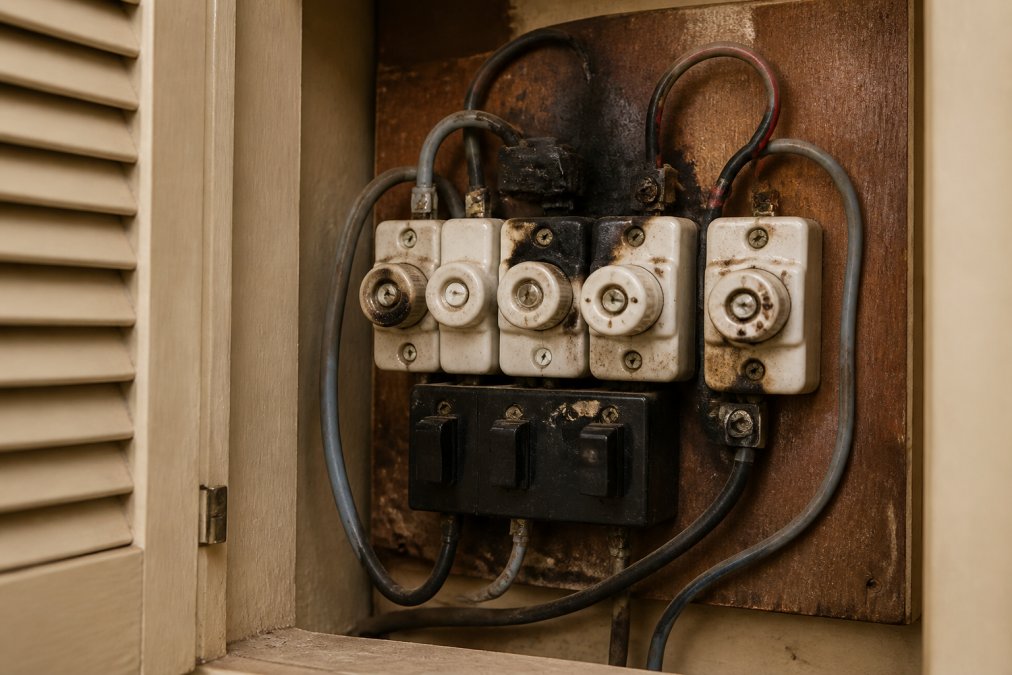
- Rewirable fuses still in use
- Scorch marks or heat damage around the unit
- Buzzing sound coming from the box
- Burning smell near the unit
- Nuisance tripping that keeps happening
- Cracked casing or a wooden backboard
- No RCD protection fitted
If you count two or more, book an electrician.
Visual Clues: Scorch Marks, Cracked Casing and Heat Damage
Scorch marks are the clearest visual clue. Blackening around the breakers or fuse carriers means heat has built up, usually from overloading or loose connections.
Buzzing Sounds, Burning Smells and Nuisance Tripping
A buzzing sound points to a loose connection or a failing breaker. A burning smell means something inside is overheating. Both need urgent attention.
The Dangers of Old Fuse Boxes and Rewirable Fuses
Old fuse boxes were built for a time when homes used far less power. Today's kitchens, chargers and heat pumps pull more electrical load than they were ever designed for.
The main dangers are:
- No RCD protection, so a fault can shock you
- Rewirable fuses that can be bypassed with the wrong wire
- Heat damage from overloading
- Outdated wiring that may not meet current standards
BS 7671 Wiring Regulations Consumer Units Must Meet
BS 7671 is the standard that sets out how electrical installations must be built and protected. It is often called the Wiring Regulations, and it applies to every consumer unit fitted today.
RCD Protection and RCBOs Explained
An RCD, or residual current device, is a safety switch that cuts power within milliseconds when it detects a fault. It protects people from electric shock.
Consumer Unit Replacement Cost UK: What Affects the Price
Consumer unit replacement cost UK is not a single flat rate. A straightforward swap in a small flat and a full upgrade in a large house with ageing wiring can differ by several hundred pounds, so any figure quoted over the phone without a site visit should be treated as a rough guide only.
What Actually Drives the Price
The main things that affect the price:
- Number of circuits in your home, a one-bedroom flat may need 6 ways, a four-bedroom house with a garage, outbuilding or electric shower may need 16 or more
- Condition of the existing wiring, if circuits fail insulation resistance testing, they must be remedied before the new unit can be certified
- Whether the tails and earthing need upgrading, older installations often have undersized meter tails or a missing main protective bonding conductor to gas and water
- Remedial work such as replacing a wooden backboard, correcting borrowed neutrals, or separating a shared neutral
- Ease of access to the unit and the routing of new cables
- Whether an EICR is carried out at the same time, which is often cheaper than booking it separately
- Whether RCBOs are fitted on every circuit rather than a mix of MCBs and a single RCD, RCBOs cost more per device but reduce nuisance tripping
What a Proper Quote Should Include
A reputable quote for consumer unit replacement should itemise:
- The unit itself, its enclosure type and the number of ways
- Protective devices (RCBOs, MCBs, SPD if fitted)
- Labour for removal and installation
- Testing and certification, including the Electrical Installation Certificate
- Notification to the local authority building control body where the work is notifiable under Part P
- Making good, if any is needed
Be wary of a quote that does not mention testing or certification. A consumer unit that is fitted but not tested and certified is not a compliant installation, and it can cause problems when you sell, remortgage or rent out the property.
Why Quotes Vary So Much
Two electricians can quote very differently for what sounds like the same job because they are pricing different scopes. One may be allowing for remedials, testing and certification; another may be assuming the existing circuits will pass and excluding anything that does not. Always compare the scope, not just the total.
EICR Testing for Home Buyers and Landlords
An EICR, or Electrical Installation Condition Report, is a full safety check of your wiring and consumer unit. It is carried out by a competent electrician who inspects and tests every circuit, then grades any defects as C1 (danger present), C2 (potentially dangerous), C3 (improvement recommended) or FI (further investigation required).
What the Report Tells You
A C1 or C2 code means the installation is not satisfactory and remedial work is required. A consumer unit with no RCD protection, a wooden backboard, or signs of heat damage will typically attract a C2. A C3 is advisory, it does not make the report unsatisfactory, but it flags something worth addressing.
EICR Testing for Home Buyers
EICR testing for home buyers is now standard practice before purchase. A report gives you a clear picture of the electrical condition of the property and a basis for negotiating on price if remedial work is needed. A failing consumer unit is one of the most common issues an EICR uncovers, and it is often the single largest item on the remedial list.
EICR Testing for Landlords
For landlords, an EICR is a legal requirement in the private rented sector. The rules are:
- An EICR must be carried out by a qualified and competent person at least every five years
- The report must be supplied to existing tenants within 28 days of the inspection
- New tenants must be given a copy before they move in
- If the local authority requests a copy, it must be provided within seven days
- Any C1 or C2 defect must be remedied within 28 days, or sooner if the report specifies a shorter period
- Proof of the remedial work must be supplied to the tenant and, on request, to the local authority
Insurance Implications of an Outdated Consumer Unit
This is the angle most guides miss. Your home insurance policy is a contract, and it usually includes a condition that you must take reasonable steps to maintain the property and comply with the law. If a fire or electrical fault is traced to a consumer unit that was known to be defective, or that should have been replaced under an EICR recommendation, an insurer may reduce or refuse a payout.
How Often Should You Get an EICR?
For a privately owned home, the recommended interval is typically every ten years, or on a change of occupancy. For rented property, it is every five years. For commercial premises, the interval is shorter and depends on the type of use. If your consumer unit is old, has no RCD protection, or has shown any of the warning signs in this guide, do not wait for the interval to expire, book an inspection now.
DIY vs Professional: Why Consumer Unit Work Is Not a DIY Job
A qualified electrician will:
- Isolate and test the supply safely
- Fit the correct protective devices
- Test every circuit after fitting
- Issue an electrical installation certificate
Frequently Asked Questions
When should a consumer unit be replaced?
Replace it when you see scorch marks, smell burning, hear buzzing, or the unit keeps tripping. Units with rewirable fuses or wooden backboards are long past their safe life. If your consumer unit lacks RCD protection, current BS 7671 wiring regulations expect an upgrade, especially before selling, renting or adding circuits like an EV charger.
How much does consumer unit replacement cost in the UK?
Pricing depends on the number of circuits, whether RCBOs are fitted, access to the unit and whether fault finding is needed. A straightforward swap costs less than one combined with remedials or a partial rewire. Knox Power & Data provides a fixed quote after a site assessment, so you know the full figure before any work starts.
Can you have a new consumer unit without a rewire?
Yes, in many cases. If the existing wiring passes insulation resistance and continuity tests, a new consumer unit can be fitted on its own. The electrician will test circuits first and flag anything unsafe. Older properties with degraded wiring may need remedial work, but a full rewire is not automatically required.
Does a new consumer unit require an EICR?
No, a new consumer unit needs an Electrical Installation Certificate instead. An EICR is a periodic inspection, typically needed every 10 years for owner-occupied homes, every 5 years for rented properties, and on change of tenancy. Landlords must also provide tenants with a copy of the EICR report.
An old consumer unit is one of those problems that stays quiet until it does not. If you have spotted scorch marks, a buzzing sound or a lack of RCD protection, the safest move is to get it checked now rather than later. Knox Power & Data offers same-day emergency callouts across West Yorkshire, alongside full consumer unit replacements, EICR testing and certification under BS 7671. Get a quote from Knox Power & Data and put your home's electrical safety in qualified hands.