 how-to
How to Find a Reliable Local Sparky: 2026 UK Guide
Table of Contents
- Why Finding a Reliable Local Sparky Matters
- How to Start Your NAPIT Registered Electrician Search
- Part P Building Regulations Explained for Homeowners
- Questions to Ask an Electrician Before Hiring
- Understanding Electrical Certification Requirements
- Verifying Insurance and Public Liability
- How to Spot a Rogue Trader and Emergency Pricing
- Frequently Asked Questions
Last Updated: October 2, 2026
Why Finding a Reliable Local Sparky Matters
Finding a reliable local sparky is the difference between a job done safely and a job that puts your home at risk. At Knox Power & Data, we see the fallout from bad electrical work every week. Faulty wiring causes around 2,000 house fires a year in the UK, according to Electrical Safety First, and most of those fires trace back to unqualified or careless work.
Electrical work is not a DIY job. It is regulated, it is tested, and it must be certified. Skip that step and you risk fire, shock, and an insurance claim that gets refused.
How to Start Your NAPIT Registered Electrician Search
Begin your NAPIT registered electrician search with the official registers, not social media. NAPIT and NICEIC both run online directories where you can search by postcode and see a tradesperson's registration status. If a sparky is not listed, walk away.
Here is the fastest route to a vetted tradesperson:
- Search the NAPIT or NICEIC register by your postcode
- Check the Competent Person register for Part P compliance
- Cross-check the business on Companies House
- Read verified reviews on independent platforms, not just their own site
- Ask for two recent local references
Part P Building Regulations Explained for Homeowners
Part P building regulations explained simply: Part P is the law that says most electrical work in a home must be designed, installed, and certified to a set standard. It covers kitchens, bathrooms, gardens, and any new circuit.
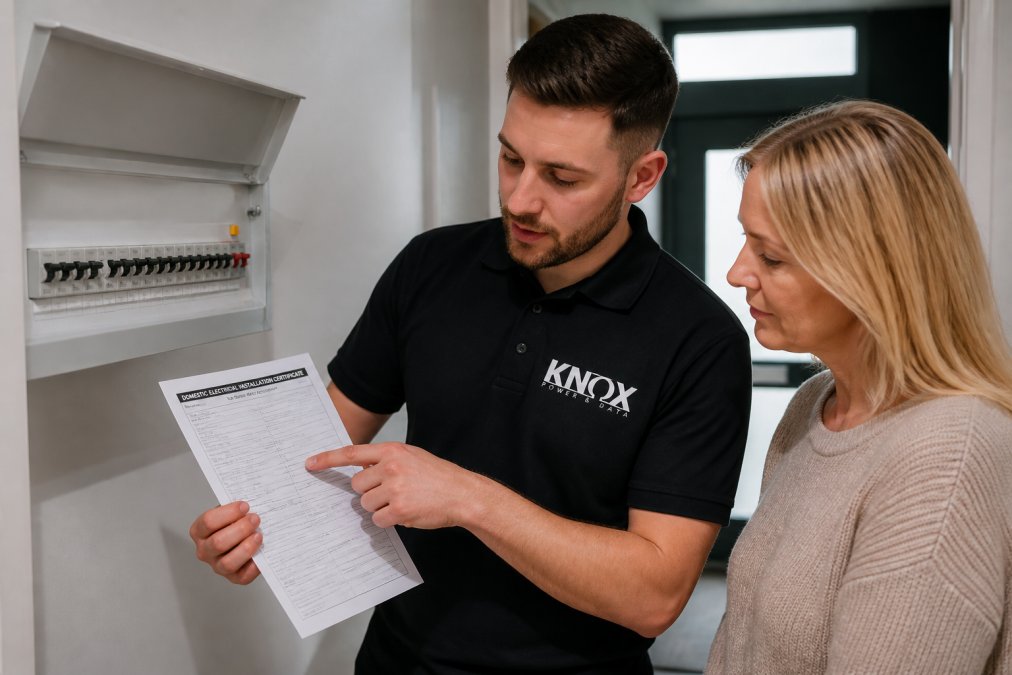
Work that must comply includes:
- Consumer unit replacements
- New circuits anywhere in the home
- Rewiring
- Any work in a bathroom, kitchen, or outdoors
Questions to Ask an Electrician Before Hiring
The questions to ask an electrician before hiring should cover registration, insurance, certification, and price structure. Ask them all before you agree to anything.
Use this checklist:
- Are you NAPIT or NICEIC registered? What is your number?
- Do you hold public liability insurance? What is the cover level?
- Will I receive an EICR certificate or a Minor Works Certificate?
- Is your quote fixed-price or hourly rate?
- What is your emergency call-out charge?
- Who is your qualified supervisor?
- Do you offer a workmanship guarantee?
Understanding Electrical Certification Requirements
Electrical certification requirements exist so that every job leaves a paper trail. Without the right certificate, you cannot prove the work was done to BS 7671, and your home insurance may not pay out after a fault.
The main documents you should receive are:
- EICR (Electrical Installation Condition Report): a periodic safety check, typically recommended every 10 years for a homeowner and every 5 years for a rented property. It records the condition of the existing installation and gives each observation a code (C1, C2, C3, FI).
- EIC (Electrical Installation Certificate): issued for new circuits, consumer unit replacements, and rewires. It is signed by the qualified supervisor who designed, installed, and tested the work.
- Minor Works Certificate: issued for small additions to an existing circuit, such as adding a socket or a light fitting, where no new circuit is created.
- Building Regulations Compliance Certificate: issued by the Competent Person scheme operator (for example NAPIT or NICEIC) after the work is notified. This is the document your solicitor will ask for when you sell the property.
- PAT Testing records: for appliances in rental or commercial property, showing the test date, result, and tester.
Who issues what, and when
If your sparky is registered with a Competent Person scheme, they self-certify the work and notify the scheme operator, who then issues the Building Regulations Compliance Certificate directly to you and to the local authority. This usually arrives within a few weeks of completion. If your sparky is not registered, you must notify building control yourself before work starts, and a building control officer will inspect and certify the work, a slower and often more expensive route.
What to do with the paperwork
Keep the original certificate, not just a photo. Store it with your boiler service record and any other property documents. If you sell, rent out, or remortgage the property, the buyer's solicitor or lender will ask for it. An EICR is also worth keeping on file even when it is not legally required, because it demonstrates a maintenance history.
If a certificate is missing or wrong
A missing certificate is not a small admin problem. Without it, you cannot prove compliance with Part P, and any future buyer's surveyor may flag the work as unverified. If your sparky cannot produce the certificate, contact the Competent Person scheme they claim to belong to and ask them to confirm the notification. If they were never registered, you may need to commission an EICR from a different electrician and, in some cases, notify building control retrospectively.
Verifying Insurance and Public Liability
Verifying insurance and public liability takes two minutes and saves you thousands. Public liability insurance covers damage to your property or injury to someone on site. Without it, you carry the risk.
- The policy is current, not expired
- The cover level suits the job size
- The business name matches the quote
How to Spot a Rogue Trader and Emergency Pricing
Spotting a rogue trader comes down to patterns: pressure, cash demands, no paperwork, and prices that shift. Emergency call-out pricing is where the worst of them operate, because you are stressed and unlikely to shop around.
Emergency vs. planned work: how the pricing actually differs
Emergency electrical work is priced differently from planned work, and understanding why helps you spot when you are being taken advantage of.
- Planned work is quoted as a fixed price or a day rate. The sparky has seen the job, priced the materials, and can commit to a number. You have time to get two or three quotes.
- Emergency work is usually charged as a call-out fee plus an hourly rate, often with a minimum charge (commonly one hour). Out-of-hours, weekend, and bank holiday rates are legitimately higher because the sparky is disrupting their own time.
- Fault-finding is the variable that catches people out. A fault that takes 20 minutes to trace is cheap; a fault buried behind plaster can take hours. Ask whether fault-finding is charged at the same rate as the repair, and whether the call-out fee is credited against the final bill.
Red flags to watch for
- They demand cash up front, or ask for a deposit before they have seen the job
- They quote a suspiciously low fixed price, then add "extras" once work has started
- They cannot show ID or a registration number
- They pressure you to decide on the spot, or offer a discount for immediate payment
- They refuse to put anything in writing, including the price
- They knock on the door uninvited offering electrical "deals"
If the work turns out to be substandard
If work turns out to be substandard, you have a clear path, and it is worth knowing before you need it.
- Put your complaint in writing to the trader, stating what is wrong and what you want done. Keep a copy.
- Report the trader to trading standards through the Citizens Advice consumer service, which passes cases to the relevant local authority trading standards team (Reporting to Trading Standards).
- Raise a dispute through the scheme if the sparky is registered with a Competent Person scheme such as NAPIT or NICEIC. These schemes have complaints and workmanship guarantee procedures, and they can require the member to put the work right.
- Keep every message, receipt, and certificate. A registered electrician's work is covered by a workmanship guarantee, which is exactly why registration matters.
- For larger losses, you may be able to pursue a claim through the small claims track of the county court. The Money Claim Online service is the usual route for straightforward disputes.
Frequently Asked Questions
How do I know if an electrician is legit?
Check if they are registered with a competent person scheme like NAPIT or NICEIC. Ask for their registration number and verify it on the scheme's website. A legitimate electrician will also have public liability insurance and provide a fixed-price quote before starting work. Knox Power & Data, for example, is NAPIT registered (Member No. 69848).
Is it a legal requirement for an electrician to be NAPIT or NICEIC registered?
Not exactly, but to certify work under Part P of the Building Regulations, they must be registered with a competent person scheme. If they are not, you must notify your local building control before work starts, which can be costly. Using a registered electrician ensures compliance and saves you hassle.
What questions should I ask before hiring a local sparky?
Ask about their registration and scheme, insurance, experience with your type of work, whether they provide a fixed-price quote, and what documentation you will receive. Also ask about their process for emergency call-outs and how they handle disputes. A reliable electrician will answer these openly.
How can I spot a rogue trader?
Rogue traders often demand cash upfront, offer deals that seem too good, and cannot provide a verifiable registration or insurance. They may also pressure you to make quick decisions. Always check reviews on trusted platforms and never pay in full before work is completed and certified.