 how-to
Can My Home Electrics Support an EV Charger?
Table of Contents
- How to Check If Your Home Electrics Can Support an EV Charger
- EV Charger Load Management Systems Explained
- Consumer Unit Upgrade for EV Charger: When Is It Needed?
- DNO Application for EV Charger: What Homeowners Must Know
- Standard 3-Pin Plug vs Dedicated Wallbox: Why It Matters
- Common Mistakes When Assessing Home Electrics for an EV Charger
- Conclusion
- Frequently Asked Questions
Last Updated: September 16, 2026
How to Check If Your Home Electrics Can Support an EV Charger
Most homes can support an EV charger, but the answer depends on your consumer unit, main fuse rating, and existing electrical load. At Knox Power & Data, we assess these three factors before recommending any installation, because a charger that trips your supply is worse than no charger at all.
Step 1: Locate Your Consumer Unit and Main Fuse
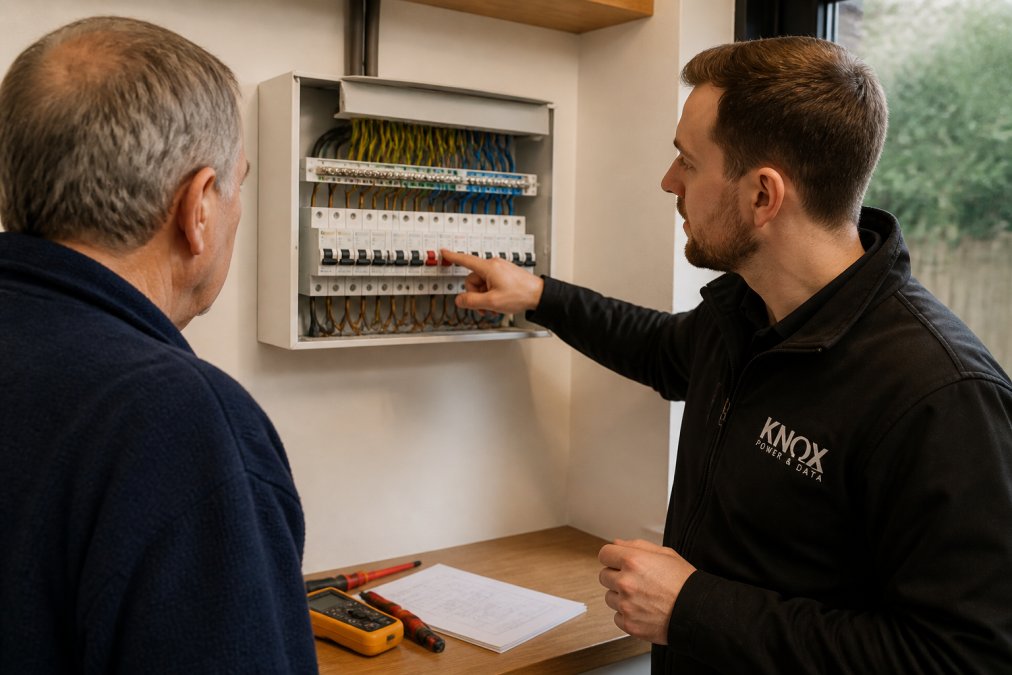
Find your consumer unit, often in a hallway cupboard, garage, or under the stairs. Check the main switch rating printed on it and look for a separate main fuse near your electricity meter.
Step 2: Assess Your Existing Electrical Load
Add up the approximate demand of your major appliances. An electric shower can draw 8-10kW, an oven around 2-3kW, and an immersion heater 3kW.
Step 3: Check for High-Draw Appliances
Homes with electric heating, heat pumps, or multiple electric showers need particular care. These appliances compete with a charger for the same supply.
DIY Load Worksheet: Self-Qualify Before You Call an Electrician
Most guides stop at "ask an electrician." You can get 80% of the way there yourself in ten minutes with a pen and the table below. This is a rule-of-thumb worksheet, not a substitute for a BS 7671 diversity calculation, but it will tell you whether you're likely to sail through, need load management, or need a supply upgrade.
Step A, Write down your supply capacity.
| Main fuse rating | Approximate total capacity |
|---|---|
| 60A | ~13.8kW |
| 80A | ~18.4kW |
| 100A | ~23kW |
| Appliance | Typical load | Notes |
|---|---|---|
| Electric shower | 8-10kW | Highest single draw in most homes |
| Immersion heater | 3kW | Often on a timer overnight |
| Oven (single) | 2-3kW | Intermittent |
| Induction hob | 7kW peak | Rarely all zones at once |
| Heat pump | 3-7kW | Runs long cycles in winter |
| Tumble dryer | 2-3kW | Intermittent |
| Kettle | 3kW | Short bursts |
| EV charger (7kW) | ~7kW | Continuous for hours |
Step C, Apply the diversity rule of thumb.
- Take the largest single appliance (usually the shower or the charger) at 100%.
- Add 50% of the next largest.
- Add 25% of the rest.
Worked example, a typical 100A home:
-
Electric shower: 9kW at 100% = 9kW
-
EV charger: 7kW at 50% = 3.5kW
-
Immersion, oven, hob, dryer, kettle combined: ~15kW at 25% = 3.75kW
-
Total: ~16.25kW against a 23kW supply, comfortable headroom, no upgrade needed.
-
Electric shower: 9kW at 100% = 9kW
-
Heat pump: 5kW at 50% = 2.5kW
-
EV charger: 7kW at 25% = 1.75kW
-
Everything else: ~10kW at 25% = 2.5kW
-
Total: ~15.75kW against a 13.8kW supply, over capacity. This home needs either load management or a DNO upgrade.
Why Existing High-Draw Appliances Change the Answer
Two homes with identical consumer units can get completely different answers depending on what's already installed. The three appliances that most often tip a home over the line are:
- Electric showers, a single 9kW shower uses more than a 7kW charger. A home with two electric showers is almost always a load-management case.
- Heat pumps, they run long, steady cycles in winter, exactly when you're most likely to be charging overnight in cold weather.
- Induction hobs, peak draw can hit 7kW, but only briefly. They matter less than showers because the duty cycle is short.
EV Charger Load Management Systems Explained
EV charger load management systems explained simply: they monitor your home's total electricity demand and reduce charger output when other appliances are running, so you never exceed your supply capacity.
Static vs Dynamic Load Management
Not all load management is the same, and the difference matters for your quote.
| Type | How it works | Best for |
|---|---|---|
| Static | You set a fixed maximum current for the charger (e.g. 16A instead of 32A) at install | Homes with a known, stable spare capacity |
| Dynamic | A sensor reads total household demand in real time and adjusts charger current continuously | Homes with electric showers, heat pumps, or uncertain headroom |
How Dynamic Load Balancing Actually Works
The mechanism is straightforward once you see it:
- A current transformer (CT) clamp is fitted around the live tail between your meter and consumer unit.
- The CT continuously reports total household current draw to the charger's controller.
- The controller subtracts that from your configured supply limit (for example, 60A).
- The remainder is the maximum current the charger is allowed to draw.
- The charger adjusts its output in real time, typically in small steps, so the main fuse never sees more than its rating.
- When the shower switches off or the oven finishes, the charger ramps back up automatically.
This is why a home on a 60A fuse can safely run a 7kW charger without a DNO upgrade: the charger simply yields whenever the rest of the house needs the capacity.
What Load Balancing Doesn't Solve
Dynamic load management is powerful, but it has limits:
- It can't fix a consumer unit with no spare ways. You still need a dedicated circuit and appropriate RCD protection.
- It can't fix an undersized supply for a multi-charger setup. Two 7kW chargers on a 60A supply will still need a DNO conversation.
- It depends on the CT being fitted correctly. A misplaced clamp gives the controller wrong data, and the fuse can still trip.
- It doesn't remove the need for DNO notification where the installation exceeds 13.8kVA.
Why This Matters for Your Installation Decision
If your DIY worksheet from the previous section came in close to your supply limit, dynamic load management is usually the difference between a straightforward install and a five-figure supply upgrade. It's also the reason a 60A home shouldn't automatically assume the worst, a properly configured smart charger can often deliver full-speed overnight charging without any change to your supply.
Consumer Unit Upgrade for EV Charger: When Is It Needed?
A consumer unit upgrade for EV charger installation is needed when your existing unit lacks spare ways, uses obsolete fuse types, or has no RCD protection suitable for EV charging.
Signs you need an upgrade:
- Plastic consumer unit without metal enclosure
- No RCD protection on existing circuits
- No spare ways for a new dedicated circuit
- Fuse box with rewireable fuses rather than MCBs
- Evidence of overheating or scorching
DNO Application for EV Charger: What Homeowners Must Know
A DNO application for EV charger installation is required when your charger exceeds 13.8kVA, or when you're installing multiple chargers on a single supply. For most single 7kW home chargers, you notify the DNO after installation rather than applying beforehand.
Standard 3-Pin Plug vs Dedicated Wallbox: Why It Matters
A standard 3-pin plug charges at roughly 2.3kW, adding around 8-10 miles of range per hour. A dedicated 7kW wallbox charges at three times that rate, adding 25-30 miles per hour.
| Feature | 3-Pin Plug | Dedicated Wallbox |
|---|---|---|
| Charging speed | ~2.3kW | 7kW (single-phase) |
| Range added per hour | 8-10 miles | 25-30 miles |
| Safety certification | Not designed for continuous load | Purpose-built, RCD protected |
| Weatherproofing | None | IP-rated for outdoor use |
| Load management | None | Dynamic balancing available |
| Installation certificate | Not applicable | Required under BS 7671 |
Common Mistakes When Assessing Home Electrics for an EV Charger
The biggest mistake is assuming your existing setup is fine because nothing has tripped before. Adding a continuous 32A load is different from intermittent appliance use.
Other errors we see regularly:
- Ignoring the main fuse rating and assuming the consumer unit tells the whole story
- Skipping the load calculation because "it'll probably be fine"
- Installing a charger without RCD protection suitable for DC leakage
- Forgetting to notify the DNO where required
- Assuming a 60A supply automatically means an expensive upgrade is needed
Conclusion
Assessing whether your home electrics can support an EV charger isn't guesswork. Check your main fuse rating, calculate your existing load, and identify any high-draw appliances. In most cases, a 7kW charger with load management works without a supply upgrade.
Frequently Asked Questions
Can my home support an EV charger?
Most homes can support an EV charger, but it depends on your consumer unit, main fuse rating, and existing electrical load. A 7kW charger typically needs a 32A dedicated circuit. If your main fuse is 60A or lower, a load management system or DNO notification may be required. A qualified electrician can assess your home electrics and confirm what is needed.
Can you charge an EV from a normal house socket?
Charging from a standard 3-pin plug is possible but slow, adding roughly 3-5 miles of range per hour. It also puts continuous high current through a circuit not designed for it, which risks overheating. For regular charging, a dedicated wallbox on its own circuit is safer and faster. A 7kW unit adds around 25 miles of range per hour.
Do I need a consumer unit upgrade for an EV charger?
Not always. If your consumer unit has spare ways and your main fuse and earthing arrangements meet BS 7671 requirements, a dedicated circuit can often be added without a full upgrade. Older units with rewireable fuses or no RCD protection usually need replacing. An electrician will check capacity, RCD type, and earthing before advising.
What is a DNO application for EV charging?
A DNO application notifies your Distribution Network Operator about the new load you are adding. For chargers above 7kW, or where your main fuse is under 100A, the DNO may need to approve the connection or upgrade your supply. Your installer handles this paperwork. Approval can take several weeks, so apply early to avoid delays.
Getting this wrong means tripped circuits, failed inspections, or worse. Knox Power & Data handles the full assessment, consumer unit work, DNO notification, and certified installation under one roof. Our NAPIT-registered team (Member No. 69848) works to BS 7671 18th Edition standards, and every installation is fully tested and certified. Get a quote from Knox Power & Data and charge at home with confidence.