 blog
Do Smart EV Chargers Really Cut Energy Bills?
Last Updated: November 1, 2026
Quick Summary
Smart charging cuts energy bills by moving your car's charging into the cheapest hours on a time-of-use tariff, so the same energy costs less. In our worked example, scheduling all charging in a cheap overnight window costs about £230 a year instead of about £690 at peak rate, a saving of roughly £460.
- A smart charger on a flat tariff saves nothing, and a cheap overnight tariff with a dumb charger saves nothing either.
- Compare five figures before switching: off-peak unit rate, peak unit rate, standing charge, export rate, and contract term and exit fees.
- Load management throttles charging when other appliances run, so the car may not finish in the cheap window and needs an expensive top-up.
- Smart charging with solar panels diverts surplus generation into the car instead of exporting it at a low rate.
- Savings fail without a time-of-use tariff, with the wrong schedule, with peak-rate creep, or when supply limits throttle charging.
Table of Contents
- How Smart Charging Actually Reduces Energy Bills
- 1. Off-Peak EV Charging Moves Your Most Expensive Hours
- 2. Smart EV Charging Tariffs Reward Flexible Load
- 3. EV Charger Load Management Protects Your Supply and Your Bill
- 4. Smart Charging With Solar Panels Uses Power You Already Paid For
- 5. A Worked Example: What a Year of Scheduled Charging Looks Like
- 6. Lower Peak Demand Cuts Bills Beyond the Car
- 7. When Smart Charging Savings Do Not Materialise
- Frequently Asked Questions
How Smart Charging Actually Reduces Energy Bills
Smart charging is the practice of letting software decide when your electric vehicle charges, rather than plugging in and drawing power immediately. The question most people ask is simple: does any of this actually lower the bill? The short answer is yes, but only when the charger and the tariff work together. Below, we break down the seven benefits of smart charging for energy bills, including a worked example and the cases where the savings never show up.
What the charger controls and what the tariff controls
A smart charger controls timing, speed and load. It can delay a charge, slow it down, or pause it when the house is drawing heavily.
The tariff controls price. A time-of-use tariff charges less outside peak hours, usually overnight.
Neither works alone. A smart charger on a flat tariff saves nothing.
Get both right and the car becomes a flexible load you can shift to the cheapest hours.
1. Off-Peak EV Charging Moves Your Most Expensive Hours
Off-peak EV charging shifts the bulk of your car's electricity use into the cheapest window on your tariff, typically the small hours.
This is the single biggest lever on your bill. Most households charge in the evening, right when peak rates apply.
A smart charger handles this automatically. You plug in at 6pm, and nothing happens until the cheap window opens.
2. Smart EV Charging Tariffs Reward Flexible Load
Smart EV charging tariffs are electricity deals that price power by time of day, and they reward you for being flexible. Suppliers want demand spread out, so they discount the hours when the grid is quiet. The benefit to your bill is real, but only if the whole tariff, not just the headline overnight rate, suits your household.
These tariffs come in a few shapes:
- Static time-of-use: fixed cheap and peak windows every day, so you can plan around them.
- Dynamic: prices that track wholesale costs and change daily or half-hourly, which can be cheaper but requires the charger and app to respond automatically.
- EV-specific: cheap windows designed around overnight charging, often with a higher daytime rate to compensate.
A neutral way to compare smart tariffs
Do not choose on the off-peak unit rate alone. Compare these five figures side by side before you switch:
- Off-peak unit rate, the price you will pay for most of your car's charging.
- Peak unit rate, the price for everything else, including evening cooking, heating and lighting.
- Standing charge, a daily fixed amount that never moves, so a cheap unit rate can be cancelled out by a high standing charge.
- Export rate, if you have solar panels, the rate you are paid for surplus power matters as much as what you pay for imported power.
- Contract term and exit fees, a twelve-month fix may look attractive until your mileage or household pattern changes.
A simple test: take your annual household consumption excluding the car, split it between peak and off-peak hours as honestly as you can, then add the car's scheduled charging. The tariff with the lowest total annual cost, units plus standing charge, is the one to pick, not the one with the cheapest overnight headline.
Where the savings can go wrong
A common pattern is a household that switches for the cheap overnight rate but does most of its washing, cooking and heating in the peak window.
Dynamic tariffs add a second risk: if the charger is not set to respond to price signals automatically, you may charge at an expensive half-hour without noticing.
For the wider picture of how these systems work, read our guide to EV charger load management systems explained.
3. EV Charger Load Management Protects Your Supply and Your Bill
EV charger load management is the system that stops your charger from overloading the supply. It monitors the whole house and reduces charging power when other appliances are running, then restores it when demand falls. The bill benefit is indirect but real: it lets you charge within the supply you already have rather than paying for a bigger connection.
How the mechanism works
A current transformer clamp on the main supply cable measures total household draw. The charger's controller compares that figure with a configured limit, typically the rating of your main fuse, and throttles the charge rate so the two never exceed it. Some systems use a hard wired connection to a meter or a smart meter's data, and some rely on a CT clamp alone.
Why that matters for bills
Two reasons.
First, an overloaded supply trips. A tripped main fuse can mean a callout and, in some cases, a supply upgrade you did not plan for.
Second, load management lets you charge at a higher rate later rather than paying for a bigger connection now. If your existing supply can carry the car overnight with management, you avoid the upgrade entirely.
The trade-off nobody mentions
Load management can quietly erode your off-peak saving. If the charger is throttled for most of the cheap window because other appliances are running, the car may not finish charging before the peak rate returns.
A common pattern is a household that sets a departure time, plugs in, and assumes the car will be full by morning. If the cheap window is short and the charger is heavily managed, it may not be.
What to check before installation
A common mistake is buying a high-power charger without checking the existing supply capacity. In practice, most homes do not need the fastest unit available. They need one that shares the supply sensibly. Ask three questions:
- What is the rating of the main fuse, and what limit will the charger be configured to?
- Does the load management use a CT clamp, a meter connection, or both, and what happens if the clamp is disturbed?
- Does the app show the charging curve and cost per session, so you can verify the car charged in the cheap window?
For the full picture of how these systems work, read our guide to EV charger load management systems explained.
4. Smart Charging With Solar Panels Uses Power You Already Paid For
Smart charging with solar panels diverts surplus generation into the car instead of exporting it.
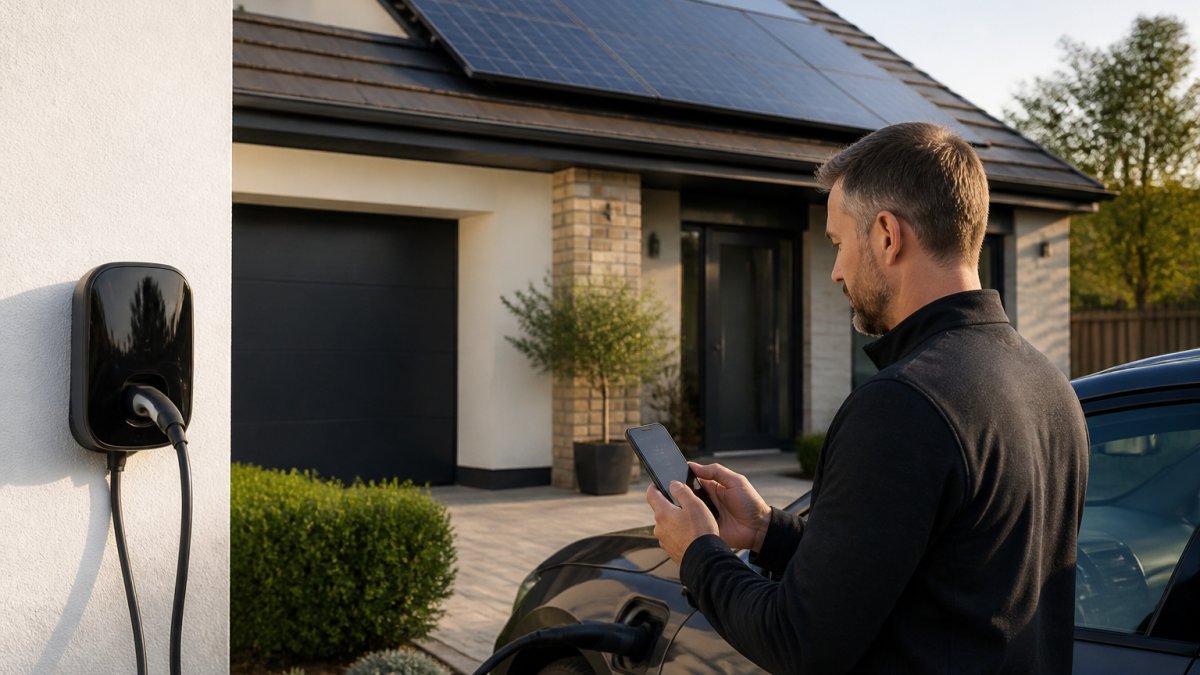
That is power you have already paid for through the panel installation. Sending it to the car is better value than exporting it at a low rate and buying it back at night.
The catch is seasonality. If you are weighing up panels and a charger together, our guide to integrating solar panels with EV charging covers the practical side.
5. A Worked Example: What a Year of Scheduled Charging Looks Like
Here is a transparent example using round figures, so you can swap in your own numbers.
Assume a driver covers 8,000 miles a year at roughly 3.5 miles per kWh. That is about 2,300 kWh of charging at home.
| Scenario | Rate paid | Annual cost | Notes |
|---|---|---|---|
| All charging at peak rate | 30p per kWh | About £690 | Plug in on arrival, no scheduling |
| All charging in a cheap overnight window | 10p per kWh | About £230 | Smart charger schedules the full charge |
| Half solar, half overnight | Blended | About £150-£180 | Depends on roof size and season |
The gap between the first two rows is roughly £460 a year, from scheduling alone. That is the entire argument for smart charging in one table.
Your own figures will differ. Mileage, efficiency, tariff and panel output all move the result.
6. Lower Peak Demand Cuts Bills Beyond the Car
Lower peak demand helps the whole household, not just the car.
The car is the easiest load to move because nobody notices. Dishwashers, washing machines, tumble dryers and immersion heaters can follow the same logic.
A smart charger with app control makes this visible.
There is a wider benefit too.
If you want the broader overview before drilling into tariffs, our guide to the benefits of smart home EV chargers covers the full set of advantages.
7. When Smart Charging Savings Do Not Materialise
Savings are not guaranteed. There are four common reasons a smart charger fails to cut the bill.
- No time-of-use tariff. A smart charger on a flat rate has nothing to work with.
- Wrong schedule. The charger is set to charge on arrival, not on the cheap window.
- Peak-rate creep. The cheap window is short and the daytime rate is high, so other usage eats the gain.
Watch out: a charger installed without a proper supply assessment can end up capped for most of the night, which quietly wipes out the saving you were promised.
If the numbers are not adding up, check two things first: whether your tariff actually has a cheap window, and whether the installation was set up correctly. Our EV charger installation grant guide explains eligibility and costs that affect real payback. When you are ready to act, you can request a quote from Knox Power & Data.
The gap between a smart charger that saves money and one that just sits on the wall comes down to setup: the right tariff, the right schedule, and a supply that can carry the load.
Frequently Asked Questions
How can a smart EV charger reduce energy bills?
A smart charger shifts the bulk of your charging into the cheapest hours your tariff offers, usually overnight, and can pause charging when household demand spikes. It does not change how much electricity the car needs, but it changes what you pay per unit for most of it. The saving depends on the gap between your peak and off-peak rates. If you are on a flat rate with no cheap window, the scheduling itself saves very little until you switch tariff.
Is it cheaper to charge an electric car overnight?
On most time-of-use tariffs, yes. Off-peak EV charging usually falls in a window such as 23:30 to 05:30, when unit rates are at their lowest. A smart charger or the car's own scheduling can hold charging until that window opens and still have the car ready by your departure time. Check the exact window and rate on your supplier's tariff sheet, because the cheap period is not the same on every plan and some plans exclude weekends or apply a higher daytime rate to compensate.
Do smart EV chargers work with time-of-use tariffs?
Yes, and that pairing is where most of the saving comes from. Smart EV charging tariffs give you a low unit rate in set windows, and the charger schedules charging to land inside them. Some suppliers also run their own managed charging schemes that control the charger directly in exchange for a lower rate. Before committing, confirm the charger model is compatible with your supplier's scheme and that your installer can configure the schedule and departure time properly.
Are smart EV chargers worth the cost?
They are worth it if you drive enough miles and can access a cheap overnight rate. The extra hardware cost over a basic unit is modest against a year of scheduled charging, and load management may avoid the need for a supply upgrade, which is the larger expense. They are harder to justify on a flat tariff with low annual mileage. Ask your installer to model your mileage against your tariff before you buy.