 blog
Electrical Safety Certificates for HMOs: A 2026 Guide
Table of Contents
- What You Need to Know About Electrical Safety Certificates for HMOs
- HMO EICR Requirements: Legal Obligations for Landlords
- How Often Does an HMO Need an EICR?
- What an Electrical Installation Condition Report Covers
- EICR Cost for Landlords: Understanding Pricing and Budgeting
- EICR Remedial Work: What Happens When Defects Are Found
- Choosing a Qualified Inspector and Next Steps
- Frequently Asked Questions
Last Updated: October 21, 2026
What You Need to Know About Electrical Safety Certificates for HMOs
Electrical safety certificates for HMOs are a legal requirement for landlords managing houses in multiple occupation, proving electrical installations meet safety standards and protecting tenants and owners from serious risks.
An Electrical Installation Condition Report (EICR) is the formal inspection document landlords must obtain for electrical safety certificates HMO properties, it's law, not optional.
The rules are straightforward, but many landlords get the timing and scope wrong, leading to fines or liability.
HMO EICR Requirements: Legal Obligations for Landlords
Landlords with HMOs must follow strict electrical safety rules under the Private Rented Sector (Electrical Safety) Regulations 2020. These regulations apply across the private rented sector and carry real penalties for non-compliance.
Your legal obligation is clear:
- You must ensure fixed electrical installations are safe
- You must obtain an EICR from a qualified electrician
- You must provide a copy of the certificate to all tenants
- You must keep records for at least 7 years
- You must act on any defects found within a set timeframe
The regulations define an HMO as a house occupied by more than two unrelated people. The rules apply whether the property is registered with your local authority or not.
Failure to comply can result in:
- Local authority enforcement action
- Fines up to £30,000
- Criminal prosecution
- Liability for tenant injuries caused by electrical hazards
A qualified electrician must carry out the inspection, DIY checks don't count.
How Often Does an HMO Need an EICR?
Most HMOs need a periodic electrical inspection every five years, the standard interval for electrical safety certificates HMO properties (Electrical safety standards in the private and social rented sectors: guidance). Timing depends on several factors:
First EICR after renovation or change of tenant: If you've just refurbished or taken on new tenants, you need a fresh inspection before they move in, don't assume the previous certificate is valid.
Ongoing five-year cycle: Once you have a baseline certificate, the next inspection is due five years later, mark the date.
More frequent inspections for high-risk properties: Older wiring, frequent tenant turnover or previous electrical issues may warrant inspections more often than five years.
Missing the deadline puts you in breach of regulations, and tenants can report non-compliance to the local authority.
What an Electrical Installation Condition Report Covers
An EICR is a detailed inspection of all fixed electrical installations. A qualified electrician tests circuits, wiring, consumer units and safety devices to identify hazards.
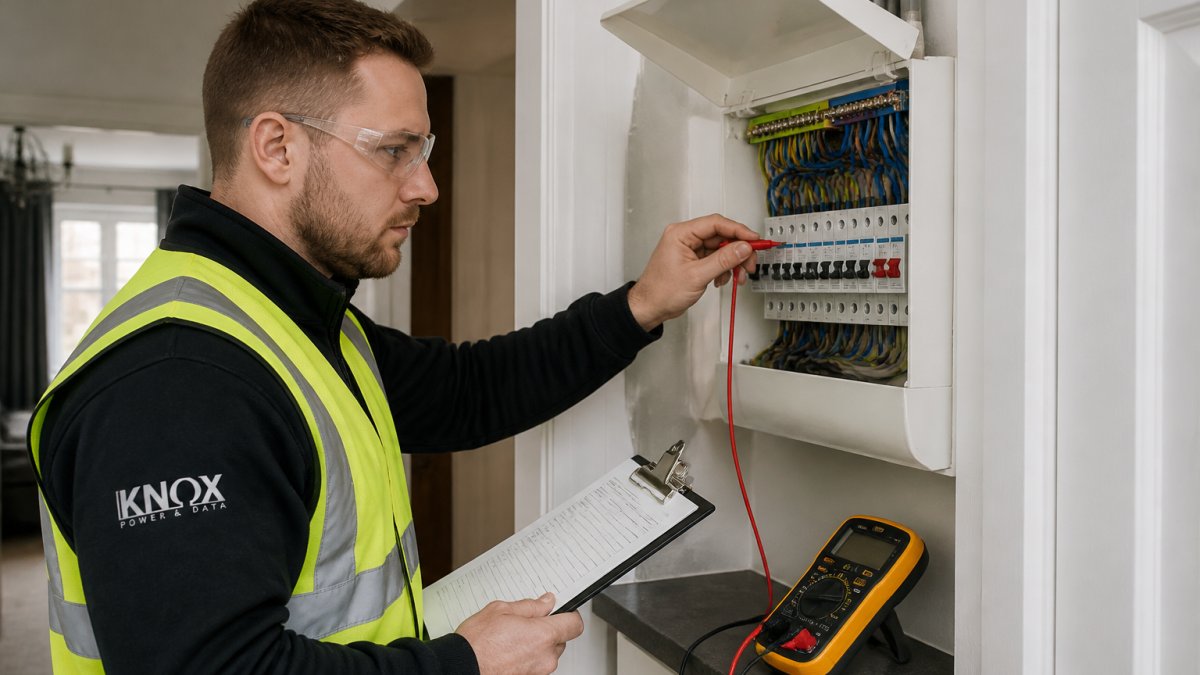
The inspection covers:
- Consumer unit (fuse box) condition and labelling
- Wiring and cable condition throughout the property
- Earthing and bonding systems
- Circuits and protective devices
- Fixed appliances and installations
The electrician assigns codes to any defects found:
- C1: Danger present. Remedial work required immediately.
- C2: Potentially dangerous. Remedial work required as soon as possible.
- C3: Improvement recommended.
- FI: Further investigation needed.
The report includes the inspection date, property details, circuits tested, safety device results, defect photos, remedial recommendations, the electrician's registration details and validity period.
A satisfactory report means no C1 or C2 codes and the property is safe for occupation.
EICR Cost for Landlords: Understanding Pricing and Budgeting
There is no single fixed EICR price: it's based on the testing work involved, not bedrooms alone. A small two-storey HMO with one consumer unit and six circuits is a very different job from a three-storey conversion with two consumer units, storage heaters and communal areas.
What a quote should be built from
A transparent EICR quote should itemise the following, or state the assumptions behind a single figure:
- Number of consumer units and distribution boards to be inspected
- Number of final circuits to be tested (lighting, sockets, immersion heaters, cookers, showers, smoke alarm supplies and communal circuits all count)
- Percentage of accessories to be sampled, the standard sampling approach means not every socket is removed, but the sample size should be stated
- Whether communal areas, shared kitchens, shared bathrooms and external lighting are included
- Access arrangements: keys, tenant liaison, loft access, locked risers and any areas requiring a second visit
Typical price ranges
What changes the final bill
- Property size and layout: more circuits, more boards and more floors mean more testing time.
- Age and condition of the installation: older wiring, rubber or lead-covered cables, and previous DIY alterations all slow the inspection down.
- Number of consumer units: HMOs converted from older houses often have a main board plus a landlord's board for communal areas, and each must be tested.
- Access and occupancy: occupied rooms, tenants working shifts and locked communal cupboards can force a return visit.
- Defects found: a C1 or C2 finding may require further investigation (an FI code) before the extent of the problem is known.
Budgeting approach for HMO portfolios
Treat the inspection as a fixed cost and remedial work as a contingency. Budget the inspection fee per property per five-year cycle, then hold a separate contingency for remedials, older conversions and DIY alterations should carry a larger one.
EICR Remedial Work: What Happens When Defects Are Found
If the EICR identifies defects, you must arrange remedial work to bring the installation up to standard.
C1 defects (danger present): Fix immediately.
C2 defects (potentially dangerous): Fix as soon as possible, usually within 28 days.
C3 defects (improvement recommended): Not urgent, but should be addressed within a reasonable timeframe.
Common remedial work includes:
- Replacing old consumer units
- Rewiring circuits or sections of the property
- Installing or repairing RCDs
- Fixing earthing and bonding systems
- Replacing damaged cables or conduit
After remedial work, the electrician must issue a completion certificate confirming the defects are fixed and the installation meets standards.
Choosing a Qualified Inspector and Next Steps
Most guides stop at "use a registered electrician". That is the minimum, not a selection method.
A verification checklist before you book
Work through these in order and keep a record of the answers:
- Registration and scope. Confirm the electrician is registered with a recognised competent person scheme, such as NAPIT, NICEIC, ELECSA or SELECT, and check the registration is current on the scheme's own register, not just on a website badge.
- Qualifications. Ask for BS 7671 18th Edition certification and a specific inspection and testing qualification (for example C&G 2391 or equivalent). General electrical qualifications alone do not demonstrate testing competence.
- Insurance. Request a current public liability certificate and check the cover level is appropriate for commercial work in occupied premises.
- Report quality. Ask to see a redacted sample EICR. A proper report includes circuit schedules, test results, defect codes with location and photographic evidence, not a one-page summary.
- HMO experience. Ask whether they are familiar with local authority licensing conditions in your area.
- Remedial capability. Confirm whether they can quote for and carry out remedial work, or whether you will need a separate contractor. Either is acceptable, but you need to know before the report lands.
- Turnaround. Ask when the report will be issued, a written timescale, not "soon".
- Terms. Confirm the quote is fixed, what happens if a return visit is needed, and whether the report fee is payable on completion.
Planning an HMO inspection so it happens in one visit
HMOs are harder to inspect than single-let houses, mostly because of access and scope. Before the visit:
- Map the consumer units. Conversions often have a main board plus a landlord's board for communal areas. List every board and its location so nothing is missed.
- List communal areas explicitly. Hallways, stairwells, shared kitchens, shared bathrooms, laundry rooms, external lighting and any landlord's supply must be in scope. Confirm in writing that they are included in the quote.
- Arrange access to every room. Give tenants written notice, agree a window when all rooms can be entered, and hold keys for any room that cannot be accessed. A locked bedroom means a return visit and often an extra charge.
- Clear the consumer unit area. Boxes, furniture and stored items in front of the board slow the inspection and can prevent safe isolation.
- Note anything unusual in advance. Storage heaters, immersion heaters, electric showers, PV panels, EV charge points and alarm supplies all add circuits and testing time.
After the report: a clear sequence
- Read the codes first. C1 means danger present, isolate and make safe immediately. C2 means potentially dangerous, arrange remedial work promptly. C3 is improvement recommended and can be planned. FI means further investigation is needed before the extent of the defect is known.
- Prioritise by code, not by cost. Fix C1s the same day, then C2s, then schedule C3s into planned maintenance.
- Get a written remedial quotation that references the defect codes and locations in the report.
- Keep evidence. Retain the original report, the remedial quotation, the invoice and the completion certificate together, licensing officers and insurers may ask for the full chain.
- Provide the certificate to tenants. Give a copy to each tenant and, where your local authority requires it, supply a copy on request.
- Retain records. Keep the report and remedial evidence for at least the period your local authority licensing conditions specify, commonly the life of the tenancy plus a further period, and never less than the five-year inspection cycle.
- Diarise the next inspection. Set the reminder from the date of the satisfactory report, not the date of the remedial work.
A note on local licensing conditions
Electrical safety duties under the private rented sector regulations apply across the sector, but HMO licensing conditions set by individual local authorities can add requirements, for example, specifying the form of certificate, requiring notification of remedial completion, or setting additional standards for communal areas.
Frequently Asked Questions
How often does an HMO need an electrical safety certificate?
HMOs must have an Electrical Installation Condition Report (EICR) every five years, or more frequently if the property is particularly old or shows signs of wear. The five-year inspection cycle is a legal requirement under the Private Rented Sector (Electrical Safety) Regulations 2020. Some local authorities may require more frequent inspections depending on the property's condition and age. Always check with your local authority, as HMO licensing conditions can vary by region.
What does an HMO EICR check include?
An EICR inspects all fixed electrical installations in an HMO, including consumer units, wiring, sockets, switches, and communal areas. The inspection identifies electrical hazards, defects, and fire risks. Inspectors assign fault codes: C1 for dangerous defects requiring immediate action, C2 for potentially dangerous conditions, C3 for minor issues, and FI for further investigation. The report confirms whether the installation is satisfactory or unsatisfactory, and recommends remedial work where needed.
What is EICR remedial work and how much does it cost?
Remedial work involves fixing electrical defects identified in the EICR report. C1 defects must be corrected immediately. For accurate pricing on remedial work specific to your property, contact a qualified electrician or NAPIT-registered professional who can assess the defects and provide a detailed quote.
Who is qualified to carry out an HMO electrical inspection?
Only a competent person qualified to BS 7671 18th Edition standards can carry out an EICR. Look for electricians registered with recognised bodies such as NAPIT, NICEIC, or the Electrical Contractors' Association (ECA). Such registrations confirm the inspector has the knowledge and experience to identify electrical hazards, assess compliance, and produce a valid certificate that satisfies legal requirements and local authority HMO licensing conditions.
Electrical safety for HMO properties is a legal requirement that protects your tenants and your business. Regular EICRs, prompt remedial work, and proper record-keeping keep you compliant and reduce your liability risk. Knox Power & Data provides professional EICR inspections and remedial work backed by NAPIT registration and BS 7671 certification. Get a quote today and ensure your properties meet all electrical safety standards.