 blog
7 Signs a 1950s House Needs a Full Rewire
Last Updated: October 29, 2026
Quick Summary
Rewiring a 1950s house is usually worth it when the existing wiring is perished, overloaded or failing, because the risk is in the wiring rather than the age of the property. Start with an EICR, which records whether the installation is unsafe or non-compliant. Partial rewires only make sense where the retained wiring is confirmed sound.
- Look for cloth-covered or rubber-insulated cables, scorch marks, and repeated trips as warning signs.
- A partial rewire is only defensible if an EICR shows no C1 or C2 observations on the retained circuits.
- Ask for EICR observations in writing, citing regulation numbers, before agreeing to a partial rewire.
- Get a site-specific quote with the same scope, covering points, consumer unit, making good and certification.
- Treat rewiring as a safety and compliance decision first, and sale readiness second.
Table of Contents
- Why 1950s Wiring Is Different From Modern Installations
- Signs a House Needs Rewiring
- Full House Rewire vs Partial Rewire: What Actually Makes Sense
- What Does Rewiring a 1950s House Cost?
- How Long Does a House Rewire Take?
- Insurance, Resale Value and Building Regulations
- Booking an EICR and Your Next Step With Knox Power & Data
- Frequently Asked Questions
Most owners of a 1950s house eventually face the same question: is it worth rewiring a 1950s house, or can the existing system be patched along? The honest answer depends on the condition of the wiring, not on the age of the property alone.
Insurers and mortgage lenders often treat rewiring as a condition attached to cover or lending on older properties. Rewiring is frequently identified as a necessary step to satisfy those requirements for properties of this era. That alone makes the question more than academic. rewiring guidance for older homes
Why 1950s Wiring Is Different From Modern Installations
Wiring installed in the 1950s was designed for a very different home. Houses had few sockets, light fittings on single circuits, and little in the way of electrical appliances. Modern homes run kettles, computers, chargers, heaters and entertainment systems all at once.
Original systems were not designed to handle that load. The fabric itself also ages, which leads directly to the warning signs below.
Signs a House Needs Rewiring
The clearest evidence is usually visible or measurable. Check for these signs before deciding anything.
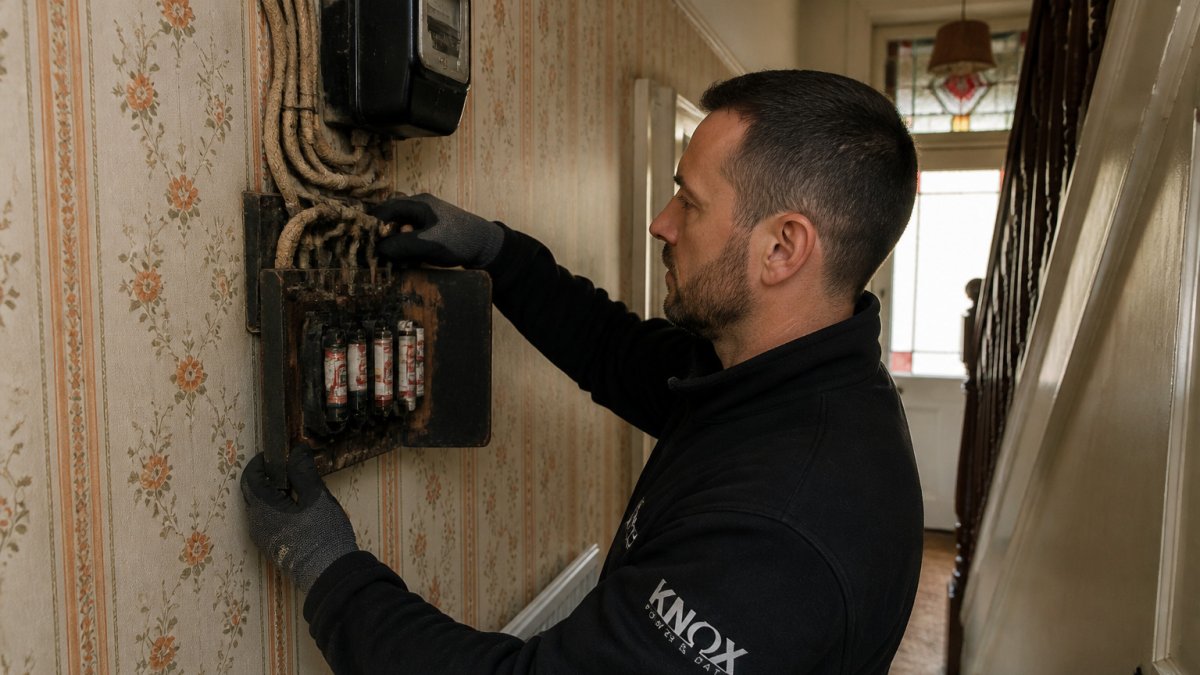
- Cloth-covered or rubber-insulated cables
- Scorch marks around sockets or switches
- A fuse box rather than a modern consumer unit
- Lights that dim when appliances start
- Sockets that feel warm or smell of burning
- Repeated fuse or breaker trips
- Too few sockets, leading to daisy-chained extension leads
!An electrician in work gloves inspecting an old fuse box with cloth-covered cables in a period hallway of a 1950s home
Rubber insulation and perished cables
Rubber insulation becomes brittle with age. Once it cracks or crumbles, the conductor inside can be exposed, which raises the risk of short circuits and shocks. Perished wiring is one of the main reasons an older system stops being safe, even when nothing has visibly failed yet.
Tripping circuits and flickering lights
Circuits that trip often, or lights that flicker without an obvious cause, are signs of a system under strain. They can point to loose connections, overloaded circuits, or deteriorating insulation. Treat them as a warning rather than an inconvenience.
The clearest evidence is usually visible or measurable, so check for these warning signs before deciding anything.
| Sign | What it suggests | What to do |
|---|---|---|
| Cloth-covered or rubber-insulated cables | Ageing insulation | Get an EICR |
| Scorch marks around sockets or switches | Overheating or arcing | Stop using the point and get it checked |
| Fuse box rather than consumer unit | Outdated protection | Assess the whole system |
| Lights dim when appliances start | Strained circuits | Get an EICR |
| Sockets feel warm or smell of burning | Failing connections | Turn off and call an electrician |
| Repeated fuse or breaker trips | Overload or fault | Investigate the cause |
| Too few sockets, daisy-chained leads | Circuits not designed for modern load | Plan additional circuits |
Full House Rewire vs Partial Rewire: What Actually Makes Sense
A full rewire replaces the whole installation: every circuit, every cable run, the consumer unit, earthing and bonding. A partial rewire replaces only the worst sections. Partial work can be sensible where the rest of the wiring is sound, but it is not a shortcut for a system that is failing throughout.
The partial rewire myth
A common belief is that you can 'patch' the dangerous bits and leave the rest. In practice, a partial rewire is only defensible when the remaining wiring is genuinely sound and compatible with the new work. Three problems tend to undermine patching:
- Mixed cable types. If original rubber-insulated or lead-sheathed cable remains in the walls, a new circuit joined to it inherits the old cable's failure risk. An electrician cannot certify a circuit as safe when part of it is perished.
- Earthing and bonding. Older installations often lack adequate main protective bonding or have high earth loop impedance. Adding a modern circuit to an inadequate earthing system can make the whole installation non-compliant, even if the new cable itself is fine.
- Consumer unit and circuit protection. A modern consumer unit with RCBOs will not protect a circuit whose old cable insulation is breaking down. The protection device trips on fault current, but the underlying deterioration remains.
What the regulations actually require
Work on existing installations must comply with BS 7671 (the IET Wiring Regulations, 18th Edition) (BS 7671 - Requirements for Electrical Installations). That does not mean every older circuit must be brought up to current standards, but it does mean new work must not leave the installation less safe than before.
Many electrical works in homes are subject to Building Regulations notification requirements (Electrical safety: Approved Document P). Check the current position with your local authority or the official government guidance before work starts.
When partial makes sense
Partial work is reasonable where:
- The existing wiring is confirmed sound by an EICR with no C1 or C2 observations on the circuits being retained.
- The partial work is an addition (for example, a kitchen refurbishment) rather than a repair of failing cable.
- The earthing and bonding are already adequate, or are upgraded as part of the job.
Where the inspection finds perished insulation throughout, piecemeal work usually costs more in the long run because you keep paying to revisit the same system. A single full rewire is often cheaper than three partial rewires spread over a decade, and it produces one certificate rather than a patchwork of them.
Assessment comes first. Some older electrical systems are cleaner and more carefully installed than later, cheaper additions. A professional inspection is recommended before assuming a full rewire is mandatory. Where the existing wiring is sound, a targeted replacement may be enough.
What Does Rewiring a 1950s House Cost?
Costs vary with the size of the property, the number of circuits, how much access is available, and how much making good is involved. Pricing depends on the size of the property, the number of circuits, access and making good, so a site-specific quote is needed. For current pricing and a quote for your property, visit the Knox Power & Data website.
What drives the price
Rather than quote a single national average, it helps to understand the variables an electrician is pricing:
- Property size and room count. A two-bedroom terraced house needs fewer circuits and cable runs than a four-bedroom detached house. Most of the cost is labour and cable, both of which scale with the number of points.
- Number of sockets, switches and light fittings. A 1950s house often has two or three sockets per room.
- Consumer unit and circuit protection. A modern board with RCBOs, surge protection and spare ways is a material line item in its own right.
- Access and making good. Lifting and relaying floors, chasing walls, and repairing plaster after cable runs add labour. A house with solid floors and hard plaster costs more to rewire than one with suspended timber floors and plasterboard.
- Earthing and bonding. Upgrading main protective bonding to gas and water, and improving earth loop impedance, is often necessary and is priced separately.
- Certification and notification. An EICR before work, an Electrical Installation Certificate on completion, and Building Regulations notification where required are all part of a compliant quote.
How to compare quotes
Be wary of national averages. A figure from a general cost guide may not reflect a 1950s house in West Yorkshire, where access, plaster condition and the number of rooms differ. Get a site-specific quote, and make sure each quote covers the same scope: number of points, consumer unit specification, making good, certification and notification. A cheaper quote that excludes making good or certification is not cheaper.
Resale value versus cost
Rewiring is generally treated as a safety and compliance matter rather than an improvement that adds value in the way a new kitchen can. Treat it as a safety and compliance decision first, and as a sale-readiness measure second. The practical return is that the sale proceeds without a renegotiation over electrical defects, and the property is mortgageable and insurable on normal terms.
How Long Does a House Rewire Take?
A full rewire is a disruptive job, and timing depends on the size and layout of the house. Floors may need to be lifted, and plaster may need repair. Partial rewires are shorter, but the same planning applies: confirm the scope, agree access, and expect some making good afterwards.
Always ask for a written programme before work starts. It should show what will be done, in what order, and when the power will be off.
Insurance, Resale Value and Building Regulations
Insurance and lending can be practical considerations. A house with unsafe wiring may face restricted cover or conditions attached to a mortgage. Keep records of any electrical work and certification.
Building regulations govern electrical work in homes, and most new circuits and consumer unit changes need to be certified. Your electrician should provide the relevant certification on completion. Confirm this before paying the final invoice.
Resale value is harder to pin down, and a certified modern installation may reassure buyers. Treat rewiring as a safety and compliance decision first, and as a sale-readiness measure second.
Booking an EICR and Your Next Step With Knox Power & Data
If you are unsure what condition your wiring is in, start with an Electrical Installation Condition Report (EICR). It tests the installation and records anything unsafe or non-compliant. You can find out more about EICR checks on the Knox Power & Data website.
Knox Power & Data is NAPIT registered (Member No. 69848), fully insured, and qualified to BS 7671 18th Edition. To discuss your house and get a quote, get in touch with our team today.
Frequently Asked Questions
Do old houses need rewiring?
Not every older house needs a full rewire, but houses wired in the 1950s with rubber or early PVC insulation often do. The practical test is an Electrical Installation Condition Report (EICR) carried out by a registered electrician. It grades any defects and tells you whether the wiring is safe to keep, needs remedial work, or should be replaced. Many insurers and mortgage lenders also ask for an EICR, so a clean report can matter as much as the wiring itself.
How can I tell if a 1950s house needs rewiring?
Look for warning signs such as rubber-coated cables that feel brittle or crumble, lights that dim when appliances start, circuits that trip often, scorch marks around sockets, and a fuse box rather than a modern consumer unit. These point to deterioration or overloading. Even if none are present, an EICR is the reliable way to confirm the condition of the insulation, earthing and bonding behind the walls.
Can you rewire part of a house instead of doing a full rewire?
Yes. A partial rewire can replace the worst circuits, such as the kitchen or a damaged floor, while leaving sound wiring in place. This can lower the upfront cost. However, mixing old and new wiring needs careful planning, and in some cases it only postpones the bigger job. A registered electrician can test the existing circuits and advise whether a partial approach is safe for your property.
Is it safe to live in a house while it is being rewired?
In most cases yes. Work is usually staged room by room, and power is switched off only on the circuit being worked on. Expect some disruption, including chasing into walls, dust and temporary loss of sockets. Ask your electrician to explain the sequence, how they will keep key circuits such as the fridge and heating running, and how the property will be tested and certified on completion.