 ultimate-guide
EV Charger Installation Grant Guide 2026: Costs & Eligibility
Table of Contents
- What the 2026 EV Charger Installation Grant Covers
- Eligibility Criteria: Homeowners, Renters and Flat Owners
- The Workplace Charging Scheme and Landlord Applications
- How to Apply: Grant Application Process Step by Step
- EV Charger Installation Costs UK: What You Actually Pay
- EV Charger Load Management Systems Explained
- NAPIT Certified EV Installer Benefits and Site Survey
- After Installation: Maintenance, Smart Charging and V2G
- Frequently Asked Questions
Last Updated: September 25, 2026
What the 2026 EV Charger Installation Grant Covers
The 2026 ev charger installation grant guide 2026 landscape is defined by two schemes: the Homecharge scheme for homeowners and the Chargepoint Grant for renters and flat owners. Both reduce the upfront cost of buying and installing a compliant charging point at your property.
Homecharge and Chargepoint Grant schemes at a glance
| Scheme | Who it's for | What it covers | Key condition |
|---|---|---|---|
| Homecharge | Homeowners with off-street parking | Chargepoint unit + installation contribution | Must own or have permission for the property |
| Chargepoint Grant | Renters and flat owners | Chargepoint unit + installation contribution | Landlord permission required |
| Workplace Charging Scheme | Businesses and charities | Voucher toward chargepoint costs | Must have dedicated staff parking |
GOV.UK guidance on electric vehicle chargepoint grants
Eligibility Criteria: Homeowners, Renters and Flat Owners
Eligibility for the ev charger installation grant guide 2026 comes down to three things: property ownership status, off-street parking, and proof you meet the scheme's conditions. If any one is missing, the application stalls.
Off-street parking, landlord permission and proof of ownership
For homeowners, the requirement is straightforward: you need a dedicated off-street parking space, such as a driveway or garage, where the chargepoint will be installed. The property must be your primary residence, and you'll need to provide proof of ownership.
- Proof of property ownership or tenancy agreement
- Written landlord permission (renters and flat owners)
- Evidence of a dedicated off-street parking space
- Confirmation the property is your primary residence
The Workplace Charging Scheme and Landlord Applications
Businesses and landlords access funding through the Workplace Charging Scheme, which provides a voucher toward the cost of purchasing and installing chargepoints. The scheme is aimed at organisations with dedicated staff parking, and landlords can apply on behalf of their tenants.
How to Apply: Grant Application Process Step by Step
The application process follows a fixed sequence, and getting the order wrong is the fastest way to a rejection. The steps below reflect how the Homecharge and Chargepoint Grant schemes actually run in practice, including the parts most guides skip.
Before you start: the readiness check
Most rejections happen before the form is even opened. Run this check first.
- You have a dedicated off-street parking space (driveway, garage, or a legally assigned bay, not a shared or unallocated communal space)
- The property is your primary residence
- You can evidence ownership (title deeds, mortgage statement, or council tax bill) or tenancy
- Renters and flat owners: written landlord permission is in hand, not promised
- Your chosen installer is approved under the relevant scheme (they must be, or the claim fails regardless of the hardware)
- You have not already installed the chargepoint, approval must come first
The seven-step sequence
- Confirm eligibility against the scheme criteria for your property type. If you rent or own a flat, confirm the parking space is allocated to your property, not a communal bay.
- Obtain written landlord permission if you rent or own a flat. An email confirming consent is usually sufficient, but it must be in writing and retained.
- Choose an approved installer and get a quote. The installer must be registered under the relevant scheme. Ask for the quote to itemise the chargepoint unit, the installation labour, and any cable run or groundworks separately.
- Complete the online application with proof of ownership or tenancy, evidence of the parking space, and landlord permission where applicable.
- Receive approval before installation begins. Do not book the install date until the approval is confirmed in writing.
- Have the chargepoint installed and certified. The installer issues the electrical certification and the scheme paperwork.
- Submit the grant claim with the installation paperwork, certification, and any invoice evidence the scheme requires.
How long it takes and what can delay it
A common pattern is two to four weeks from application to approval, but the clock only starts once the documentation is complete. The three delays that come up most often are:
- Landlord permission not in writing, a verbal yes is not accepted, and chasing a signature can add a week or more.
- Parking evidence that doesn't prove allocation, a photo of a communal car park does not establish a dedicated space. A lease clause or allocation document does.
- Installer not approved under the scheme, this is only discovered at claim stage, by which point the installation is already done.
What happens after approval
Approval is not the end of the paperwork. Keep the approval reference, the installer's certification, and the final invoice together. If the scheme later queries the claim, these are the three documents that resolve it. Most installers will handle the claim submission on your behalf, but you remain responsible for the accuracy of the eligibility information you supplied.
GOV.UK guidance on electric vehicle chargepoint grants
EV Charger Installation Costs UK: What You Actually Pay
EV charger installation costs UK vary widely depending on cable runs, whether your consumer unit needs upgrading, and the type of chargepoint you choose. Rather than quote a single figure, it's more useful to understand what drives the cost, and which of those drivers the grant actually offsets.
What the grant covers versus what you pay
The grant contributes toward the chargepoint unit and a portion of the installation. It does not cover:
- Electricity supply upgrades, if your consumer unit or main fuse needs replacing to support the chargepoint, that is a separate cost.
- Groundworks, trenching across a garden, lifting and reinstating paving, or ducting for a long cable run.
- Load management hardware where it is not bundled into the chargepoint.
- Any remedial work identified at site survey, such as earthing improvements.
The four cost drivers, in order of impact
1. Cable run distance. This is usually the largest variable. A short run from a consumer unit on the same wall as the chargepoint is straightforward. A run across a driveway, under a path, or to a detached garage adds labour, cable, and often conduit or ducting. Ask your installer to price the cable run as a separate line item, on longer runs, the labour and materials for the cable frequently exceed the cost of the chargepoint itself.
Tethered vs untethered, and why VAT matters on the quote
When comparing quotes, always ask for a VAT inclusive figure. Domestic chargepoint installation is usually charged at the reduced rate, but the rules depend on the property and the work involved. A quote that excludes VAT is not comparable to one that includes it, and the difference can be material on a job with significant labour.
A realistic way to budget
Rather than anchor on a single national figure, budget in three tiers: a straightforward install on a modern property with a short cable run and spare consumer unit capacity; a mid-tier install with a longer run or a consumer unit upgrade; and a complex install with groundworks or a supply upgrade. The grant reduces the first two meaningfully. The third is where the grant's contribution becomes a smaller proportion of the total, because the excluded items, groundworks and supply upgrades, are doing the heavy lifting on cost.
HMRC guidance on VAT for energy-saving materials and chargepoints
EV Charger Load Management Systems Explained
EV charger load management systems explained simply: they monitor your home's total electricity demand and reduce the chargepoint's draw when other appliances are running, preventing your main fuse from tripping.
IET guidance on electric vehicle charging installations
NAPIT Certified EV Installer Benefits and Site Survey
A NAPIT certified EV installer gives you a documented paper trail: the work is tested, certified, and compliant with BS 7671. That certification matters both for the grant claim and for your home insurance.
After Installation: Maintenance, Smart Charging and V2G
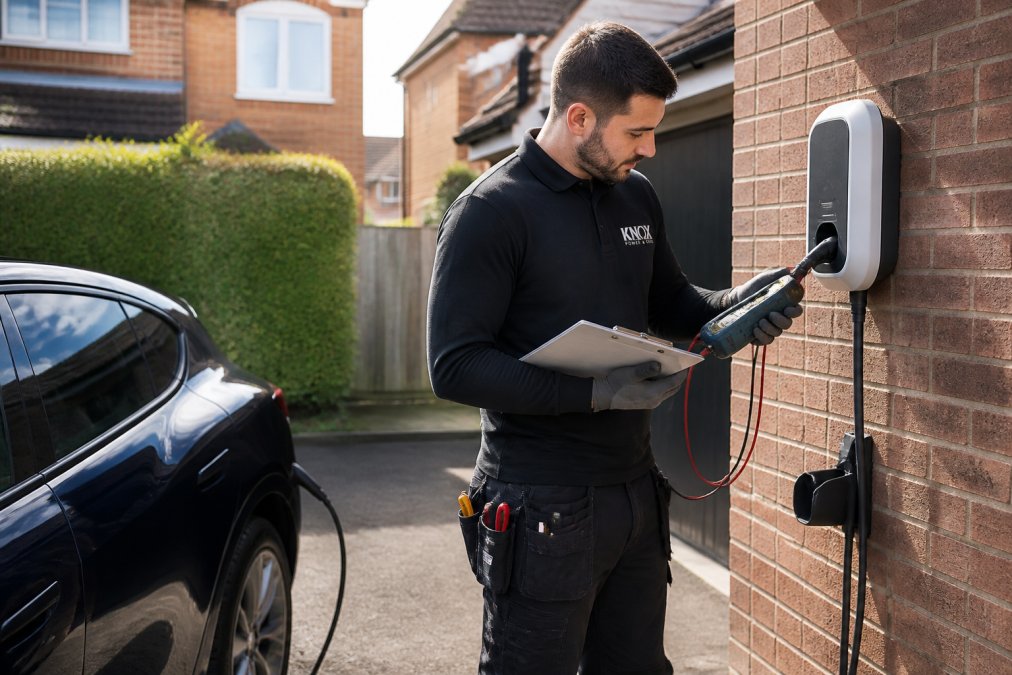
Post-installation, a chargepoint needs very little maintenance, but a periodic visual check and an occasional test of the unit and cable will catch wear before it becomes a fault. Smart charging integration lets you schedule charging for off-peak energy tariffs, cutting running costs.
Frequently Asked Questions
Can I get a grant to install an EV charger at my home?
You can apply for an EV charger grant if you own or rent a property with dedicated off-street parking, use a qualifying electric vehicle, and install an OZEV-approved chargepoint through a registered installer. Renters need landlord permission, and flat owners must have their own designated parking space. The grant is capped per installation and covers part of the unit and fitting cost, not the full amount. Check current scheme rules before booking, as funding can close or change.
How much does an electrician charge to install an EV charger in the UK?
EV charger installation costs UK vary with cable run length, whether your consumer unit needs upgrading, and whether the charger is tethered or untethered. A straightforward install on a modern board costs less than one requiring a new circuit, trenching, or load management hardware. Knox Power & Data prices each job after a site survey, so you get a fixed, VAT inclusive figure rather than an estimate that shifts mid-job. Request a quote for your property.
Do I need a smart charger to qualify for government funding?
Yes. Grant-funded chargepoints must be smart, meaning they can receive and respond to signals, schedule charging to off-peak windows, and meet the relevant EVSE technical standards. This matters because smart charging integration lets you pair the unit with a time-of-use energy tariff and cut running costs. A basic untethered unit without smart functionality will not pass the grant claim, so confirm the model before ordering.
Does an EV charger installation require a building regulations certificate?
Not a building regulations certificate in the usual sense, but the work must comply with BS 7671 and be notified under the relevant competent person scheme where it applies. Your installer should issue an Electrical Installation Certificate and, where required, a Building Regulations Compliance Certificate through their registration body. Knox Power & Data is NAPIT registered, so notifications and certification are handled as part of the job and you receive the paperwork for your records and insurer.
What is the difference between the Workplace Charging Scheme and home grants?
The Workplace Charging Scheme is a voucher-based government incentive for businesses, charities and public sector bodies, covering a set number of sockets per applicant across their sites. Home grants are aimed at individual homeowners, renters and landlords with off-street parking. If you run a business with staff parking, you can often claim the workplace voucher for staff and fleet use, while a separate home grant covers your own driveway charger.
How do load management systems help if my supply is limited?
Load management systems monitor your home's total demand and reduce or pause charging when other appliances are drawing power, so the charger never pushes the supply past its rating. This avoids an expensive supply upgrade in many properties and lets a 7kW charger run safely on a 60A or 80A cutout. A site survey confirms whether dynamic load management is needed and which hardware suits your consumer unit.
The gap between a compliant, grant-funded installation and an expensive mistake usually comes down to preparation: eligibility, documentation, and a survey done properly. Knox Power & Data handles the full process, from NAPIT-registered installation to BS 7671 certification and smart charging setup, with transparent pricing and no surprises. Get a quote from Knox Power & Data and install your chargepoint with confidence.