 how-to
What NAPIT Registration Means: A Homeowner's Guide
Table of Contents
- What NAPIT Registration Actually Means
- NAPIT Registration Requirements and Competence Standards
- How to Check NAPIT Registration and Verify Your Electrician
- NAPIT Electrical Certificates and What You Receive After Work
- NAPIT vs NICEIC: Practical Differences for Homeowners
- What NAPIT Registration Does Not Guarantee
- Frequently Asked Questions
Last Updated: October 12, 2026
What NAPIT Registration Actually Means
NAPIT registration means an electrician is a member of a Government-authorised competent person scheme and has demonstrated they meet defined standards for electrical safety, qualifications, and practical skills.
This matters because uncertified electrical work creates serious safety risks, faulty wiring causes thousands of domestic fires annually.
At Knox Power & Data, we're NAPIT-registered (Member No. 69848), which means every electrical installation we complete is certified to current Building Regulations. That certification stays with your property and protects you if you ever need to prove compliance for insurance, mortgage, or resale purposes.
NAPIT Registration Requirements and Competence Standards
To become NAPIT-registered, an electrician must meet strict criteria across qualifications, practical skills, and ongoing compliance.
Qualifications and Practical Skills
NAPIT requires relevant electrical qualifications. The standard is the Level 3 Diploma in Electrical Installations (or equivalent), covering electrical theory, safety principles, and installation practices.
Beyond qualifications, NAPIT assesses practical competence, the electrician must show they can perform work safely and correctly, not just pass an exam.
Continuing competence is mandatory: members must complete ongoing professional development and submit to regular audits and inspections. If training lapses or work quality drops, the scheme can suspend or withdraw membership.
Government-Authorised Standards and UKAS Accreditation
NAPIT operates as a Government-authorised competent person scheme under the Building Regulations, formally recognised by regulatory authorities as meeting defined quality standards (Competent person scheme - current schemes and how schemes are authorised).
Accreditation is not automatic. NAPIT must regularly demonstrate that members are competent, that assessment procedures are fair and thorough, and that it investigates complaints and acts against members who breach standards, or it could lose its accreditation and authority to certify work.
How to Check NAPIT Registration and Verify Your Electrician
Before hiring an electrician, verify they're registered and check what work they're approved to carry out.
Using the NAPIT Directory
NAPIT maintains a public directory of registered members on its website. Search by postcode, name, or company name to confirm current registration, and check the member's approval scope, the specific types of electrical work they're authorised to certify.
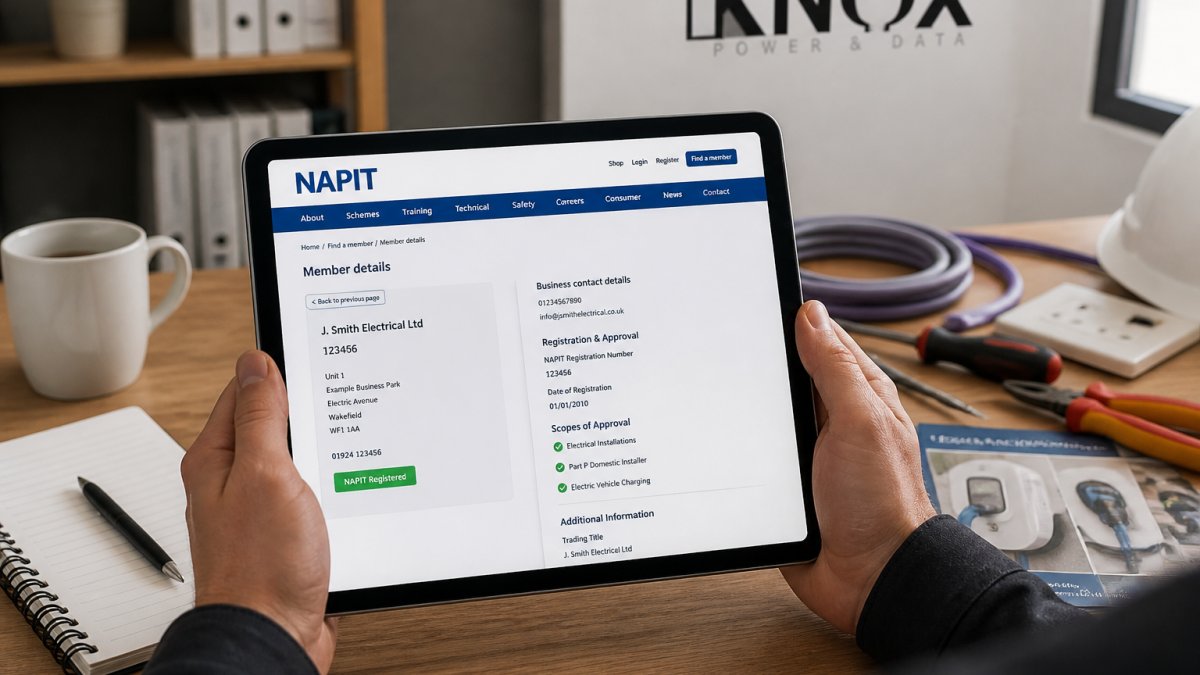
When you search, look for:
- Current registration status (active, not expired or suspended)
- Approval scope that covers the work you need (e.g., domestic installations, consumer unit replacements, new circuits)
- The member number and registration date
If an electrician claims NAPIT registration but doesn't appear in the directory, they're not registered. Don't proceed, this is a major red flag.
What to Look for in a Member's Work Scope
NAPIT registration is not a single, unlimited approval, each member is approved for specific work within their competence. A member might cover domestic installations but not specialist work like solar panels or EV charger wiring. Work outside their approval scope can't be legally self-certified, so you'd need a separate Building Regulations inspection.
Before booking, confirm their approval scope matches your job. Ask directly: "Are you approved by NAPIT to carry out [specific work]?" If they're vague, ask to see their NAPIT certificate or check their directory entry.
NAPIT Electrical Certificates and What You Receive After Work
After a NAPIT-registered electrician completes notifiable work, you should receive an electrical installation certificate (or a minor works certificate for smaller jobs), certifying the work meets Building Regulations standards and is safe to use. But the certificate is only part of the paperwork trail, understanding the full process separates a properly documented job from one that could cause problems later.
The certificate itself
The certificate includes:
- Details of the work completed
- Test results confirming the installation is electrically safe
- The electrician's name, NAPIT membership number, and signature
- A unique certificate number for future reference
- The applicable British Standard, typically BS 7671 (the IET Wiring Regulations) (BS 7671 - Requirements for Electrical Installations)
This certificate proves to your insurer, mortgage lender, or future buyers that the work was done properly and certified. Keep it safe, ideally with your property deeds.
The Building Regulations notification route
For notifiable work in England and Wales, the NAPIT-registered electrician self-certifies compliance through the scheme, and NAPIT notifies the local authority building control (LABC) on your behalf. Most homeowners never see this step, but it's what makes the work legally compliant.
Within a few weeks of completion, you should receive one of the following:
- A Building Regulations compliance certificate issued by NAPIT, confirming the work has been registered
- A building control notification from the local authority, depending on the scheme's process
When selling your home, your solicitor will typically ask for this evidence during conveyancing. A missing compliance certificate can delay a sale or trigger an indemnity policy requirement.
What to do if the certificate is missing
If an electrician completes notifiable work without providing a certificate, they've either skipped proper testing or aren't properly registered. Either way, you're at risk.
Homeowners often discover the problem months or years later, during a house sale or insurance claim. If that happens:
- Check the NAPIT directory to confirm whether the electrician is still registered and whether their approval scope covered the work.
- Contact NAPIT directly with the member number and job details. The scheme holds records of certificates it has issued.
- Contact your local authority building control team. If the work was notifiable and no notification was made, they can advise on regularisation, a formal process to certify work after the event. This usually involves an inspection and a fee.
- Do not rely on a verbal assurance that the work is compliant. Without the paperwork, you have no documented proof.
Why the paperwork matters beyond compliance
Registration isn't a guarantee of perfect workmanship, but it is a guarantee of accountability. The certificate and compliance notice are the evidence trail that makes it enforceable. Without them, your options for redress are limited, and you may face unexpected costs when you sell, remortgage, or claim on insurance.
NAPIT vs NICEIC: Practical Differences for Homeowners
NICEIC is another Government-authorised competent person scheme, similar to NAPIT. Both assess competence, require ongoing training, and allow members to self-certify notifiable domestic work. For homeowners the practical difference is minimal, both provide the same legal protection and certification, but understanding how they operate helps you verify a member and set expectations.
What is genuinely the same
- Both are authorised under the Building Regulations to operate competent person schemes.
- Both require members to hold relevant qualifications and demonstrate practical competence.
- Both carry out ongoing assessments and inspections of members' work.
- Both provide a complaints and dispute resolution process.
- Both allow members to self-certify notifiable work and notify the local authority.
Where they differ in practice
- Membership size and availability: NICEIC has a larger membership base, so you may find a NICEIC-registered electrician more easily in some areas. NAPIT's membership is smaller but still substantial, particularly among smaller firms and sole traders.
- Assessment approach: The schemes use slightly different criteria and visit frequencies, though both meet the Government's minimum standards. The practical effect for homeowners is negligible.
- Scope of approval: Both approve members for specific work categories. A member of either may cover domestic installations but not specialist work such as solar PV, battery storage, or EV charge point installation. Always check the individual member's scope, not just the scheme logo.
- Cost: Membership fees differ, but this rarely affects what you pay, pricing is set by the contractor, not the scheme.
- Dispute resolution: Both have complaints procedures, but processes and timescales vary slightly. Check the scheme's published process before escalating.
How to verify a member of either scheme
Whichever scheme an electrician claims to belong to, verification is the same:
- Check the official directory. Both NAPIT and NICEIC maintain public searchable directories. Search by postcode, name, or company name.
- Confirm current status. Look for active registration, not expired, suspended, or withdrawn.
- Check the approval scope. Confirm the member is approved for the specific type of work you need. A general domestic approval does not automatically cover every job.
- Ask for the member number. A genuine member will have no difficulty providing it. Cross-check it against the directory entry.
- Ask what certificate you will receive. A registered member should be able to explain the certificate and the Building Regulations notification process clearly.
What matters more than the scheme
What matters more is that the electrician is approved for your specific work, has good local reviews, and can explain the certification and notification process in plain English. Vagueness about registration, scope, or paperwork is a warning sign regardless of the scheme they claim.
What NAPIT Registration Does Not Guarantee
NAPIT registration provides important protections, but it's not a guarantee of perfect work or a problem-free future.
Registration guarantees:
- The electrician has met defined competence standards
- The work has been tested and certified to Building Regulations
- The scheme will investigate complaints and take action if standards are breached
- You have a clear dispute resolution pathway if something goes wrong
Registration does NOT guarantee:
- The electrician will arrive on time or finish by the promised date (schedule reliability is not part of the scheme's scope)
- The work will be perfect or problem-free for the rest of your life
- The electrician will be friendly, responsive, or easy to work with
- The price will be competitive (registration doesn't control pricing)
- The electrician will handle non-notifiable work to the same standard (NAPIT only covers notifiable work)
NAPIT membership is about technical competence and safety certification, not customer service or value for money.
If you dispute quality or service, NAPIT's complaints process investigates whether the work met Building Regulations standards, not disagreements about price, timescale, or behaviour.
Electrical safety is non-negotiable for your home and family. NAPIT registration gives you documented proof that the work has been carried out by someone assessed as competent and that the installation has been tested to current safety standards.
Frequently Asked Questions
What does NAPIT registration mean for homeowners?
NAPIT registration means an electrician has demonstrated competence, holds relevant qualifications, and is authorised to self-certify notifiable domestic electrical work under Building Regulations. Members must comply with BS 7671 standards and pass annual assessments. Registration does not guarantee the quality of every job, but it does mean the electrician operates under a Government-authorised scheme with accountability and insurance requirements.
How can I verify a NAPIT-registered electrician's credentials?
Use the NAPIT online directory on their website to search by name, postcode, or membership number. The directory shows each member's work scope, approved installation types, and whether they can self-certify notifiable work. You can also request their membership certificate and ask for evidence of current insurance and BS 7671 18th Edition qualifications before booking.
Is NAPIT registration the same as NICEIC?
No. Both are Government-authorised competent person schemes, but they are separate organisations with different membership criteria and assessment processes. NAPIT and NICEIC both allow members to self-certify notifiable domestic electrical work, but membership requirements and annual fees differ. Either scheme provides credible assurance, but you cannot assume an electrician is registered with both.
What should I receive after a NAPIT-registered electrician completes notifiable work?
You should receive a signed electrical installation certificate (or minor works certificate if applicable) that confirms the work complies with Building Regulations. The certificate includes details of the work, test results, and the electrician's declaration that the installation is safe. This certificate is essential for your property records and may be required if you sell or let your home.