 how-to
Is NAPIT Registration Legally Required? 2026 Guide
Table of Contents
- Is NAPIT Registration Legally Required? The Short Answer
- Part P Building Regulations Compliance: What the Law Actually Says
- How to Verify an Electrician's Registration in 3 Steps
- Electrical Installation Condition Report Requirements for Landlords
- What NAPIT Registration Means for Homeowners and Landlords
- Legal Liability for Homeowners Using Unregistered Electricians
- Frequently Asked Questions
Last Updated: September 23, 2026
Is NAPIT Registration Legally Required? The Short Answer
No, NAPIT registration is not a legal requirement in itself. No law compels an electrician to join NAPIT or any other competent person scheme. This guide from Knox Power & Data explains what the law actually demands, where registration fits in, and why the practical answer is more complicated than a simple no.
The distinction matters because two separate duties are often confused. The first is a legal duty to make sure notifiable work complies with Part P of the Building Regulations. The second is a commercial reality: membership of a government-approved scheme is the simplest route to proving that compliance, and it is frequently demanded by insurers, lenders and landlords.
Below, we break down what Part P requires, how self-certification differs from a Building Control notification, and how to verify any electrician's registration in three steps.
Part P Building Regulations Compliance: What the Law Actually Says
Part P is the section of the Building Regulations that applies to electrical installations in dwellings. It sets a statutory requirement: electrical work in homes must be designed and installed to BS 7671, the wiring regulations, and must be tested and certified.
Notifiable vs Non-Notifiable Work
Notifiable work must be reported to a local authority. It typically includes new circuits, consumer unit replacements, and most work in special locations such as bathrooms and kitchens. Non-notifiable work, such as like-for-like replacements of accessories, does not need reporting.
Self-Certification vs Building Control Notification
There are two lawful ways to notify notifiable work:
- Self-certification through a competent person scheme. A registered electrician completes the work, tests it, and issues a certificate, then notifies the local authority on the customer's behalf. This is where NAPIT registration does its work.
- Building Control notification. The homeowner or contractor submits a building notice or full plans application to the local authority before work starts, and the council inspects and certifies it. This route is slower and usually costs more.
Both routes satisfy the statutory requirement. The scheme route is faster and produces the certificate that buyers, lenders and insurers expect to see.
How to Verify an Electrician's Registration in 3 Steps
Verifying registration takes minutes and prevents months of problems. Every government-approved scheme, including NAPIT, maintains a public register, and the official register of competent person schemes lists the approved bodies.
| Check | What to Look For | Why It Matters |
|---|---|---|
| Membership number | Traceable, current | Confirms active registration |
| Register entry | Name matches the trader | Prevents borrowed credentials |
| Scope of work | Covers your job type | Ensures valid certification |
| Insurance | Public liability in place | Protects you if things go wrong |
Electrical Installation Condition Report Requirements for Landlords
An Electrical Installation Condition Report, or EICR, is a periodic inspection and test of a property's electrical installation. For landlords in the private rented sector, an EICR is a legal obligation under the electrical safety standards regime: the installation must be inspected and tested at least every five years by a qualified and competent person, and any remedial work coded C1 (danger present) or C2 (potentially dangerous) must be completed within 28 days, or sooner if the report specifies.
EICR Rejection Scenarios: Why Certificates Get Flagged
A common pattern in forums and among conveyancers is a report that is technically valid but gets pushed back by a third party. The usual culprits:
- Insurance-driven rejection. Some insurers and brokers ask for evidence that notifiable work was certified by a scheme member. An EICR signed by an electrician who is not on a competent person scheme can be queried, even when the report itself is accurate, because the insurer cannot easily verify the signatory's competence.
- Mortgage lender rejection. Lenders rarely inspect electrics directly, but their valuers and solicitors do. A missing Building Regulations completion certificate for a consumer unit replacement, or an EICR with no traceable scheme registration behind it, can trigger a retention or a condition on the mortgage offer.
- Conveyancing rejection. Buyers' solicitors routinely request certificates for notifiable work. Where the seller cannot produce them, the buyer's solicitor may advise a re-inspection, a price renegotiation, or an indemnity policy, all of which cost time and money.
- Tenant or local authority challenge. A local authority can require remedial work where an installation breaches the Building Regulations, and the cost falls on the property owner, not the tenant.
Self-Certification vs Building Control Notification for EICR Remedials
This is the distinction most landlord guides skip. An EICR is a report, not a notification. But the remedial work it recommends often is notifiable. Replacing a consumer unit, adding a new circuit, or carrying out work in a special location such as a bathroom typically requires either self-certification through a competent person scheme or a Building Control notification to the local authority.
What NAPIT Registration Means for Homeowners and Landlords
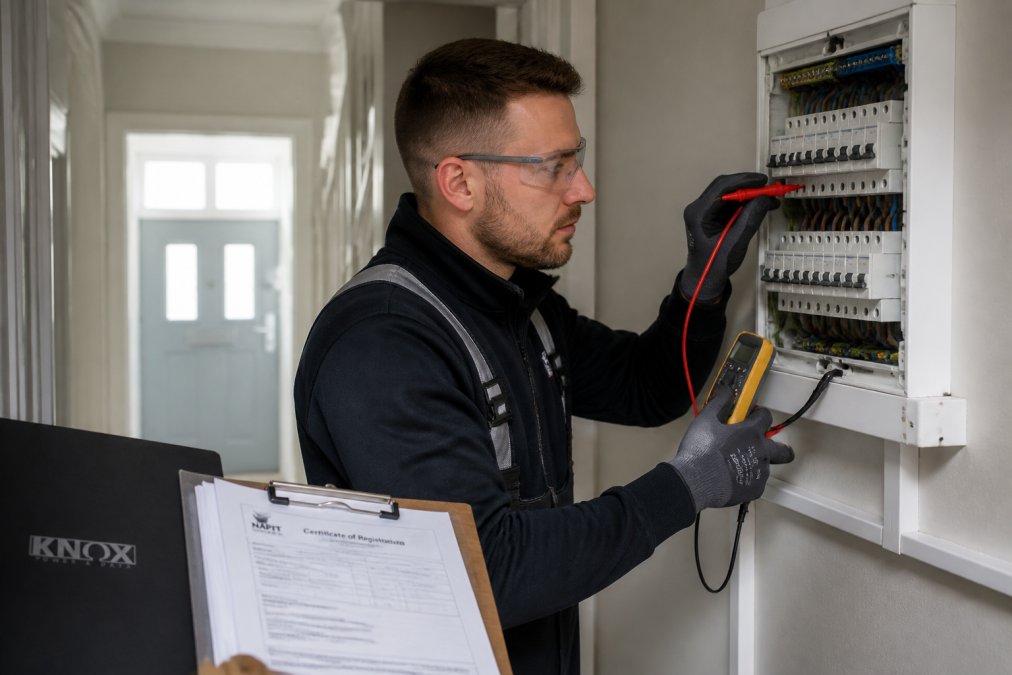
For homeowners and landlords, the practical value is threefold:
- Verified competence. Registration requires proof of qualification, including BS 7671 18th Edition and inspection and testing credentials.
- A certificate trail. Registered electricians self-certify notifiable work and notify the local authority, producing documentation a buyer or lender can rely on.
- Recourse. Scheme membership includes a complaints and workmanship guarantee process, which matters if something goes wrong.
Legal Liability for Homeowners Using Unregistered Electricians
Legal liability for homeowners is the angle most guides skip. If you commission electrical work, you carry responsibility for it being compliant, and an unregistered electrician does not remove that responsibility from you. The law places the duty on the person arranging the work, not only on the person doing it.
The legal mechanism: Building Act enforcement
Notifiable electrical work that is carried out without notification, or that does not comply with Part P of the Building Regulations, is a breach of the Building Regulations. Local authorities have enforcement powers under the Building Act 1984. In practice this means a local authority can require the owner to rectify non-compliant work, and can prosecute in serious cases. The cost of putting it right falls on the property owner, not on the electrician who did the work, even if the owner did not know the work was notifiable.
Insurance: the non-disclosure trap
Home insurance policies typically require the policyholder to disclose material facts and to maintain the property in a reasonable state of repair. If a fire or fault traces back to uncertified electrical work, an insurer can reduce or refuse a payout on the basis that the work was not carried out to a recognised standard, or that the policyholder failed to disclose it.
Property sales and conveyancing
Buyers' solicitors request certificates for notifiable work as a matter of routine. Missing paperwork means delays, renegotiation, or a failed sale. In some cases the buyer's solicitor will advise an indemnity policy, but indemnity policies only cover the legal cost of enforcement, they do not cover the cost of remedial work, and they do not satisfy a lender who wants evidence of compliance.
The practical distinction
This is why the "it's not mandatory" answer is technically correct and practically misleading. Registration is voluntary. Compliance is not. The certificate that proves compliance is almost always produced through a scheme, because the scheme route is the one that generates the Building Regulations compliance certificate a lender, insurer or buyer will accept.
Frequently Asked Questions
Is NAPIT registration a legal requirement for all electrical work?
No. NAPIT registration is not a statutory requirement in itself, but Part P of the Building Regulations makes it a legal obligation to ensure notifiable electrical work complies with safety standards. Registered electricians can self-certify this compliance, while unregistered installers must notify the local authority and pay for a separate inspection. For most homeowners, using a registered professional is the practical way to meet the legal obligation without extra cost or delay.
Can an unregistered electrician legally sign off electrical work?
An unregistered electrician cannot self-certify notifiable work under Part P. They can carry out the installation, but the work must then be notified to the local authority's building control team, which arranges an inspection. This adds time and cost. For non-notifiable tasks, such as replacing a light fitting, an unregistered electrician can issue a minor works certificate, but they cannot produce the compliance certificate that mortgage lenders and insurers typically expect.
Do I need a NAPIT-registered electrician for Part P compliance?
You need someone who can demonstrate Part P compliance, and a NAPIT-registered electrician is one of the most straightforward ways to get that. Registered members can self-certify their work and notify the local authority directly. If you use an unregistered electrician for notifiable work, you or they must notify building control before work starts, which usually costs more and takes longer to complete.
What happens if I use an unregistered electrician and something goes wrong?
If notifiable work is done by an unregistered electrician without building control notification, you may face enforcement action, difficulty selling your property, and a rejected insurance claim. Your home insurance policy may be invalidated if a fire or fault traces back to non-compliant work. Mortgage lenders also frequently ask for building regulations completion certificates during conveyancing, and missing paperwork can delay or derail a sale.