 how-to
How to Rewire a House Without Removing Plaster
Last Updated: November 1, 2026
Quick Summary
You can rewire a house without removing plaster by routing new cable through existing voids, such as stud bays, lifted floorboards, lofts and basements, instead of chasing channels into the walls. Knowing how to rewire a house without removing plaster starts with identifying each wall's build-up, because plaster on masonry has no cavity and may still need chasing. Combine routes and keep access holes small to limit damage.
- Drill slowly on plaster on lath and avoid levering against the fragile wall face.
- Pull the old cable out and reuse its route for the new cable to avoid fresh holes.
- Drill small, centred holes through top and bottom plates after checking for pipes and cables.
- A room-by-room rewire keeps power on in most of the property but stretches over weeks.
- Test and certify every circuit before patching access holes, or you will cut them open again.
Table of Contents
- Planning a Plaster-Preserving Rewire
- How to Rewire a House Without Chasing Walls
- Rewiring a House One Room at a Time
- How Long Does a House Rewire Take?
- Electrical Work You Can Do Yourself
- Making Good: Patching Plaster and Finishing
- Getting a Professional Rewire Quote
- Frequently Asked Questions
Planning a Plaster-Preserving Rewire
This guide explains how to rewire a house without removing plaster in many cases, but not every case. The trick is planning the cable routes before anyone picks up a tool.
The honest answer most guides skip: minimal-damage work depends on the property. Some homes need chasing, and the result may only be a partial reduction in wall damage. Plan around that reality instead of fighting it.
Assessing Existing Wiring and Hazard Checks
Start with a hazard check before any cable work. Old wiring in older homes brings risks that change the whole plan.
Check for these warning signs:
- Round-pin sockets or black rubber cables
- A fuse box with rewireable fuses rather than a modern consumer unit
- Dim lights that flicker when appliances switch on
If you spot any of these, treat the circuit as unsafe until tested. You can review the warning signs yourself with our Wakefield rewiring checklist before you commit to anything.
Room-by-Room Circuit Documentation
Document every circuit before you touch a cable. This step saves hours later.
Map each room and note:
- Which circuits feed the sockets, lights and fixed appliances
- Where the consumer unit sits and how full it is
- Cable routes you can reuse and routes you cannot
Photograph the consumer unit and label every fuse or breaker. When you remove old wiring, this record tells you what each cable did. It also makes inspection and testing far quicker at handover.
How to Rewire a House Without Chasing Walls
Rewiring a house without chasing walls means routing new cable through existing voids instead of cutting channels into plaster. It works best in homes with hollow stud walls, floorboards you can lift, and lofts or basements to run cable through.
Reading the Wall Build-Up First
Plaster on lath, plaster on masonry, and modern plasterboard each behave differently when you drill or fish. A few minutes with a bradawl and a torch saves hours of damage.
- Plaster on lath: the plaster sits on horizontal timber strips with a void behind. The keys holding the plaster to the lath are fragile, so drill slowly and avoid levering against the wall face. A small hole saw is gentler than a hammer drill in chiselling mode.
- Plaster on masonry: there is no cavity to fish through. Cable must run in surface trunking, in the void behind a dry-lined wall, or through floor and ceiling voids instead. Chasing is often the only in-wall option, which is why a partial rewire may be the honest answer.
- Plasterboard on stud: the easiest case. Stud bays are open, top and bottom plates are accessible, and a 25 mm access hole hides behind a socket or switch plate.
Lath and plaster can contain asbestos in older properties, particularly in textured coatings, old fuse boards, and some ceiling finishes. If you suspect it, stop and arrange a survey before drilling. Do not assume a small hole is low risk.
Using Existing Cable Routes and Wall Cavities
Old cables already run through wall cavities and stud bays. Follow them where you can.
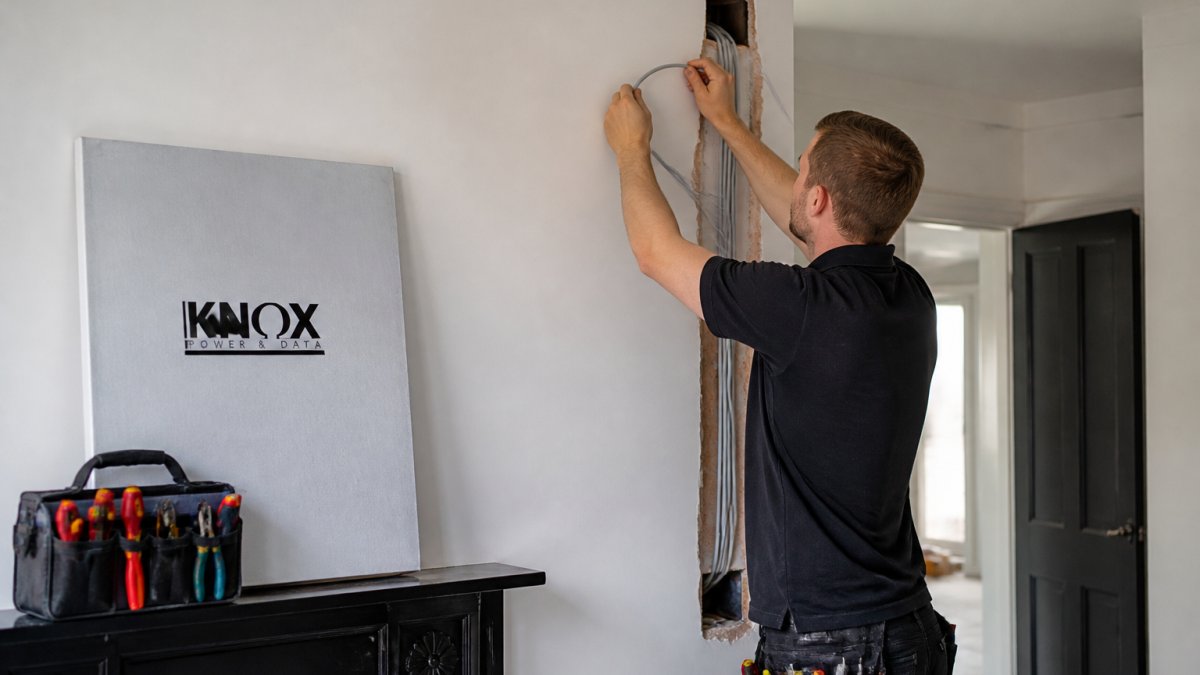
Pull the old cable out and use its route for the new one. This avoids fresh holes and keeps disruption low. Where a cavity is blocked, by noggins, insulation, or a later stud wall, a short access hole at the top and bottom of the wall often gets you through.
Drilling Through Top and Bottom Plates
Top plates and bottom plates are the timber frames at the top and bottom of each stud bay. Drilling a small hole through them lets cable pass from the loft or floor void into the wall.
Keep holes small and centred. Check for pipes and existing cables first. A common mistake is drilling blind into a plate and hitting a water pipe, which turns a tidy job into an emergency repair.
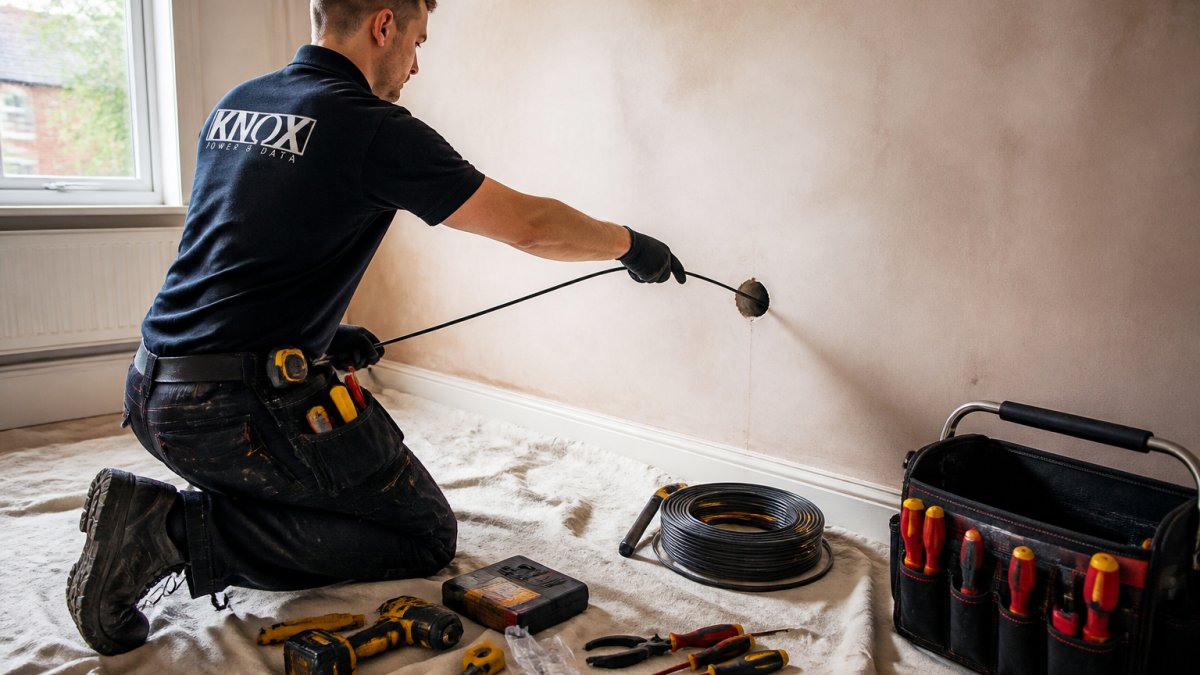
Fishing Cables with Flexible Auger Bits and Fish Tape
Flexible auger bits and fish tape do the heavy lifting. An auger bit bores through timber in tight spots. Fish tape then pulls the cable through the cavity.
The sequence:
- Drill a small access hole at each end of the run
- Push the fish tape through the cavity
- Hook the cable to the tape and pull it back
- Secure the cable and test continuity
For a deeper walkthrough of the technique, our guide on routing Cat6 cables through internal walls covers the same fishing methods in detail.
Choosing the Access Route: A Practical Comparison
Route choice drives disruption, feasibility, and repair effort more than any other decision. Compare the options before committing.
| Route | Disruption | Feasibility | Repair effort |
|---|---|---|---|
| Loft and ceiling void | Low | Good in houses with accessible lofts | Low, lift insulation, replace |
| Floorboards lifted | Medium | Good where boards are not tongue-and-groove | Medium, refit and make good |
| Basement or sub-floor void | Low | Only where a void exists | Low |
| Skirting and dado trunking | Low | Good for surface runs | Low, paint to match |
| Small wall openings | Medium | Universal fallback | Medium, patch and decorate |
A common pattern is to combine routes: loft for the first-floor lighting, lifted floorboards for socket drops, and small wall openings only where a cavity is blocked. That mix keeps plaster damage to a minimum without pretending every wall can be avoided.
Photograph each access hole before you patch it. The record helps the electrician trace runs later and supports the inspection and testing at handover.
Rewiring a House One Room at a Time
Rewiring a house one room at a time suits lived-in homes. You keep the power on in most of the property while one room is worked on.
The trade-off is time. A phased approach spreads disruption but stretches the project over weeks.
| Approach | Disruption | Best For | Main Drawback |
|---|---|---|---|
| Room by room | Low, spread out | Occupied homes | Longer overall timeline |
| Floor by floor | Medium | Two-storey houses | Power off for whole floors |
| Full rewire at once | High, short burst | Empty properties | You need to move out |
If you are weighing how much to tackle at once, our guide on full house rewire vs partial rewire sets out the decision clearly.
How Long Does a House Rewire Take?
A plaster-preserving rewire can take longer than a standard rewire. Fishing cable through voids and patching access holes adds time, even though it can reduce plaster repair.
Duration depends on the size of the property and how many routes need access holes; request a survey for an estimate. A phased, room-by-room job can run across several visits. The honest range is wide because the variables below matter more than the headline number.
What Actually Drives the Timeline
- Number of circuits and rooms: a three-bedroom house with a single consumer unit is a different job from a larger property with outbuildings and multiple boards.
- Route difficulty: lifted floorboards and an accessible loft shorten the job. Blocked cavities, lath walls, and masonry walls lengthen it.
- Access holes needed: every hole is drill, fish, test, then patch. Ten holes is a different day's work from forty.
- Consumer unit replacement: a board change adds testing and certification time and may require an isolator and meter tails upgrade.
Compliance and Inspection Time
In the UK, notifiable electrical work in a home must be done by a registered competent person or signed off by building control (Domestic electrical work). Testing and certification take time, and any building control involvement adds a scheduling step.
Plan the rewire around the testing and certification date, not the cable-pulling date. Patching before testing is complete means cutting holes open again.
Phased Versus Single-Visit Programmes
A phased, room-by-room job spreads disruption but stretches the project over weeks. It also means the consumer unit and main runs may need revisiting later. A single-visit programme on an empty property is faster overall but concentrates the disruption.
For a fuller breakdown of duration and budget, see our guide on the cost of a full house rewire.
Electrical Work You Can Do Yourself
Very little of a rewire is a DIY job. In the UK, notifiable electrical work in a home must be done by a registered competent person or signed off by building control.
You can safely handle these tasks:
- Clearing rooms and lifting floorboards
- Moving furniture and protecting surfaces
- Patching small access holes after the electrician finishes
- Painting and redecorating
Leave cable installation, consumer unit work, testing and certification to a qualified electrician. The official guidance on electrical safety in the home sets out why this work carries legal duties.
Making Good: Patching Plaster and Finishing
Patching is the last stage, and it is where a plaster-preserving rewire earns its name. Small access holes fill easily. The result is far less mess than chasing full channels.
Work through it like this:
- Let the electrician confirm all circuits test correctly first
- Fill deep holes in layers, letting each dry
- Use a filler matched to the wall, lime-based for old plaster
- Sand flush and prime before painting
Watch out: filling over a hole before testing is complete means cutting it open again. Always test and certify before you make good.
Getting a Professional Rewire Quote
A proper quote starts with a survey, not a guess over the phone. The electrician needs to see the routes, the consumer unit and the age of the wiring before pricing the job.
Ask for these in any quote:
- A clearly stated price
- Confirmation of NAPIT or equivalent registration
- Testing and certification included
- What happens if a wall needs chasing after all
Knox Power & Data is a NAPIT-registered electrical contractor (Member No. 69848) with BS 7671 18th Edition and inspection qualifications. For a quote, contact Knox Power & Data directly through its website.
Frequently Asked Questions
Can a house be rewired without removing plaster?
Yes, in many cases a house can be rewired without removing large areas of plaster. Electricians use existing cable routes, wall cavities, floorboards, and lofts to fish new cables with minimal damage. However, some properties, especially those with solid walls or complex layouts, may require chasing or small access holes. A professional assessment will confirm what is feasible for your home.
How much plaster damage should you expect during a rewire?
The amount of plaster damage depends on the property and the methods used. A plaster-preserving rewire aims to limit damage to small access holes around sockets, switches, and ceiling roses, which are patched afterwards. Older homes with lath and plaster may need more careful handling. Discuss expected disruption with your electrician before work starts so you can plan decoration.
Can you plaster over electrical wires?
No, you should never plaster directly over electrical wires. Cables must be run in safe zones or protected by conduit or capping, and they need to remain accessible for inspection and testing. Plastering over wires without proper protection is a safety hazard and can fail inspection. Always follow BS 7671 wiring regulations and consult a qualified electrician.
What electrical work can you legally do yourself?
In the UK, you can legally carry out some minor electrical work, such as replacing a light switch or socket faceplate, provided you are competent and follow safety guidelines. However, notifiable work like new circuits, consumer unit replacements, or work in special locations must be done by a registered electrician or certified by building control. For any work involving new cable runs, it is safest to use a NAPIT-registered professional.
Rewiring without removing plaster is achievable in most homes, but it takes planning, the right access routes and a careful finish. If you want the job done safely and certified, get started with Knox Power & Data and book a free survey with a fixed quote.