 ultimate-guide
Cost of Full House Rewire 2026: Complete Guide
Table of Contents
- What Drives the Cost of a Full House Rewire in 2026
- Full House Rewire vs Partial Rewire: Which Do You Need?
- How Long Does a House Rewire Take?
- Electrical Installation Condition Report Cost and Why It Matters First
- What a Full Rewire Actually Involves
- How to Compare Rewire Quotes Without Getting Burned
- Frequently Asked Questions
Last Updated: September 21, 2026
What Drives the Cost of a Full House Rewire in 2026
The cost of full house rewire 2026 depends on property size, age, construction type, and how much of the existing wiring can be reused. Most homeowners should expect a four-figure sum rather than a fixed national rate, because no two properties present the same obstacles.
A full rewire is the replacement of every fixed cable, accessory and protective device in a property, plus the certification that proves the work complies with BS 7671, the IET Wiring Regulations. It is not a cosmetic upgrade. It is a safety-critical rebuild of the circuits that power everything you own.
The variables below move the price far more than the size of the house alone.
Property size, age, and construction type
Bedroom count is the crudest possible measure. Circuit count is what actually matters.
A three-bedroom terrace with a single ring main and one lighting circuit is a smaller job than a same-sized house with a kitchen extension, a loft conversion and an outbuilding supply. Victorian solid-brick walls resist cable routes; 1990s timber-frame construction usually makes them easier.
Older properties also tend to carry legacy problems: rubber-insulated cable, unearthed lighting circuits, and borrowed neutrals that trip modern protective devices. Each one adds labour.
Access, making good, and hidden surprises
Access is the single biggest swing factor in any quote.
Lifting carpets, cutting access hatches, working around fitted kitchens and negotiating with original plaster all take time. Plasterers and decorators are separate trades, and their costs sit outside the electrician's fee unless your quote states otherwise.
Hidden surprises are the reason a fixed price should always be qualified. Asbestos-containing materials, buried junctions, and DIY alterations from previous owners can all surface once floorboards come up. A reputable contractor will price the known work and explain how variations are handled, not pretend uncertainty doesn't exist.
Full House Rewire vs Partial Rewire: Which Do You Need?
A partial rewire replaces only the circuits that fail inspection, while a full house rewire replaces the entire installation. The right choice depends on the age and condition of the existing wiring, not on budget alone.
EICR findings drive this decision. If testing shows deterioration isolated to one circuit, a partial rewire can be a legitimate, cost-effective repair. If multiple circuits show low insulation resistance, damaged cable sheathing, or no earth continuity, patching one circuit simply defers the problem.
| Situation | Recommended Approach | Why |
|---|---|---|
| One faulty circuit, rest tests clear | Partial rewire | Isolated repair, lower disruption |
| Rubber or lead-sheathed cable throughout | Full rewire | Cable is beyond service life |
| No main earth or bonding | Full rewire | Safety-critical, affects all circuits |
| Recent extension with new wiring | Partial rewire | New circuits can be retained |
How Long Does a House Rewire Take?
A typical three-bedroom house rewire takes one to two weeks of on-site electrical work, with larger or older properties running longer. Decoration and making good add further time after the electrician leaves.
How long a house rewire takes depends on access, occupancy and how many trades are involved. An empty property moves much faster than an occupied one, because furniture, carpets and occupants don't need to be worked around.
A realistic sequence looks like this:
- Week 1: first fix, cable routes, back boxes, consumer unit position
- Week 2: second fix, accessories, testing and certification
- Weeks 3-4: plastering, making good, decoration
Live-in rewires stretch the programme. Expect circuits to be off in stages, and plan for at least one night in a hotel if the property has young children or anyone working from home.
Electrical Installation Condition Report Cost and Why It Matters First
An Electrical Installation Condition Report cost is a fraction of a rewire, which is exactly why it should come first. An EICR is a documented inspection and test of the existing installation, and it tells you whether a rewire is genuinely needed.
Reports classify observations as C1, C2 or C3. C1 and C2 mean danger or potential danger and require remedial work. C3 means improvement recommended, which is advisory rather than urgent.
This matters commercially. Landlords in the private rented sector have a legal duty to have the installation inspected and tested at least every five years by a qualified person, and to give the report to tenants. That requirement comes from the Electrical Safety Standards in the Private Rented Sector (England) Regulations 2020.
For homeowners, an EICR is the cheapest way to avoid paying for a rewire you don't need. Testing typically costs a small fraction of the cost of full house rewire 2026 and takes a few hours on site.
What a Full Rewire Actually Involves
A full rewire involves stripping out old cable, installing new circuits, fitting a modern consumer unit with RCD protection, and issuing an Electrical Installation Certificate on completion. Every stage is tested and documented.
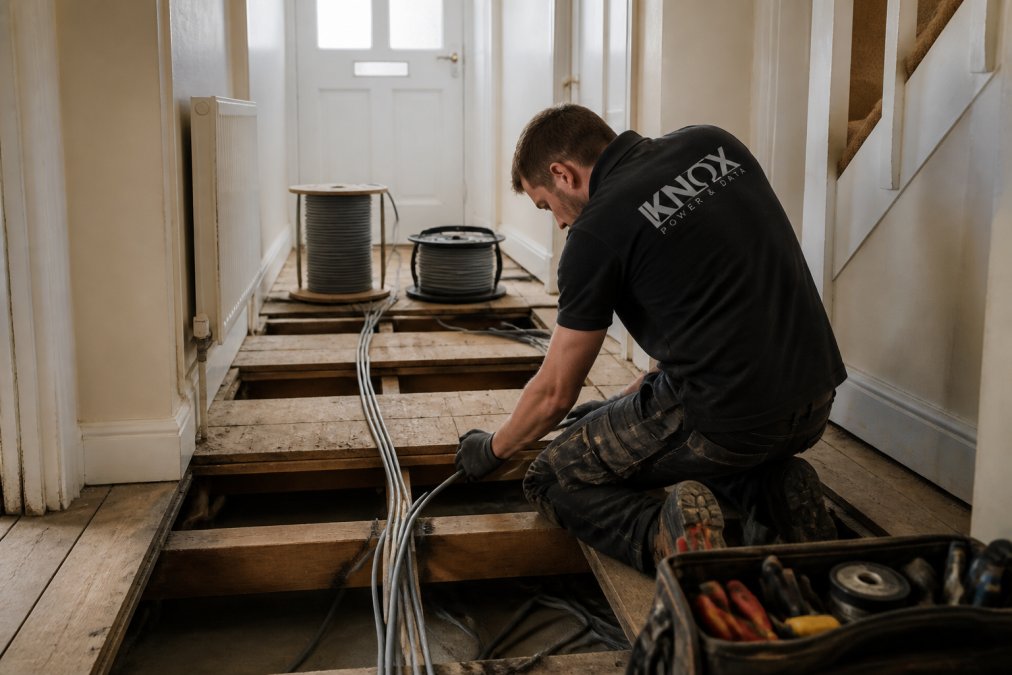
From first fix to certification
First fix is the rough-in stage: cables pulled to every point, back boxes fitted, routes drilled and chased. Second fix connects accessories, lights and the consumer unit.
Testing comes last, and it is not optional. Insulation resistance, continuity, polarity and earth loop impedance are all measured and recorded. The certificate is your proof the work complies, and it matters when you sell, remortgage or let the property.
How to Compare Rewire Quotes Without Getting Burned
Compare rewire quotes line by line, not by the total at the bottom. The cheapest figure is often the one with the most exclusions.
A quote that omits making good, certification, or a new consumer unit is not a cheaper rewire.
Check these items on every quote:
- Is the consumer unit replacement included, with RCD protection stated?
- Are making good and plastering included or excluded?
- Is testing and certification included in the price?
- Is the contractor registered with a competent person scheme?
- Are variations priced in writing before work starts?
- Is there a clear programme and start date?
Frequently Asked Questions
How long does a full house rewire take to complete?
A typical three-bedroom house takes one to two weeks of on-site work, though larger or older properties can run longer. The schedule usually splits into first fix (running cables and back boxes), second fix (fitting sockets, switches, and the consumer unit), and testing. Occupancy matters too: if you stay in the property, the electrician may work room by room, which extends the timeline. Ask for a written programme before work starts so you can plan around it.
Do I need a full rewire or just a partial rewire?
It depends on the condition of the existing installation, not the age of the house alone. A partial rewire may suit a property where most circuits test satisfactorily but one area, such as a kitchen extension, needs updating. If an electrical installation condition report flags widespread deterioration, inadequate earthing, or rubber-insulated cables, a full rewire is usually the safer route. A qualified electrician should assess the installation before you commit to either.
What factors influence the cost of a house rewire?
The main cost drivers are property size and number of circuits, age and construction (solid stone walls and lath-and-plaster take longer to work with), accessibility of floors and walls, whether you want making good and redecoration included, and the specification of fittings you choose. Adding data cabling, extra sockets, or a larger consumer unit also affects the total. Because these vary so much between properties, a site visit is the only way to get an accurate figure.
Is a full rewire covered by home insurance?
Standard home insurance policies generally do not cover rewiring as routine maintenance or improvement work. Cover may apply if damage from an insured event, such as a fire or flood, makes rewiring necessary. Some policies include limited accidental damage cover that could contribute in specific circumstances. Check your policy wording or speak to your insurer before assuming anything, and keep any electrical installation condition report as evidence of the installation's condition.
What electrical certifications are required after a rewire?
A full rewire is notifiable work, so it must comply with BS 7671 (the 18th Edition wiring regulations). After completion you should receive an Electrical Installation Certificate, plus a Building Regulations Compliance Certificate if the work was notified through a registered competent person scheme. The electrician should also provide test results for each circuit. Keep these documents safe: they are useful when selling, letting, or making an insurance claim.
How can I tell if my house needs rewiring?
Warning signs include an old fuse box with rewireable fuses, rubber or fabric-covered cables, sockets that feel warm or show scorch marks, frequent tripping, and lights that flicker when appliances switch on. A property that has never been rewired and still has original wiring from before the 1970s is a strong candidate for assessment. An electrical installation condition report gives you a clear, documented answer rather than guesswork.
Does an electrical installation condition report cost much compared to a rewire?
An electrical installation condition report costs a fraction of a full rewire and is the sensible first step if you are unsure whether rewiring is needed. The price depends on property size and the number of circuits tested, so ask for a quote based on your floor plan. If the report comes back satisfactory, you may only need minor remedial work. If it flags serious issues, you have written evidence to justify the larger spend.