 ultimate-guide
Commercial CCTV Installation Cost Guide 2026
Table of Contents
- Understanding Commercial CCTV Installation Costs
- Average CCTV Installation Cost and Price Ranges
- Business CCTV System Cost: Equipment vs Labour Breakdown
- CCTV Installation Cost Per Camera and System Sizing
- Factors That Affect Commercial CCTV Installation Price
- CCTV Installation Quote Checklist for Commercial Properties
- Commercial CCTV Maintenance Costs and Total Cost of Ownership
- Commercial Versus Residential Installation Costs
- Frequently Asked Questions
Last Updated: October 9, 2026
Understanding Commercial CCTV Installation Costs
Commercial CCTV installation cost varies with system size, site complexity, and equipment specifications.
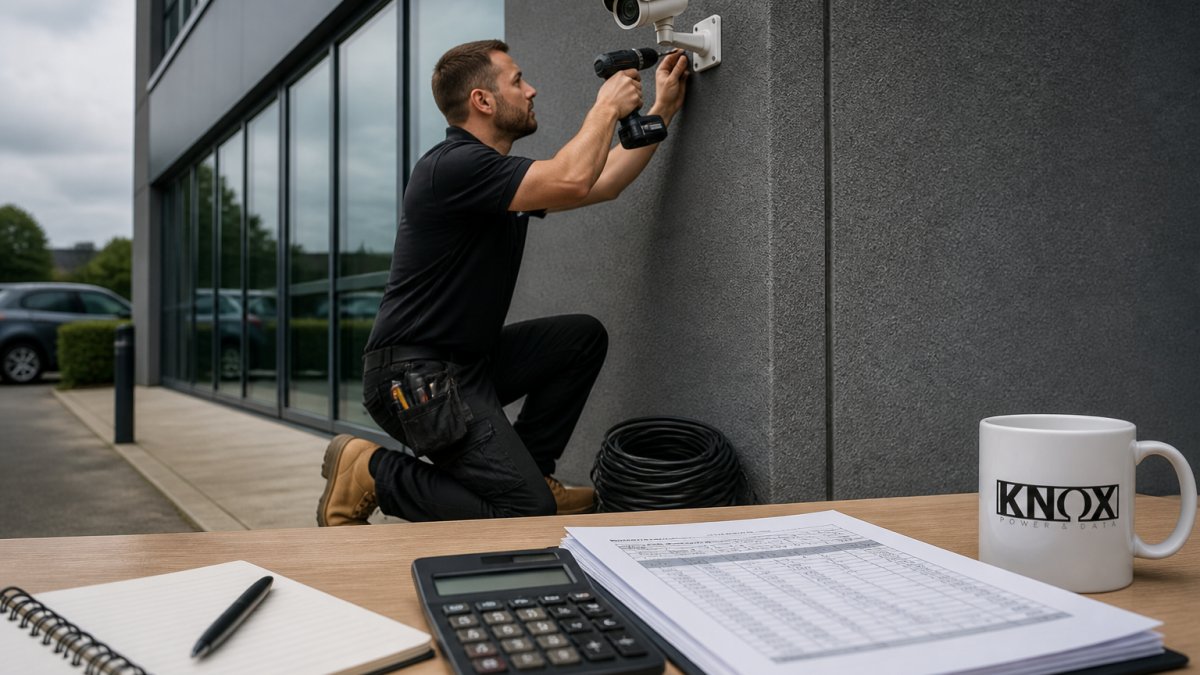
Total cost breaks into three components: equipment (cameras, recorders, storage), labour (installation and configuration), and ongoing operational expenses (monitoring, maintenance, cloud storage).
Many businesses underestimate infrastructure costs, cabling, power upgrades, network configuration, which often equal or exceed camera costs.
Average CCTV Installation Cost and Price Ranges
Commercial CCTV pricing does not scale linearly with camera count: a four-camera office and a four-camera warehouse with 80-metre cable runs and no existing network can differ by a factor of three. The ranges below are structured by business type and site size.
Small business premises (4-8 cameras)
Typical sites: single-unit retail, small offices, cafés, clinics, salons, and workshops under roughly 200 m².
- Camera count: 4-8
- Typical specification: 4MP IP cameras, fixed lens, IP66 external rating, one 8-channel NVR with 4-8TB storage
- Installation scope: short cable runs, existing power and network largely reused, single-day to two-day install
At this size, labour and commissioning dominate rather than hardware. Accessible cable routes and a single recording location sit at the lower end; solid walls, no ceiling void, or out-of-hours working push toward the upper end.
Medium commercial premises (8-20 cameras)
Typical sites: multi-floor offices, larger retail units, restaurants with back-of-house areas, small warehouses, and professional services premises between roughly 200 m² and 800 m².
- Camera count: 8-20
- Typical specification: mix of 4MP and 8MP IP cameras, some varifocal lenses, PoE switch, 16-channel NVR with 8-16TB storage
- Installation scope: structured cabling, cable containment, network configuration, 2-4 day install
Here infrastructure dominates: cable containment, PoE switch capacity, and network segmentation are the largest line items after labour. Sites with existing structured cabling and spare switch capacity sit at the lower end; those needing new containment throughout can exceed it.
Large and multi-site operations (20-50+ cameras)
Typical sites: warehouses, manufacturing facilities, distribution centres, retail chains, and multi-building campuses.
- Camera count: 20-50+, often across multiple buildings or sites
- Typical specification: 8MP IP cameras, varifocal and panoramic lenses, analytics-enabled models, redundant NVRs or server-based recording, fibre backbone between buildings
- Installation scope: extended cable runs, fibre termination, network upgrades, project management, phased rollout, 1-4 weeks depending on scale
Cost per camera falls at this scale, but total infrastructure investment rises sharply. Fibre runs, dedicated network hardware, and phased project management are the main drivers. Multi-site operations add coordination costs: consistent specification, centralised monitoring, and standardised retention policies all require design work before a single camera is mounted.
Indicative cost by business type
| Business type | Typical camera count | Indicative installed cost | Main cost driver |
|---|---|---|---|
| Small retail unit | 4-6 | £2,500-£4,500 | Labour and commissioning |
| Café or restaurant | 4-8 | £3,000-£6,000 | Cable routing around kitchen and back-of-house |
| Small office | 6-10 | £4,000-£8,000 | Network integration and containment |
| Larger retail store | 10-20 | £7,000-£14,000 | Coverage density and till-area detail |
| Warehouse or industrial unit | 12-30 | £10,000-£30,000 | Cable runs, containment, and weather-rated externals |
| Multi-site operation | 30+ | £25,000-£60,000+ | Coordination, fibre, and centralised monitoring |
What pushes a project to the top of its band
The same camera count can land at either end of a range depending on:
- Cable route accessibility, existing voids and ceiling tiles keep costs down; solid walls, concrete, and surface containment push them up.
- Power availability, spare capacity for PoE loads avoids upgrade costs; older distribution boards often do not.
- Network readiness, existing structured cabling and spare switch ports reduce labour; legacy networks may need replacement.
How to use these ranges
Treat the bands above as the envelope a credible quote should fall within. If a proposal comes in well below, check what has been excluded, usually containment, commissioning, or compliance documentation. If well above, ask which complexity factor drives the premium and whether it can be designed out.
Business CCTV System Cost: Equipment vs Labour Breakdown
Wired versus wireless systems
Wired systems remain the industry standard for commercial installations: reliable power, stable connectivity, no bandwidth constraints. They require professional cabling, typically the largest single labour cost, but deliver superior performance and longevity. Wireless systems eliminate cabling but introduce dependencies on network infrastructure, battery management, and signal reliability that many operators find problematic at scale.
For most commercial properties, wired installations prove more cost-effective over five years despite higher initial labour costs.
Camera types and specifications
IP cameras dominate modern commercial installations because they integrate with structured cabling, support remote viewing, and enable analytics; analog systems are largely obsolete except for legacy upgrades.
Specialist cameras, thermal imaging for perimeter security, panoramic lenses for wide coverage, analytics-enabled models for traffic monitoring, add significant cost but solve problems standard cameras cannot.
CCTV Installation Cost Per Camera and System Sizing
Determining camera count for your coverage area
Camera count depends on coverage area, required detail level, and sight lines. A rule of thumb suggests one camera per 20-30 square metres for general surveillance, but retail needs tighter coverage at points of sale, warehouses can use wider-angle cameras for aisles, and offices need only entry points and common areas.
A site survey by a qualified installer determines optimal placement, identifies blind spots, and calculates the camera count needed, preventing overspecification and coverage gaps.
| Coverage Area | Typical Camera Count | System Complexity | Installation Scope |
|---|---|---|---|
| Small retail (up to 200 m²) | 4-6 cameras | Low | Straightforward |
| Medium office (200-500 m²) | 6-12 cameras | Medium | Standard cabling |
| Large warehouse (500-2000 m²) | 12-30 cameras | High | Extended infrastructure |
| Multi-site operation | 30+ cameras | Very high | Distributed network |
Recording capacity and storage costs
Recording capacity determines how long footage remains available before overwriting. Commercial systems typically retain 7-30 days depending on camera count, resolution, and storage budget.
Storage cost scales with camera count and retention period: a 16-camera 4MP system requires substantially more storage than a 4-camera 2MP system. Many installers recommend hybrid approaches, local storage for immediate access, cloud backup for compliance and disaster recovery.
Factors That Affect Commercial CCTV Installation Price
Site survey and installation complexity
Installation complexity directly impacts labour costs. A single-floor retail shop with accessible cabling routes costs less than a multi-floor building requiring vertical runs, trays, or conduit. Heritage restrictions, difficult routing (underground ducts, concrete penetrations), and specialist access equipment (scaffolding, cherry pickers) all increase labour costs significantly.
A professional site survey identifies these complexity factors before quoting, preventing cost overruns from complications discovered during installation.
Cabling, power supply, and network infrastructure
Infrastructure costs often surprise business owners because they are less visible than cameras. Commercial-grade cabling (Cat6 or fibre for larger systems) costs more than domestic cabling, power upgrades may be needed if circuits lack capacity, and network improvements (switches, routers, bandwidth) enable remote viewing but add cost.
These infrastructure elements are non-negotiable: cutting corners on cabling or network leads to performance issues and costly remediation later.
Compliance, cybersecurity, and privacy costs
UK GDPR and the Data Protection Act 2018 impose requirements on commercial CCTV: signage, retention policies, access controls, and audit logging all carry cost implications. Systems covering sensitive areas (cash handling, HR offices) may need extra measures, and cybersecurity hardening, network segmentation, encryption, secure remote access, adds implementation and management cost.
These compliance elements are not optional: regulatory exposure and liability risks make cutting corners unwise, so professional installers build them into quotes.
CCTV Installation Quote Checklist for Commercial Properties
Most commercial CCTV quotes are not directly comparable: one installer bundles cabling into labour, another lists it separately; one includes commissioning, another charges extra. Without a consistent structure, the cheapest headline figure often turns out to be the most expensive project. The checklist below forces every quote into the same shape.
The itemised quote structure to demand
Ask every installer to break their proposal into these lines, even if they normally quote as a lump sum:
- Cameras, model, resolution, lens type, weather rating (IP66/IP67 for external), and quantity per location.
- Recorder and storage, NVR model, number of channels, hard drive capacity in terabytes, and calculated retention days at your specified resolution.
- Cabling and containment, cable type (typically Cat6 or Cat6A for IP; fibre for long runs), estimated metreage, and whether conduit, trunking, or cable tray is included.
If an installer refuses to itemise, treat that as a signal: a lump sum with no breakdown makes it impossible to verify what you are buying or compare against competing proposals.
A worked example of first-year and multi-year totals
Consider two quotes for a 12-camera retail installation. Both come in around the same headline figure, but the structure differs:
| Cost line | Installer A | Installer B |
|---|---|---|
| Cameras (12 × 4MP IP) | Included | Included |
| NVR and 8TB storage | Included | Included |
| Cabling and containment | Included | £1,200 extra |
| PoE switch and network config | Included | £650 extra |
| Labour (2 technicians, 3 days) | Included | Included |
| Commissioning and training | Included | £400 extra |
| Compliance documentation | Not mentioned | Included |
| Year 1 warranty | 12 months parts only | 24 months parts and labour |
| Year 1 total | £7,800 | £10,050 |
| Years 2-5 maintenance | £900/year (assumed) | £600/year (assumed) |
| 5-year total cost of ownership | £11,400 | £12,450 |
The headline gap narrows considerably once exclusions and the warranty difference are added: Installer B costs more upfront but carries a longer parts-and-labour warranty and includes compliance documentation Installer A has not priced at all.
Procurement and quote evaluation checklist
Use the same scoring grid for every proposal:
- Scope completeness, does the quote cover cameras, recorder, storage, cabling, power, network, labour, commissioning, and compliance?
- Specification clarity, are camera models, resolutions, and recorder capacities named, or described only in vague terms?
- Retention calculation, has the installer shown how many days of footage the proposed storage actually delivers at your resolution and frame rate?
- Warranty terms, length, parts versus labour, and what voids it.
- Service-level agreement, response time for faults, whether remote support is included, and whether on-site visits are chargeable.
- Licensing and software, are video management software licences included, and are they perpetual or subscription?
- Scalability, can the recorder and network handle additional cameras later without replacement?
- References, at least two comparable commercial sites, ideally of similar size and sector.
Hidden expenses to watch for
Beyond the obvious, watch for these recurring exclusions:
- Power supply upgrades where existing circuits lack capacity for PoE loads.
- Network infrastructure, switches, bandwidth provisioning, and VLAN configuration for segregated camera traffic.
- Cable containment, conduit, trunking, or tray where surface-mounted cabling is not acceptable.
Total cost of ownership in practice
A useful rule of thumb for commercial buyers is to budget the installation cost again over a five-year horizon to cover maintenance, storage media replacement, software subscriptions, and minor upgrades. A system quoted at £8,000 to install should be planned against a five-year total closer to £12,000-£14,000 once recurring costs are included.
Commercial CCTV Maintenance Costs and Total Cost of Ownership
Monthly subscription and monitoring fees
Cloud storage subscriptions range from modest monthly fees for basic backup to substantial costs for high-resolution, long-retention systems. Professional monitoring, where a security company watches your system and responds to alerts, adds significant recurring cost but provides rapid incident response.
Many businesses operate without professional monitoring, relying on staff alerts or periodic footage review. This reduces recurring costs but sacrifices active threat detection; the choice depends on your risk profile.
Maintenance, upgrades, and hardware replacement
Commercial systems require periodic maintenance: lens cleaning, network testing, storage reviews, and firmware updates. NVR hard drives have a finite lifespan (typically 3-5 years) and need replacement, and business growth may require additional cameras, storage, or upgrades.
Budget for these when evaluating total cost of ownership: a system costing £5,000 to install might cost £1,000-2,000 annually to maintain and operate.
Commercial Versus Residential Installation Costs
Labour costs differ significantly: commercial installations require skilled technicians, project coordination, and scheduling around business operations, while residential work is simpler and faster.
Professional commercial CCTV installation demands expertise in site assessment, infrastructure planning, compliance requirements, and system integration.
Choosing the right commercial CCTV system requires balancing coverage needs, budget constraints, and long-term operational costs.
Frequently Asked Questions
How much does commercial CCTV installation cost on average?
Commercial CCTV installation cost depends on system size, camera count, and site complexity. Small business premises typically require 4-8 cameras, while large properties may need 16 or more. A professional site survey determines exact requirements and pricing. Installation labour, equipment, cabling, and network infrastructure all contribute to the final cost. For an accurate quote, contact a professional installer who can assess your coverage area and business premises.
What is the typical CCTV installation cost per camera?
The cost per camera includes the camera unit, cabling, labour, and integration into your recording system. IP cameras and high-definition video systems cost more than basic analog alternatives. Wired systems typically cost less per camera than wireless, as labour is front-loaded during installation rather than ongoing maintenance. A professional installer will provide an itemised quote breaking down the cost per camera within your total system cost.
What should I include in a CCTV installation quote checklist?
Request itemised quotes covering: camera types and specifications, cabling and power supply costs, installation labour, network video recorder or digital video recorder, storage capacity (hard drive or cloud storage), remote viewing setup, motion detection and video analytics features, and any compliance or cybersecurity upgrades. Ask about maintenance plans, monthly subscription fees, and warranty. Clarify whether the quote includes a site survey and system configuration. Compare quotes from multiple installers to identify hidden expenses.
What are the main ongoing costs for commercial CCTV systems?
Commercial CCTV maintenance costs include monthly monitoring subscriptions, cloud storage fees (if applicable), hard drive replacement and maintenance, software updates, and system upgrades. Some systems require annual servicing to ensure night vision, motion detection, and video analytics function correctly. Budget for occasional repairs and camera replacement over time. Total cost of ownership should factor in these recurring expenses alongside the initial installation investment.
Does a wired or wireless CCTV system cost more to install?
Wired systems typically have higher upfront installation labour costs due to cabling and power supply work, but lower ongoing maintenance. Wireless systems reduce initial cabling labour but may require more frequent maintenance and battery replacement. For commercial properties with complex coverage areas, wired systems often prove more reliable and cost-effective long-term. Your site survey will determine which approach suits your business premises and budget.
How many cameras does a commercial property need?
Camera count depends on your coverage area, building layout, and security priorities. Small business premises typically need 4-8 cameras; medium-sized properties, 8-16; large facilities, 16 or more. A professional site survey assesses entry points, blind spots, and recording capacity to recommend the right number. More cameras increase equipment cost but provide better coverage and video analytics. Discuss your specific business needs with an installer to avoid over-specification or insufficient coverage.
What compliance and cybersecurity costs should I budget for?
Commercial CCTV systems may require compliance with data protection regulations regarding video storage and access. Cybersecurity upgrades, such as secure network configuration and encrypted storage, protect against unauthorised access. These costs vary by business type and site size. A professional installer familiar with commercial requirements can advise on necessary upgrades during your site survey and include them in your itemised quote.