 ultimate-guide
EICR Inspection for Older Properties: A Complete Guide
Last Updated: October 27, 2026
Quick Summary
An EICR inspection for older properties is a full assessment of the fixed wiring, earthing and protective devices against BS 7671, and it matters more in an older home because deterioration hides where nobody looks. It involves dead and live testing, insulation resistance readings, earth loop impedance and RCD trip times, with a coded report on every circuit. An average three-bedroom house takes three to five hours, and older properties take the upper end of that range or longer.
- Rubber and VIR cables from the mid-20th century become brittle and crumble at the slightest movement.
- A C2 code makes the report unsatisfactory and is the most common code found in older homes.
- The legal maximum interval for private rented property is five years, not a recommendation.
- Victorian or pre-1950 owner-occupied homes are recommended for inspection every three to five years.
- Clear access to the consumer unit, meter and every room, including the loft, speeds up the visit.
Table of Contents
- What an EICR Inspection Means for an Older Property
- Why Ageing Wiring and Infrastructure Need Closer Attention
- Common Electrical Defects in Period Properties
- How Long Does an EICR Take for an Old Property?
- Understanding Report Codes and EICR Remedial Work Costs
- What Does NAPIT Registration Mean for Your Inspection?
- Inspection Intervals and Legal Requirements for Older Homes
- Preparing an Older Property for Its EICR Inspection
- Frequently Asked Questions
What an EICR Inspection Means for an Older Property
An EICR inspection for older properties is a full assessment of the fixed wiring, earthing and protective devices against BS 7671, and it matters more in an older home because deterioration hides where nobody looks. If you are new to EICRs, you can read what happens during an EICR inspection step by step.
An Electrical Installation Condition Report is a formal, documented condition assessment of an existing installation, not a repair visit and not a PAT test of appliances.
How an EICR Inspection Differs from a Standard Check
A standard visual check confirms accessories look intact and the consumer unit has no obvious damage. An EICR goes further: dead and live testing, insulation resistance readings, earth loop impedance, RCD trip times, and a coded report on every circuit. The difference is evidence. A visual check gives you an opinion; an EICR gives you a certificate with findings you can act on and, for landlords, a document you must hold.
Why Ageing Wiring and Infrastructure Need Closer Attention
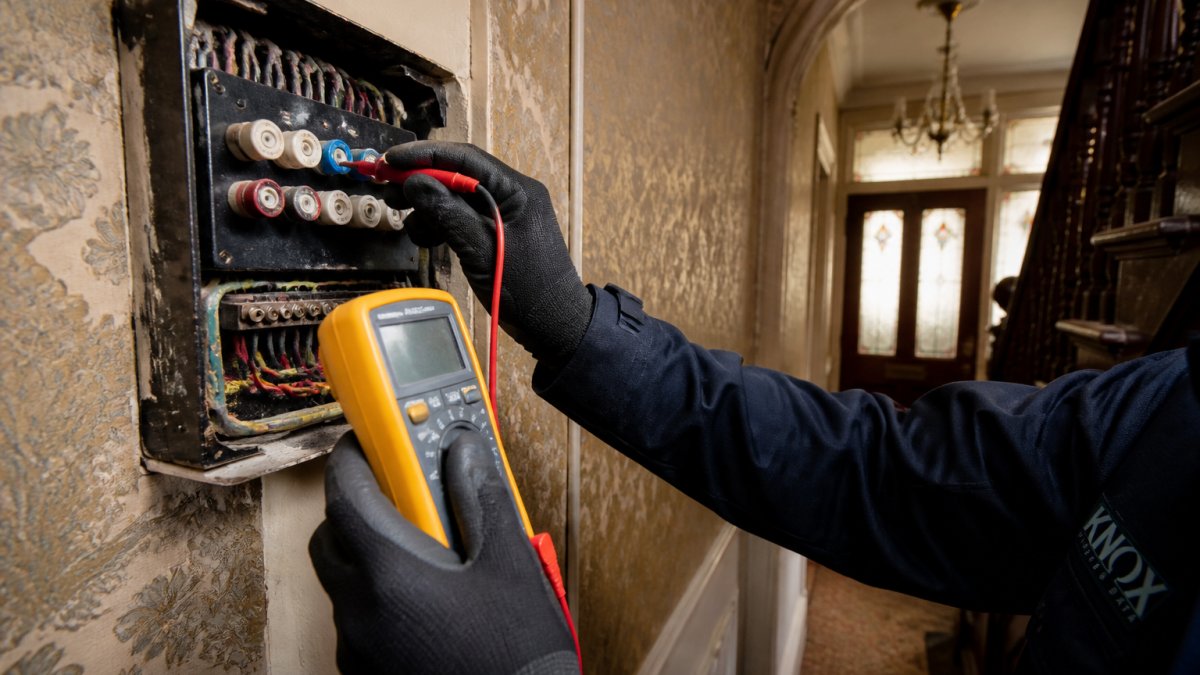
Age alone does not make wiring unsafe, but age plus alteration does. Rubber-insulated cables from the mid-20th century become brittle and crumble at the slightest movement. VIR cable degrades at terminations. Fuse boxes with rewireable fuses lack the RCD protection modern circuits assume. Add a loft conversion, an extra shower and twenty years of DIY sockets, and the original design assumptions no longer hold.
If your fuse board predates modern standards, our guide to whether your old consumer unit is safe walks through what to look for before an inspection.
Common Electrical Defects in Period Properties
- Perished rubber or VIR cable at light fittings and switch drops
- No circuit protective conductor on older lighting circuits
- Missing or inadequate main bonding to gas and water services
- Overloaded circuits extended repeatedly without recalculation
- Rewireable fuse boards with no RCD protection
- DIY additions with no test certificate
None of these are visible to a buyer or tenant. All of them show up under test.
How Long Does an EICR Take for an Old Property?
An EICR for an average three-bedroom house takes three to five hours, according to My Worthing Electrician's guidance on inspection times. Older properties take the upper end of that range, and sometimes longer: more circuits, more accessories to sample, and more investigation when readings come back unexpected. A Victorian terrace with a rear extension and an outbuilding can easily run to a full day. Anyone quoting you a one-hour certificate is not testing properly.
Understanding Report Codes and EICR Remedial Work Costs
- C1, Danger present. Risk of injury exists and immediate action is required. The inspector will usually make the installation safe before leaving, which can mean isolating a circuit or disconnecting a defective accessory. A C1 makes the report unsatisfactory.
- C2, Potentially dangerous. A defect that could become dangerous under fault conditions or normal use. It must be remedied, and a C2 makes the report unsatisfactory. This is the most common code in older homes, missing RCD protection on socket circuits, absent main bonding, or a circuit protective conductor disconnected at a light fitting.
- C3, Improvement recommended. The installation is safe but does not meet current standards in a way that would improve safety. A C3 does not, on its own, make the report unsatisfactory, and remedial work is optional. A classic example in a period property is a consumer unit with no spare ways or an old but functional earthing arrangement.
- FI, Further investigation required. The inspector has identified a potential issue but cannot determine its severity without opening up the installation, accessing a concealed area, or carrying out additional testing. An FI does not automatically make the report unsatisfactory, but it must be resolved, usually by a follow-up visit, before the circuit can be fully assessed.
From code to decision: what to do next
| Code | Report status | Urgency | Typical next step |
|---|---|---|---|
| C1 | Unsatisfactory | Immediate | Make safe, remedy before reoccupation of the affected area |
| C2 | Unsatisfactory | Remedial work required | Obtain a quote, book the work, retest the affected circuits |
| C3 | Satisfactory (unless other codes present) | Improvement recommended | Budget for improvement at next convenient point |
| FI | Depends on other codes | Investigate before concluding | Commission further investigation, then reclassify |
What remedial work actually costs
For a full walkthrough of codes, the 28-day landlord rule and re-test expectations, read our guide on what happens if you fail an EICR in Wakefield.
What Does NAPIT Registration Mean for Your Inspection?
Our team holds NAPIT registration under member number 69848 and BS 7671 18th Edition and Inspection qualifications; you can read more about what NAPIT registration means for homeowners.
Inspection Intervals and Legal Requirements for Older Homes
The legal maximum interval for private rented property is five years, per LettingaProperty's landlord compliance guidance. That is a legal maximum, not a recommendation, and it applies to the rented sector. For owner-occupiers there is no statutory interval at all, which is precisely why older homes need a reasoned interval rather than a default one.
Why age changes the interval
An EICR is a snapshot of condition at the date of inspection. The rate at which that condition deteriorates depends on the installation, not the calendar. Older properties deteriorate faster for four reasons:
- Cable insulation ages. Rubber and VIR cable becomes brittle with heat and time, and the rate of decline accelerates once the cable has been disturbed by alteration.
- Alterations accumulate. Each extension, loft conversion or DIY socket addition adds load and joints that were never designed together, and joints are where deterioration starts.
- Protective devices fall behind standards. A fuse board installed before RCD protection became standard will not trip on the faults modern circuits are designed to clear.
- Earthing and bonding degrade. Main bonding connections at gas and water services corrode, loosen or get removed during plumbing work, and the defect is invisible without testing.
A practical interval guide
| Property situation | Recommended interval | Basis |
|---|---|---|
| Private rented flat or house | 5 years | Legal maximum |
| Victorian or pre-1950 home, owner-occupied | 3-5 years | Ageing infrastructure and alteration history |
| 25-30 years since original installation or last major work | Book voluntarily | Deterioration risk |
| Recently rewired with certificate | Follow cert date | New installation |
| Property with a known C2 deferred | Before the next interval | Unresolved defect |
| Purchase or renovation of an older home | Before exchange or before work starts | Budget and planning |
The owner-occupier position
Properties approaching 25 to 30 years since original installation or last major work are increasingly booked in voluntarily, according to Go Assist's 2026 EICR cost and compliance guide, and older Victorian properties may need inspection every three to five years because ageing infrastructure can deteriorate faster than the standard cycle assumes, as Solution Electric's analysis of EICR compliance notes.
Preparing an Older Property for Its EICR Inspection
Preparation makes the visit faster and the report cleaner. Clear access to the consumer unit, meter and any outbuildings. Move furniture away from socket outlets and light switches. Note any recent alterations, extensions or DIY work so the inspector knows where to look. If you have previous certificates, have them ready: they tell the inspector what has changed and when. Expect the inspector to need access to every circuit, which means every room and the loft. When you are ready, you can book EICR testing in Wakefield with a NAPIT-registered team.
Frequently Asked Questions
How often should an EICR inspection be carried out on a property over 50 years old?
While the legal maximum for rental properties is every five years, older properties often need more frequent checks. Industry guidance suggests inspection intervals of three to five years for Victorian and period properties with ageing infrastructure. Properties approaching 25 to 30 years since their original installation or last major electrical work are also prime candidates for voluntary inspections. An EICR inspection for older properties should always follow the recommendations of your qualified electrician, who will assess the condition of the wiring and protective devices.
What happens if an older property fails its EICR inspection?
A failed report means the electrician has identified C1 or C2 codes, which indicate danger or potential danger. C1 issues must be fixed immediately, while C2 issues require remedial work to make the installation safe. You will receive a report detailing the findings, and your electrician will explain what work is needed. EICR remedial work costs vary depending on the defects found, from replacing a single protective device to a full consumer unit upgrade. Knox Power & Data can provide a clear quote for any recommended work.
Can a NAPIT-registered electrician certify older wiring systems?
Yes. A NAPIT-registered electrician is qualified to inspect and certify all types of wiring systems, including older installations. NAPIT registration means the electrician has been assessed against industry standards and works to BS 7671. For older properties, this expertise is particularly valuable because period wiring often uses materials and methods that differ from modern installations. The electrician will assess the installation against current safety standards and provide a detailed report with clear recommendations.
How much does an EICR cost for a larger, older home?
The average cost for an EICR certificate for a three-bedroom house is around £200 to £250, according to MyBuilder. Larger or older homes typically cost more due to the increased number of circuits and the time required to inspect ageing infrastructure. The final price depends on property size, age, and location. For an accurate quote, contact Knox Power & Data directly. Pricing for remedial work, if needed, will be quoted separately after the inspection.
Do I need to rewire my house if it fails an EICR?
Not necessarily. A failed EICR does not automatically mean a full rewire is required. The report will identify specific defects, and many can be resolved with targeted remedial work such as replacing a consumer unit, upgrading earthing, or correcting a single faulty circuit. A full rewire is only recommended when the wiring is beyond economical repair or poses widespread danger. Your electrician should explain the options clearly, including the costs and benefits of repair versus replacement.
An older property holds surprises that only testing reveals, and guessing is not a safety strategy. If your home or rental portfolio is due an inspection, Knox Power & Data provides NAPIT-registered EICR testing with BS 7671 18th Edition qualified engineers, same-day availability for urgent issues, and fully insured work across domestic and commercial sites. Get a quote from Knox Power & Data and know exactly where your installation stands.