 ultimate-guide
Is Full House Rewiring Mandatory for Selling?
Last Updated: November 4, 2026
Quick Summary
No, full house rewiring is not a legal requirement to sell a property, and no statute forces a seller to rewire before exchange of contracts. What drives the decision is safety, insurance, and what a buyer's survey throws up, so an EICR is voluntary for sellers.
- An EICR is not a legal requirement for selling a house in the owner-occupier market.
- Landlords in the private rented sector need an EICR every five years, but that duty attaches to letting, not selling.
- A satisfactory EICR result means no C1 or C2 observations were recorded, not that the installation is new.
- Old wiring rarely stops a sale; buyers usually request a price reduction or credit rather than a rewire.
- A full rewire is notifiable work under Building Regulations in England and Wales.
Table of Contents
- Is Full House Rewiring Legally Required to Sell?
- EICR Requirements for Selling a House
- How to Tell if a House Needs Rewiring
- The Cost of a Full House Rewire and What Drives It
- Selling a Property With Old Wiring: Buyer Surveys and Negotiations
- Rewire Before Listing or Leave It to the Buyer?
- Book an EICR Before You List Your Property
- Frequently Asked Questions
Is Full House Rewiring Legally Required to Sell?
No, full house rewiring is not a legal requirement to sell a property. There is no statute that forces a seller to rewire before exchange of contracts. The question of whether full house rewiring is mandatory for selling is one many sellers ask, and the honest answer is that the law is silent on it. What actually drives the decision is safety, insurance, and what a buyer's survey throws up.
That gap between what sellers fear and what the law requires causes real problems. People delay listings, or accept a lower offer, because they assume a satisfactory report is compulsory. It isn't.
What the Law Actually Says About Electrical Condition
The legal duty on a seller is to disclose known hazards, not to certify the installation as new. Under the Consumer Protection from Unfair Trading Regulations 2008, misleading a buyer about the condition of a property is an offence, so an electrical fault you know about and hide is a genuine legal risk. Consumer Protection from Unfair Trading Regulations 2008 guidance
They are not a sale condition. A house with old wiring can legally change hands tomorrow.
EICR Requirements for Selling a House
An EICR is not a legal requirement for selling a house in the residential owner-occupier market. Landlords in the private rented sector do need one every five years, but that duty attaches to letting, not selling. Electrical safety standards in the private rented sector
For sellers, an EICR is voluntary. It is also the single most useful document you can put in front of a buyer, because it replaces guesswork with findings. If you want to understand the report before you commission one, our guide on EICR inspection for older properties walks through what inspectors look at in period housing.
What an EICR Does and Does Not Establish
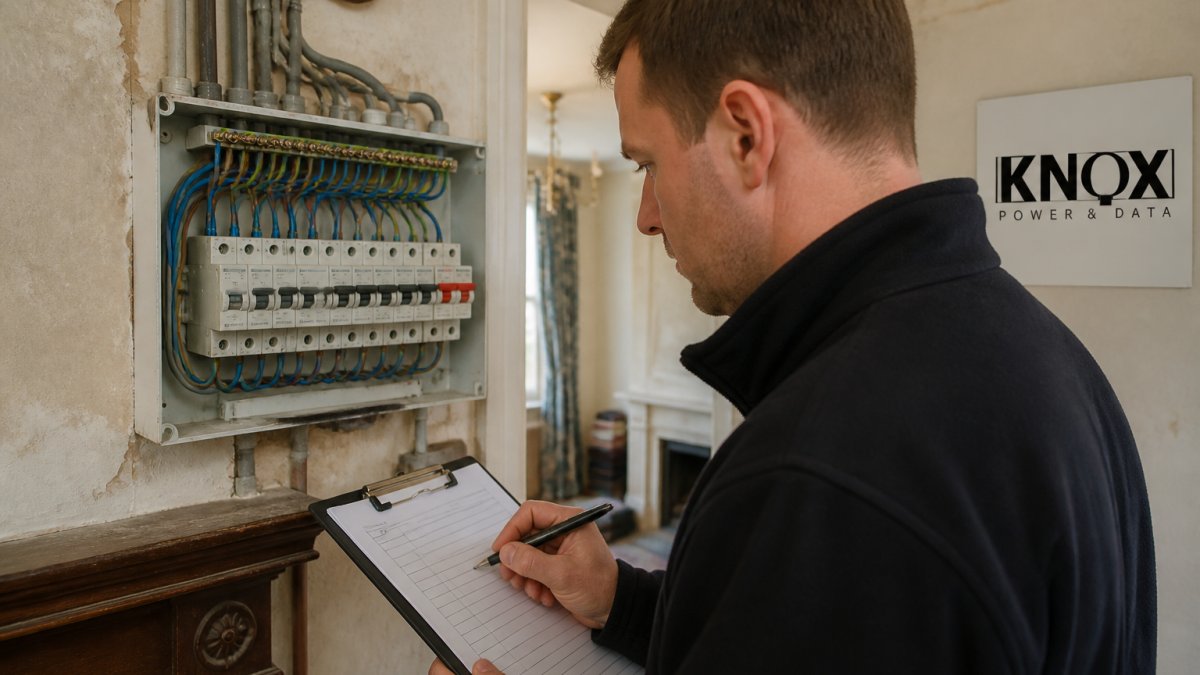
An EICR establishes the condition of the installation on the day it was tested and grades defects by code. It does not certify that the wiring will remain safe, does not confirm compliance with the current edition of BS 7671 for work done decades ago, and does not compel anyone to carry out remedial work. A "satisfactory" result means no code C1 or C2 observations were recorded, not that the installation is new. Our breakdown of how to read an EICR report and understand every code explains what each code means in practice.
Here is how the EICR requirement differs between selling and letting.
| Situation | EICR required? | Note |
|---|---|---|
| Selling an owner-occupied home | No, voluntary | Not a legal requirement for sellers |
| Private rented sector letting | Yes, every five years | Duty attaches to letting, not selling |
| Satisfactory EICR result | No C1 or C2 observations | Does not mean the installation is new |
| EICR scope | Fixed wiring, consumer unit, circuits, earthing, bonding | Grades defects by code |
How to Tell if a House Needs Rewiring
The clearest signs a house needs rewiring are old cable types, a dated fuse box, and symptoms that point to a failing circuit rather than a single accessory. Look for these:
- Rubber or fabric-insulated cable, or black rubber flex at light fittings
- A fuse box with rewireable fuses rather than a modern consumer unit with RCD protection
- Round-pin sockets, or sockets mounted in skirting boards
- Lights that dim or flicker when appliances switch on
- Warm or discoloured socket outlets and light switches
- No earthing at lighting points, or earthing connected to a water pipe
- Fuses that blow repeatedly on the same circuit
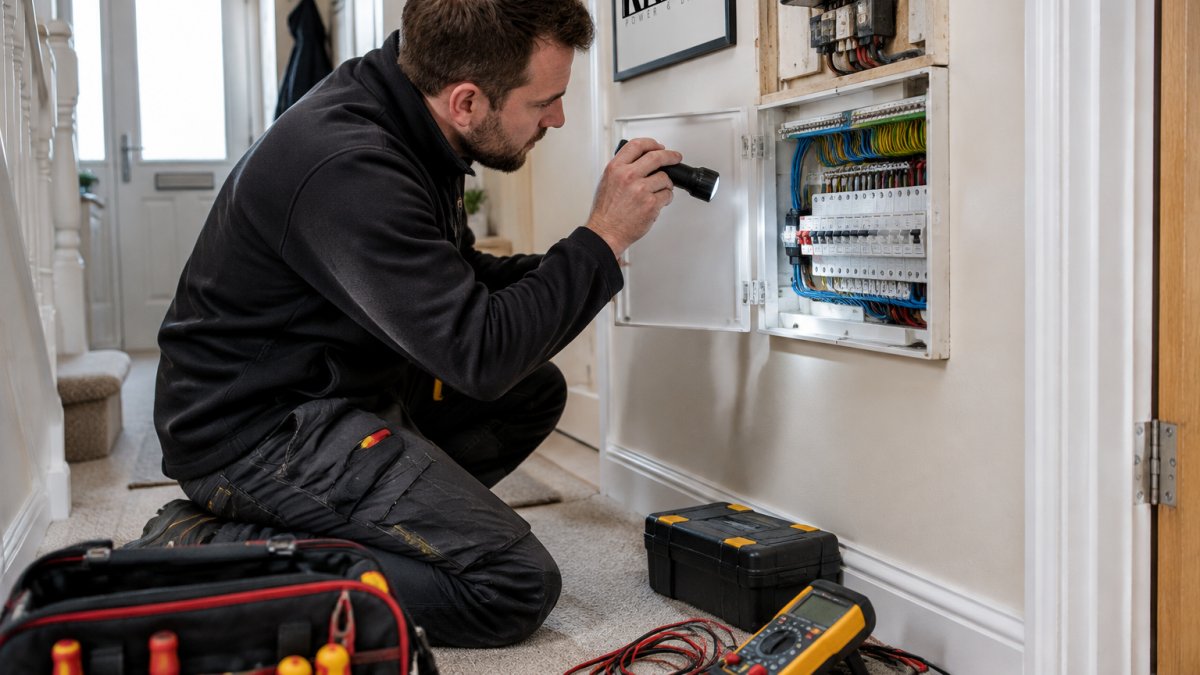
One or two of these on an otherwise sound installation often means targeted remedial work. A combination of rubber cable, rewireable fuses and no RCD protection usually points to a full rewire. Our rewiring checklist for Wakefield homes sets out the nine signs we ask sellers to check before we survey.
The Cost of a Full House Rewire and What Drives It
The cost of a full house rewire depends on property size, access, and how much making good is included.
A full rewire is a major renovation, not a maintenance item, and it should be quoted after a survey rather than over the phone. Our rewire cost guide for Wakefield explains what a fixed-price quote should itemise so you can compare like with like.
Pricing for a full rewire depends on several variables. Understanding them helps you see what moves the price up or down:
-
Property size and circuit count, a one-bedroom flat may need only a handful of circuits, while a four-bedroom house with outbuildings, electric heating, or a garage supply can require many more.
-
Access and making good, lifting and reinstating floors, chasing walls, and redecorating after cable runs add significant labour and finish costs. A property with solid floors or ornate plasterwork will cost more to rewire than one with easy access.
-
Occupancy, working around furniture and occupants slows progress and may require temporary supplies; a vacant property is usually quicker and cheaper.
-
Consumer unit and earthing, if the existing unit, main earthing, and bonding are inadequate, these must be upgraded as part of the rewire, adding to the total.
-
Certification and notification, a full rewire is notifiable work under Building Regulations in England and Wales, and the cost of certification and building control notification should be included in any quote.
When comparing quotes, always ask for a fixed-price quote that itemises labour, materials, making good, and certification so you can compare like with like.
Selling a Property With Old Wiring: Buyer Surveys and Negotiations
Old wiring rarely stops a sale, but it changes the conversation.
You have three realistic options at that point. You can rewire before listing and market the property with a satisfactory EICR in hand. You can list as seen and negotiate, accepting that the report will be used as leverage. Or you can commission an EICR yourself and disclose the findings up front, which takes the surprise out of the survey and usually shortens the negotiation.
To decide which route fits your sale, work through the following framework:
- Assess the wiring condition. If an EICR records C1 or C2 observations (danger present or potentially dangerous), a buyer's survey is likely to flag them. If the report is satisfactory with only C3 observations (improvement recommended), the negotiation risk is much lower.
- Consider your buyer type. A cash buyer or investor may accept old wiring and factor it into their offer; a mortgage lender may require remedial work before releasing funds, particularly if the survey notes safety issues.
- Weigh your sale timeline. A rewire typically takes days to weeks depending on property size and access, and can delay a sale. If you need to move quickly, negotiating a price reduction may be faster than completing the work yourself.
- Check your conveyancing contract. Your conveyancer should confirm how the sale contract treats the electrical installation. Some contracts include a clause that the buyer accepts the property in its current condition; others may require you to disclose known defects. Misrepresenting the condition can be an offence under the Consumer Protection from Unfair Trading Regulations 2008.
- Decide on the negotiation mechanism. You can agree a price reduction, offer a contribution towards the buyer's costs, or sell as-is with the report disclosed. Each has different implications for your net proceeds and the speed of exchange.
Watch out: agreeing a price reduction without a written variation to the contract can leave you exposed if the buyer later claims the reduction was conditional on work being done. Always confirm the terms with your conveyancer before exchange.
Marketing a property as "recently rewired" without paperwork to prove it invites a challenge you cannot answer. Keep the certificate, the building regulations notification and the invoice.
Rewire Before Listing or Leave It to the Buyer?
Rewiring before listing suits sellers who want a clean, fast sale and can fund the work. Leaving it to the buyer suits sellers who need to move quickly, cannot fund the work, or own a property where the installation is sound and the survey is unlikely to raise anything serious.
A satisfactory EICR is often the better first step for sellers. It costs far less than a rewire, gives the buyer documented evidence, and tells you whether a rewire is even necessary. If the report comes back clean, you have saved the cost of unnecessary work. If it doesn't, you know exactly what you are negotiating over.
Book an EICR Before You List Your Property
The practical next step is straightforward: get the installation inspected before the property goes on the market, not after a buyer's survey forces the issue. At Knox Power & Data, our NAPIT-registered team (Member No. 69848) carries out EICR testing and full or partial rewires across West Yorkshire.
You can arrange house rewiring in Wakefield or book an EICR through the same visit, and we will tell you plainly whether your installation needs a full rewire or targeted remedial work. Get started with Knox Power & Data and list your property with the paperwork a buyer actually wants to see.
Frequently Asked Questions
Is it a legal requirement to rewire a house before selling?
No. There is no statute that makes a full house rewire a legal prerequisite for a property sale. What governs the transaction is disclosure and safety: if your electrical installation is unsafe, that becomes a defect a buyer's survey can flag. Landlords face separate rules, including mandatory EICRs every five years for tenanted properties. For owner-occupiers selling up, the practical driver is the buyer's survey and their lender's requirements, not a rewiring mandate.
How does an EICR affect a property sale?
An Electrical Installation Condition Report records the condition of the wiring, consumer unit, earthing and circuits, and grades defects as C1 (danger present), C2 (potentially dangerous) or C3 (improvement recommended). A satisfactory EICR reassures buyers and can speed up a sale. An unsatisfactory one does not block the sale, but buyers often use it to request a price reduction or ask you to complete remedial work. It is evidence, not a legal pass or fail certificate.
Will a buyer pull out if the house needs a rewire?
Some will, particularly if the report shows C1 or C2 defects and the buyer needs a mortgage. Most negotiations resolve differently: the buyer asks for a price reduction or a credit to cover the cost of a full house rewire. A clear EICR plus quotes for the remedial work puts you in a stronger position than an unassessed installation, because you can negotiate from evidence rather than speculation.
Can I sell a house with non-compliant electrical wiring?
Yes. Non-compliant wiring is not automatically a bar to selling, but it must be disclosed honestly and it will surface in the buyer's survey. The risk sits in safety and insurability: outdated wiring, a lack of earthing or a fuse box with no RCD protection can make a property harder to insure and harder to mortgage. A qualified electrician can tell you whether targeted remedial work is enough or whether a full rewire is the sensible route.
How much does a full house rewire cost?
Pricing depends on the size of the property, the number of circuits and sockets, whether walls and ceilings need making good, and how accessible the existing wiring routes are. A three-bedroom semi with easy loft and floorboard access costs far less than a period property with solid walls. Get a site-specific quote rather than relying on a ballpark, and ask for the EICR findings and remedial schedule in writing so you can compare like for like.
The assumption that a rewire is compulsory costs sellers money they don't need to spend. Get the installation tested, read the findings, and negotiate from evidence rather than fear.