 listicle
How to Spot Signs of Faulty Electrical Wiring in Homes
Last Updated: November 11, 2026
Quick Summary
The signs of faulty electrical wiring in homes include flickering or dimming lights, warm or discoloured outlets, buzzing or crackling sounds, a burning smell, breakers that trip repeatedly, scorch marks, sparking outlets and extension cords used as permanent wiring. Three or more of these together is a pattern that points to the wiring behind the wall.
- Electrical malfunctions are linked to an estimated 51,000 house fires every year, with nearly 500 deaths in residential electrical fires annually.
- Switch off at the breaker and have a qualified electrician inspect any outlet or switch plate that feels warm or looks discoloured.
- If a breaker trips with nothing plugged in, stop resetting it and treat it as a failing consumer unit or degraded wiring.
- A plug-in socket tester costing around £15-£30 confirms polarity and earth presence but says nothing about the cable behind it.
- An EICR classifies observations as C1, C2, C3 or FI, and a report with C1 or C2 observations can stall a sale.
Table of Contents
- Eight Warning Signs of Faulty Electrical Wiring in Homes
- Flickering Lights Causes: What the Flicker Is Telling You
- When a Circuit Breaker Keeps Tripping
- An Electrical Burning Smell in the House: Act Immediately
- Signs a House Needs Rewiring: Age, Materials and Warning Combinations
- DIY Checks vs Professional Inspection: Where the Line Sits
- Book a Fault-Finding Inspection with Knox Power & Data
- Frequently Asked Questions
Eight Warning Signs of Faulty Electrical Wiring in Homes
Electrical malfunctions are linked to an estimated 51,000 house fires every year, according to the Electrical Safety Foundation International, and nearly 500 people die in residential electrical fires annually.
Here are the eight signs that matter most:
- Flickering or dimming lights that pulse when appliances switch on
- Warm or discoloured outlets and switch plates
- Buzzing, crackling or humming sounds from fittings
- A burning or acrid smell with no obvious source
- Breakers that trip repeatedly for no clear reason
- Scorch marks or charring around sockets
- Sparking outlets when you plug something in
- Extension cords used as permanent wiring
One or two isolated incidents can be innocent. Three or more together is a pattern, and patterns point to the wiring behind the wall.
Flickering or Dimming Lights
Flickering lights are a common sign of faulty electrical wiring, and one that is easily ignored. A single lamp that flickers is usually a loose bulb or a tired fitting.
In newer properties, dimming often traces back to a loose neutral at the consumer unit. In older homes, it is frequently wiring insulation that has degraded past the point of safe use.
Warm or Discoloured Outlets and Switch Plates
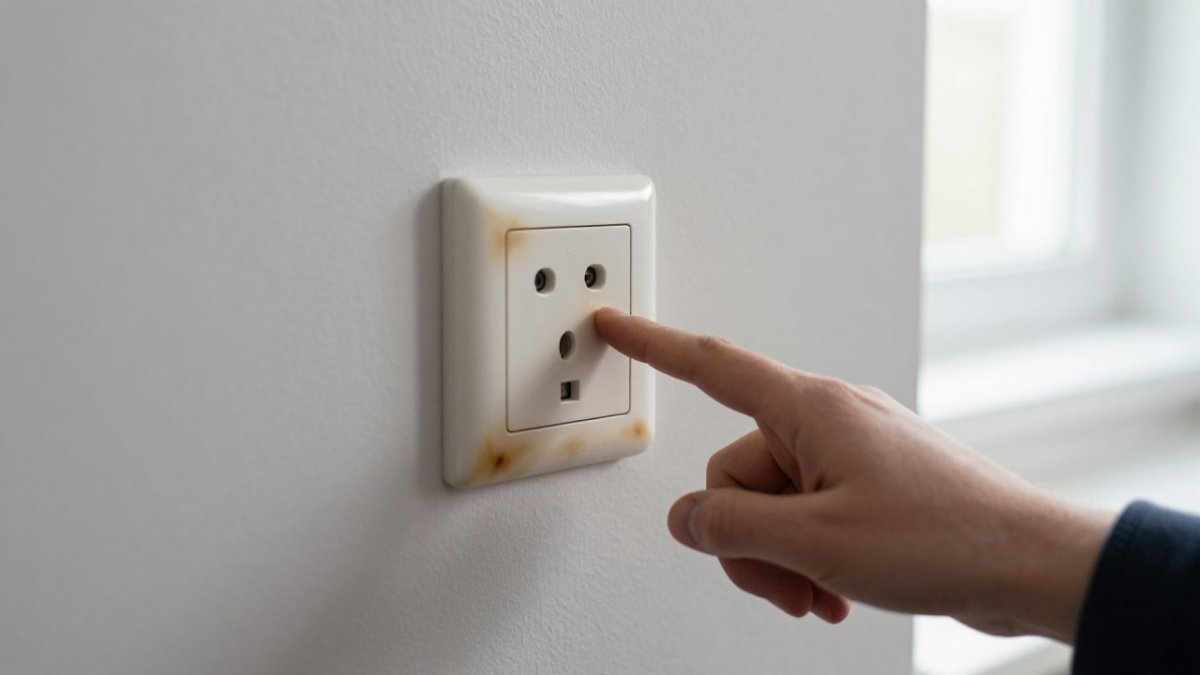
An outlet or switch plate that feels warm to the touch is a live warning. Heat means resistance, and resistance means a connection is arcing or loosening. Brown or yellow discolouration around the plate is thermal damage you can see.
Switch it off at the breaker and leave it alone, and have a qualified electrician inspect it.
Buzzing, Crackling or Humming Sounds
Buzzing from a light fitting or crackling from a socket is arcing, and arcing starts fires. A faint hum from a dimmer switch can be normal. A crackle, a pop, or a buzz that appears when nothing has changed is not.
Here are the eight warning signs of faulty wiring the article highlights, with what each one usually means.
| Warning sign | What it usually indicates |
|---|---|
| Flickering or dimming lights | Circuit struggling under load or a loose connection |
| Warm or discoloured outlets and switch plates | Resistance, arcing or a loosening connection |
| Buzzing, crackling or humming sounds | Arcing from fittings, which starts fires |
| Burning or acrid smell with no source | Overheating plastic insulation behind the wall |
| Breakers that trip repeatedly | Overload, faulty appliance, short circuit or ground fault |
| Scorch marks or charring around sockets | Thermal damage from an overheating connection |
| Sparking outlets when plugging in | Arcing at the outlet |
| Extension cords used as permanent wiring | Overloaded or undersized circuit |
Flickering Lights Causes: What the Flicker Is Telling You
The most common flickering lights causes are loose bulbs, overloaded circuits, voltage drop and failing connections at the consumer unit. Which one you have depends on when the flicker happens.
- Flickers when an appliance starts: the circuit is overloaded, or the wiring is undersized for the load.
- Flickers constantly in one room: a loose connection in that circuit or at the fitting.
- Pulses across the whole house: a supply-side or consumer unit problem, which needs professional testing.
Voltage drop is the one homeowners rarely consider. Long cable runs and undersized cable cause the voltage to sag under load, so lights dim when demand spikes. It is a design fault, not a lamp fault, and no bulb change will fix it.
When a Circuit Breaker Keeps Tripping
A circuit breaker that keeps tripping is doing its job. It is protecting the cable from overheating, and resetting it without finding the cause is how people turn a nuisance into a fire risk.
The usual culprits are overloaded circuits, a faulty appliance, a short circuit, or a ground fault where current is leaking to earth. One way to narrow it down is to unplug everything on that circuit and reset the breaker.
If the breaker trips with nothing plugged in, stop resetting it. Repeated tripping often points to a failing consumer unit or degraded wiring, and our guide on signs your consumer unit needs replacing covers when replacement becomes the sensible option rather than the expensive one.
An Electrical Burning Smell in the House: Act Immediately
An electrical burning smell in the house means something is overheating right now.
The smell is often described as fishy or acrid. It comes from overheated plastic insulation, and by the time you can smell it, the wiring behind the wall has already been running hot.
If there is smoke, flame, or the smell is strong and worsening, leave the property and call the fire service.
Signs a House Needs Rewiring: Age, Materials and Warning Combinations
The clearest signs a house needs rewiring are old cable types that have passed their safe service life, accessories that belong to a previous era, and two or more of the warning signs above appearing together. Age alone is not a verdict, but age plus symptoms usually is.
Identify the wiring type before you panic
You can often tell the era of a property's wiring from the accessories and any visible cable:
- Rubber-insulated cable (pre-1960s). Often black, sometimes cloth-braided, and it crumbles or cracks when flexed. Rubber insulation becomes brittle with heat and age and is a genuine rewire trigger.
- Lead-sheathed cable. A soft grey metallic sheath over the conductors, usually pre-war. The sheath cracks and the insulation beneath perishes.
- Fabric-braided flex. Common on older pendant lights and immersion heaters; the braid hides perished rubber underneath.
Properties from the 1970s and 1980s may have PVC cable that has since gone brittle at terminations and in lofts where it has baked in summer heat. Wiring that predates the current edition of BS 7671 wiring regulations is not automatically dangerous, but it deserves a proper inspection rather than an assumption either way.
The warning combinations that tip the balance
A single symptom in an otherwise modern installation is usually a local fault. The pattern that points to a rewire is:
- Two or more of the eight warning signs appearing in different parts of the house.
- Symptoms that return after a repair, a tripping breaker that is reset and trips again within days.
- A consumer unit with no spare ways and no RCD protection, combined with any of the symptoms above.
Our rewiring checklist walks through the specific signs to look for room by room. If the answer is yes, the next question is scope, and our guide to full versus partial rewires explains which one your situation calls for.
The insurance and resale consequences
Faulty wiring is not only a safety issue, it is a financial one.
On the resale side, a buyer's solicitor will typically ask for an EICR, and a report with C1 or C2 observations can stall a sale or force a price reduction.
Watch out: do not accept a verbal "it looks fine" from anyone inspecting your wiring, ask for the written EICR with observation codes, because that is the document insurers and conveyancers will rely on.
DIY Checks vs Professional Inspection: Where the Line Sits
Most guides list symptoms and then tell you to call an electrician. That leaves the most practical question unanswered: what can you actually check yourself without putting yourself at risk? The line is drawn by what is dead, what is surface-level, and what requires test equipment and a competent person under BS 7671 wiring regulations.
What a homeowner can safely check
These checks involve no tools beyond your eyes, nose and a socket tester, and no removal of fittings:
- Visual scan of every socket and switch plate for browning, yellowing, cracking, scorch marks or a plate that sits proud of the wall.
- The back-of-hand test on outlet and switch plates, warm is a warning, hot is a stop signal.
- Listen at each fitting with the circuit energised and appliances off; crackling or buzzing that appears without a change in load is arcing until proven otherwise.
What requires a competent person
Everything behind the accessory plate is out of scope for a homeowner.
A socket tester will not tell you whether the cable behind the wall has degraded, whether a junction box in the loft is overheating, or whether the earthing arrangement is adequate for the supply type.
Watch out: never remove a socket or switch to "take a look", the terminals may still be live after the breaker is off if the circuit is incorrectly wired, and a loose conductor can arc the moment it is disturbed.
What a professional inspection actually involves
An Electrical Installation Condition Report (EICR) is the formal answer. A qualified electrician isolates and tests each circuit, measuring insulation resistance, earth continuity, polarity, ring-circuit continuity and RCD operation, then issues a written report classifying observations as C1 (danger present), C2 (potentially dangerous), C3 (improvement recommended) or FI (further investigation).
If you want that inspection carried out properly, you can book an EICR inspection with a NAPIT-registered team.
Book a Fault-Finding Inspection with Knox Power & Data
Two or more warning signs together is your cue to stop guessing. Knox Power & Data is NAPIT registered (Member No. 69848), BS 7671 18th Edition and Inspection qualified, and fully insured for domestic and commercial sites.
We trace faults, test to current regulations and certify every installation we touch. If the diagnosis is a rewire, we scope it honestly, and you can arrange a house rewire with a free survey and a fixed quote.
If your lights flicker when the kettle goes on, or a socket has started to discolour, do not wait for the third sign.
Frequently Asked Questions
What are the first signs of faulty electrical wiring in a home?
The earliest signs usually show up at the outlet or the consumer unit: warm or discoloured switch plates, a faint burning smell, buzzing or crackling sounds, and breakers that trip more often than they used to. Flickering lights and a growing reliance on extension cords are also common early indicators. Treat any combination of these as a prompt to book an inspection rather than something to monitor.
Why do my lights flicker or dim, and is it dangerous?
Flickering lights causes range from a loose lamp connection to a loose neutral at the consumer unit or a voltage drop on an overloaded circuit. A single flickering bulb is usually harmless. Lights that dim when an appliance starts, or flicker across several rooms at once, point to a wiring or load problem behind the wall. That pattern needs a qualified electrician to test the circuit, because the fault is often hidden from view.
Is a burning smell from a socket an emergency?
Yes. An electrical burning smell in the house means heat is being generated where it should not be, often at a loose connection, a failing accessory or damaged wiring insulation. Switch off the circuit at the consumer unit if you can do so safely, unplug nearby appliances, and call an electrician the same day. Do not keep using the socket to test whether the smell returns.
How do I know if my house needs rewiring rather than a small repair?
Signs a house needs rewiring include rubber or fabric-insulated cables, an old fuse box with rewireable fuses, no RCD protection, and repeated faults across several circuits rather than one. Age matters too: wiring installed decades ago may not meet current BS 7671 requirements or handle modern electrical loads. A full EICR inspection is the only reliable way to confirm the condition of the wiring behind the walls.