 how-to
7 Steps to Take When Your RCD Keeps Tripping After Heavy Rain
Last Updated: October 24, 2026
Quick Summary
If your RCD keeps tripping after heavy rain, moisture is almost certainly reaching a circuit it shouldn't, so isolate the affected circuit at the consumer unit and reset the RCD once rather than repeatedly. Switch off every MCB on the affected RCD, reset it, then switch breakers back on one at a time to find the circuit. If it trips with nothing plugged in, treat it as a wiring fault and call an electrician.
- An RCD protects people, not wiring, and trips when it detects leakage to earth.
- An outdoor socket is the single most common rain-related culprit found.
- Never remove a socket faceplate or open a junction box to check for water.
- A washing machine or tumble dryer with a damp internal connection can trip only when running.
- Stop and call an electrician if you see water inside an accessory or smell burning.
Table of Contents
- Why Your RCD Keeps Tripping After Heavy Rain
- How to Find Which Circuit Is Tripping an RCD
- How to Reset an RCD Safely
- Water in an Outdoor Socket Causing an RCD to Trip
- Distinguishing an Appliance Fault From a Wiring Fault
- When to Call an Electrician for a Tripping RCD
- Book a Rain-Fault Diagnosis With Knox Power & Data
- Frequently Asked Questions
Why Your RCD Keeps Tripping After Heavy Rain
If your RCD keeps tripping after heavy rain, the cause is almost always moisture reaching a circuit it shouldn't.
An RCD (residual current device) is a safety switch that monitors the current flowing through a circuit and trips when it detects leakage to earth. It protects people, not wiring. That distinction matters, because it tells you what a trip actually means.
How an RCD Detects Earth Leakage
Current should leave through the live wire and return through the neutral. When some of it escapes to earth instead, the RCD senses the imbalance and disconnects the circuit. Damp materials, wet cable joints and water-filled enclosures all create that escape route. The device has no idea where the leak is, only that one exists.
Why Wet Weather Triggers a Trip
Dry faults sit dormant for months. Rain turns them live. A cracked cable gland, a tired seal on an outdoor socket, or a junction box with a loose lid all let water in. Once moisture bridges a live part to earth, the RCD trips, often within seconds of the rain starting. This is why the fault seems to appear from nowhere on a wet day.
How to Find Which Circuit Is Tripping an RCD
Start at the consumer unit. An RCD that protects several circuits at once gives you no clue on its own, so you need to narrow it down by isolation. Switch off every MCB on the affected RCD, reset the device, then switch the breakers back on one at a time.
A common mistake is resetting repeatedly without isolating anything. Each reset puts the fault back under load, and on a genuine earth fault that is wasted effort at best.
How to Reset an RCD Safely
Resetting an RCD safely means three things: dry hands, a dry area, and no assumptions. Follow this sequence:
- Switch off the appliances on the affected circuit
- Push the RCD switch fully down to the off position
- Push it back up firmly until it clicks and stays
An RCD that will not reset at all, even with every appliance removed, is telling you the fault is in the fixed wiring. That is not a DIY job.
Resetting an RCD safely follows a fixed sequence, and what happens at each stage tells you where the fault lies.
| Step | What to do | What it tells you |
|---|---|---|
| 1 | Switch off the appliances on the affected circuit | Removes appliance load from the test |
| 2 | Push the RCD switch fully down to the off position | Resets the device ready to be re-engaged |
| 3 | Push it back up firmly until it clicks and stays | A device that holds is not necessarily fault-free |
| 4 | If it holds, reconnect appliances one at a time | Tripping on one appliance points to that appliance |
| 5 | If it trips immediately with nothing plugged in, stop | Treat as a wiring fault, not a DIY job |
Water in an Outdoor Socket Causing an RCD to Trip
An outdoor socket is the single most common rain-related culprit we find. Water gets past the cover, sits in the back box, and bridges the contacts.
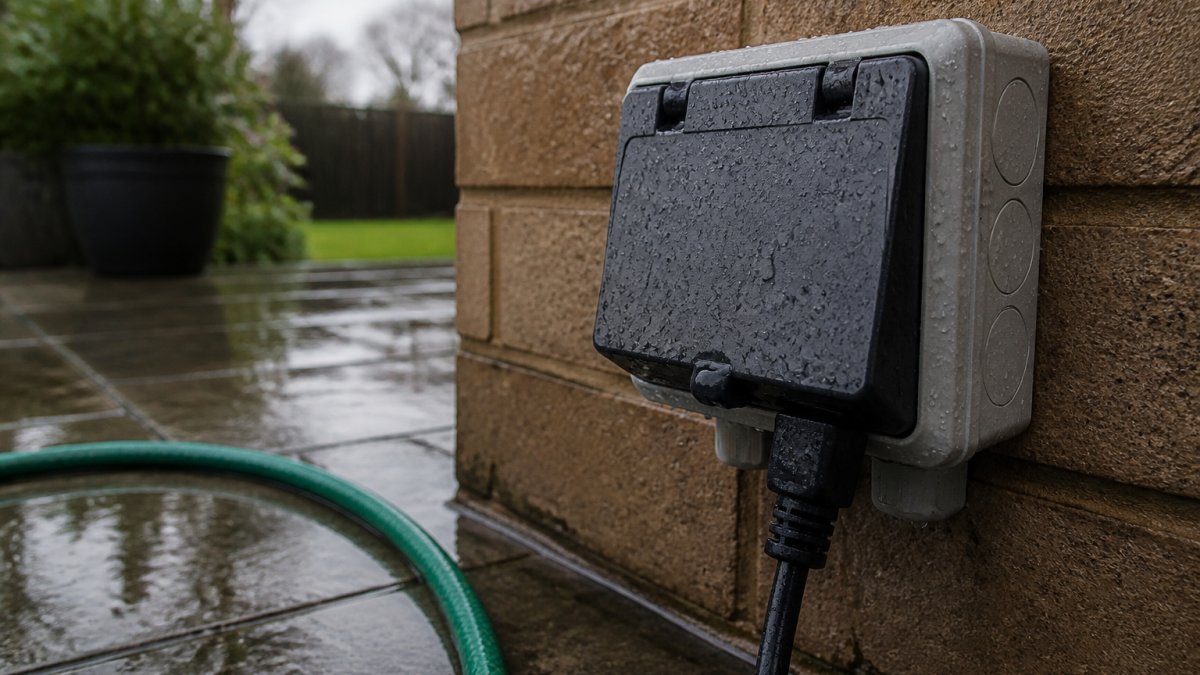
But the socket itself is only one point on a longer list. Rain-related earth faults follow water, and water follows cable routes, fixings and enclosures. A rain-specific diagnostic sequence works better than guessing at the socket first.
A Rain-Specific Diagnostic Sequence
Work through these steps in order. Each one narrows the search without opening anything.
- Confirm the link to rainfall. Note when the RCD trips relative to the weather. A trip within minutes of rain starting, or during driving rain on a particular wall, points to an exposed enclosure. A trip hours later, as water soaks through a cable route or a wall, points to a buried joint or a damaged cable sheath. A trip that only happens when an outdoor appliance is running in wet conditions points to that appliance or its lead.
- Identify the affected circuit. Isolate MCBs one at a time as described above. Write down whether the tripping circuit is the general sockets, the lights, a dedicated outdoor circuit, or a garage or shed supply. This single observation tells an electrician where to start.
- Map the outdoor points on that circuit. Walk the route the circuit takes. List every accessory on it: exterior lights, outdoor sockets, garden equipment, shed and garage supplies, pond or water-feature equipment, gate and doorbell transformers, and any junction box or adaptable box on an outside wall.
- Check the weather-facing side of each point. Look at the wall that takes the prevailing rain. Covers that face the weather, cable entries on the upwind side, and enclosures below a leaking gutter or a blocked downpipe are all higher risk.
- Repeat the reset only after isolation. Do not reset repeatedly to "see if it holds". Each reset puts the fault back under load. Isolate first, then reset once to confirm the circuit.
Outdoor and Building Locations Where Rain Gets In
Check these spots first, because they account for most wet-weather faults:
- Outdoor sockets, especially older ones with worn covers or a cover that no longer clips shut
- Exterior lights and their cable entries, particularly wall lights below a leaking gutter or on a weather-facing wall
- Garden equipment left plugged in, including mowers, strimmers and pond pumps
A common pattern is a fault that appears only in driving rain from one direction. That usually means an enclosure on the weather-facing wall, not a fault in the middle of the circuit.
Safe Checks for Water Ingress
You can look, but you must not open anything. The safe checks are visual and from a distance:
- Look at covers, seals and cable entries from the outside. A cover that is cracked, warped or no longer clips shut is a suspect.
- Look for standing water in the back box of an outdoor socket, or water tracking down the wall from a joint or enclosure.
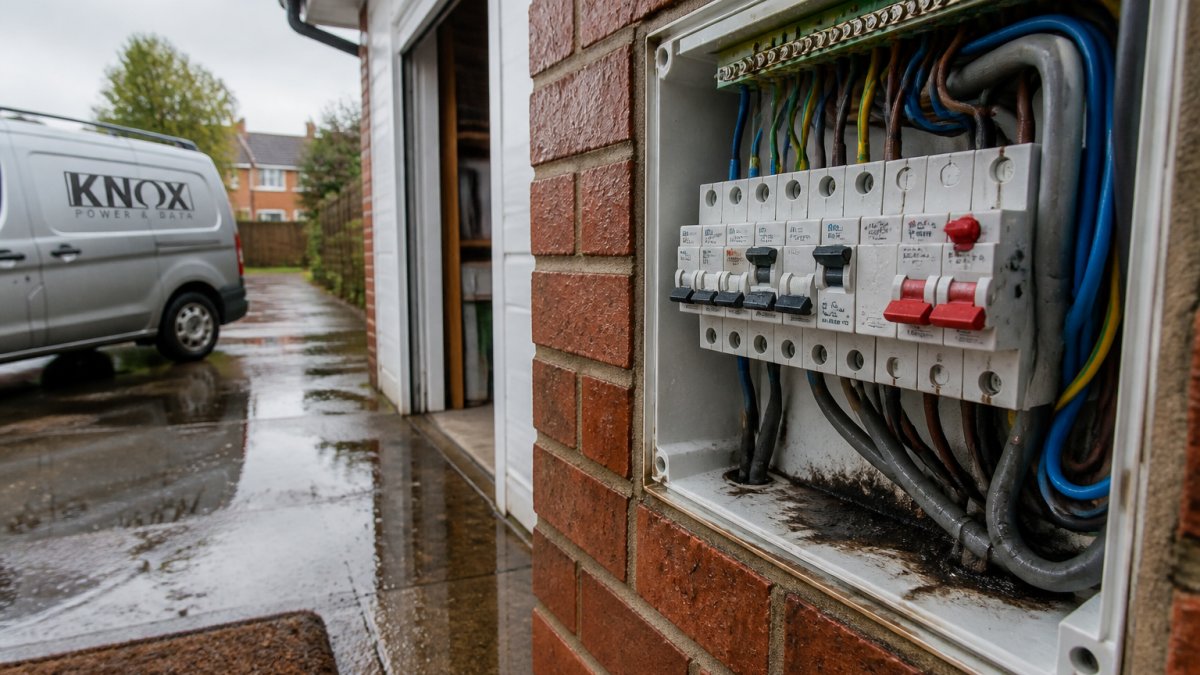
- Look for green or black discolouration, scorch marks or a damp patch around an accessory.
Never remove a socket faceplate, open a junction box or unscrew an enclosure to check inside. That work needs the circuit dead and a competent person doing it. Water and electricity are a dangerous combination, and an enclosure that looks dry on the outside can hold water behind the faceplate.
If your protection is dated, a modern RCD-protected consumer unit is the long-term fix. You can read about consumer unit replacement in Wakefield and the modern RCD-protected fuse board upgrades available. It's also worth checking the warning signs of an unsafe fuse board if the tripping keeps returning.
Distinguishing an Appliance Fault From a Wiring Fault
The test is simple: unplug everything on the affected circuit, reset the RCD, then reconnect one item at a time. If the RCD trips when a particular appliance goes back in, that appliance is your fault. Flickering lights alongside tripping point toward a wiring or connection problem rather than an appliance, and our guide to why lights keep flickering covers those symptoms in more detail.
When to Call an Electrician for a Tripping RCD
Some tripping is a nuisance; some is an emergency. The distinction matters because the wrong response, repeated resets, or poking at a wet accessory, can turn a nuisance into a danger.
Urgent Warning Signs and Emergency Escalation
Stop troubleshooting and seek urgent help if you notice any of the following:
- A burning smell, or a smell of hot plastic, near the consumer unit or an accessory
- Visible heat, scorch marks or discolouration on a socket, switch, light fitting or cable
- Buzzing, crackling or arcing sounds from an accessory or the consumer unit
In these cases, leave the affected circuit isolated, do not reset the RCD again, keep people and pets away from the area, and call a qualified electrician. Our guide to emergency electrical services in West Yorkshire explains what emergency cover involves and how to get help fast. If there is smoke, heat or a burning smell, treat it as a fire risk and call the fire service if there is any sign of fire.
Routine Reasons to Book an Electrician
Call an electrician promptly, but not as an emergency, if:
- The RCD trips repeatedly after rain, even if it resets each time
- The fault returns every time it rains, suggesting a persistent water-ingress point
- The RCD trips with everything unplugged, pointing to fixed wiring
Repeated tripping is not something to live with. A qualified electrician can test the circuit properly and find the fault rather than guessing. For urgent faults, you can book an emergency electrician in Wakefield for same-day response.
What to Do While You Wait
- Leave the affected circuit switched off at the consumer unit
- Do not keep resetting the RCD to "test" it
- Keep children and pets away from outdoor sockets, wet paving and any accessory that may be letting water in
Book a Rain-Fault Diagnosis With Knox Power & Data
Tracking down a rain-related earth fault takes patience and the right test equipment. We're NAPIT registered (Member No. 69848) and qualified to BS 7671 18th Edition, so we test the circuit properly, find the leak, and certify the repair. We offer same-day availability for emergencies, clear pricing before we start, and full testing and certification on completion.
Frequently Asked Questions
Is it safe to reset an RCD that keeps tripping?
Resetting once or twice to see whether the fault clears is reasonable. If the RCD keeps tripping straight back off, stop resetting it and start isolating circuits instead. A device that trips repeatedly is doing its job: it is detecting earth leakage and cutting the power to prevent shock and fire risk. Forcing it back on again and again, or holding the switch up, defeats that protection. If it will not reset even with every appliance unplugged, treat it as a fault needing a qualified electrician.
Why does my RCD trip when it rains?
Rain introduces moisture into places it should not reach: outdoor sockets, exterior lighting, garden equipment connections and damaged cable sheaths. Water creates a path for current to leak from live or neutral conductors to earth. An RCD measures that imbalance and trips at around 30mA. The fault is often outdoors even when the tripping only shows up indoors, which is why a rain-specific diagnostic sequence starts at the exterior fittings rather than the consumer unit.
Can water in an outdoor socket cause an RCD to trip?
Yes. An outdoor socket with a cracked cover, a perished seal or a loose gland can let rainwater reach the terminals, producing earth leakage on that circuit. Do not open the socket or poke inside it. Switch off the circuit at the consumer unit, unplug anything connected, and check the cover and seal from the outside only. If the socket looks damaged or water is visible inside the enclosure, leave it isolated and have it inspected and replaced by a qualified electrician.
When should I call an electrician about an RCD that trips in wet weather?
Call an electrician if the RCD will not reset with all appliances disconnected, if it trips again immediately after resetting, if you smell burning or see scorch marks, if any socket or fitting feels hot, or if the same circuit trips every time it rains. Repeated tripping after heavy rain usually points to water ingress that needs finding and repairing, not just resetting. A NAPIT-registered electrician can test the circuit, locate the leakage path and certify the repair.
If your RCD keeps tripping every time it rains, stop resetting it and let us find the cause. Get started with Knox Power & Data and book a rain-fault diagnosis with same-day emergency response, NAPIT-registered testing, and a certified repair.