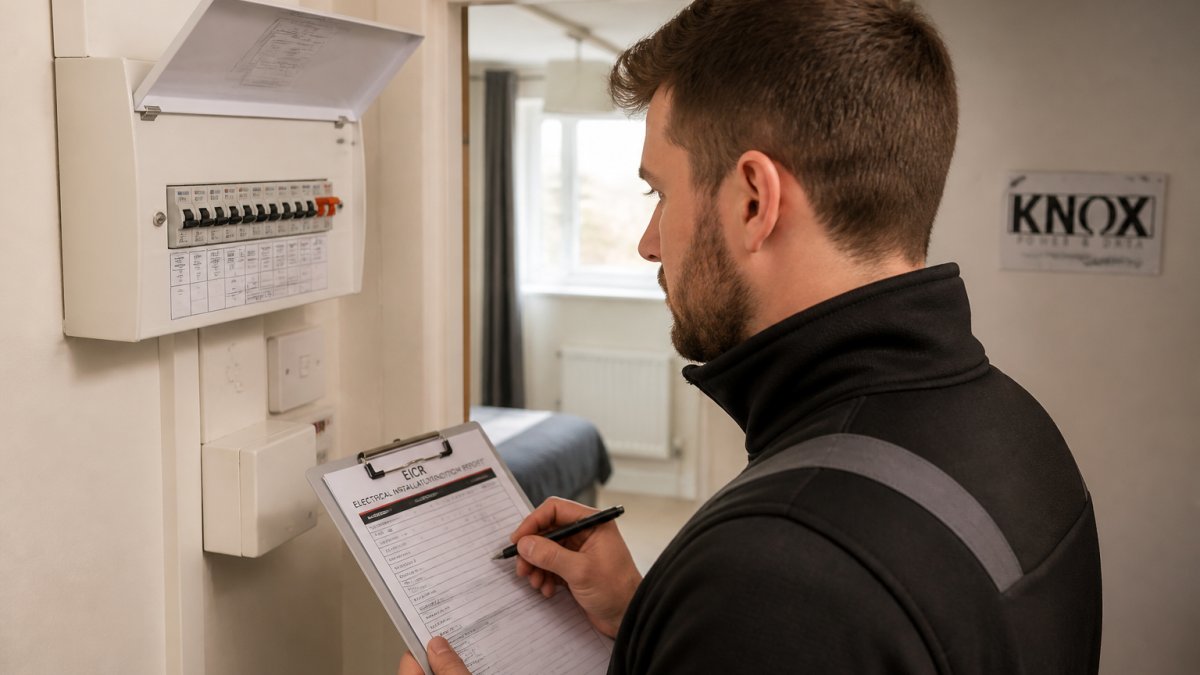
 how-to
How Often Do Landlords Need an EICR? UK Rules Explained
Table of Contents
- How Often Do Landlords Need an EICR? The Five-Year Rule
- How Long Does an EICR Last and How to Calculate Your Renewal Date
- EICR Requirements for Landlords: What the Law Actually Says
- EICR for a New Tenancy: Does a Change of Tenant Mean a New Report?
- Unsatisfactory Reports and the EICR Remedial Work Deadline
- Who Can Carry Out an EICR and How to Verify Competence
- Preparing for the Inspection and Keeping Records That Stand Up
- Frequently Asked Questions
Last Updated: October 17, 2026
How Often Do Landlords Need an EICR? The Five-Year Rule
Most landlords need a landlord EICR every five years. But the five-year rule is a minimum, not a fixed schedule, and getting that distinction wrong is where compliance problems start.
We carry out EICR testing across West Yorkshire, and the same question comes up on almost every job.
Below, we break down the five-year rule, the situations that force an earlier inspection, and how to work out your actual renewal date.
When an Earlier Inspection Is Required
An EICR can demand an earlier inspection than five years, and the report itself is the authority on when. An inspector may set a shorter interval if they find wear, damage, or ageing parts.
Other triggers force a new inspection regardless of the calendar:
- A change of tenant where the previous report is more than five years old
- Significant electrical work since the last inspection
- Storm, flood or fire damage affecting the installation
The official guidance on electrical safety standards in the private rented sector sets out the core duties, and it makes clear that the report's own recommended date takes priority.
How Long Does an EICR Last and How to Calculate Your Renewal Date
A landlord EICR lasts five years from the date of inspection for most rented homes, but the report's "next inspection due" field overrides that default. Calculating your renewal date takes about two minutes.
Here is how to do it:
- Find the date of inspection on page one of the report.
- Find the next inspection due box, usually on the same page.
- If a date is written there, that is your deadline. Use it.
- If the box is blank or says five years, add five years to the inspection date.
- Set a calendar reminder three months before that date to book the next test.
| Report Field | What It Means | Your Action |
|---|---|---|
| Date of inspection | When the test was carried out | Starting point for your five years |
| Next inspection due | Inspector's recommended date | Treat this as your hard deadline |
| Overall condition | Satisfactory or unsatisfactory | Unsatisfactory means remedial work first |
| Observations and codes | C1, C2, C3, FI findings | C1 and C2 need urgent attention |
Keep the report with your tenancy paperwork and give a copy to each tenant. Many landlords now store a PDF alongside the tenancy agreement and the gas safety record.
EICR Requirements for Landlords: What the Law Actually Says
EICR requirements for landlords in England centre on one duty: every electrical installation in a rented property must be inspected and tested by a qualified person at least every five years, and the report must be given to tenants. The Electrical Safety Standards in the Private Rented Sector (England) Regulations 2020 set this out, along with the duty to complete remedial work within 28 days where the report is unsatisfactory, and the duty to supply a copy of the report to the local authority within seven days of a written request.
The rules differ across the UK. A landlord with a property in Cardiff and another in Glasgow is subject to two different regimes, with different paperwork, enforcement bodies and triggers. The table below compares them.
England, Wales, Scotland and Northern Ireland Compared
| Jurisdiction | Core duty | Trigger for a new inspection | Report to tenant | Enforcement |
|---|---|---|---|---|
| England | Electrical Safety Standards in the Private Rented Sector (England) Regulations 2020 | At least every five years; before a new tenancy where no valid report exists; on a written request from the local authority | Before the tenancy begins, and within 28 days of a request | Local authority housing enforcement; financial penalties up to £30,000 |
| Wales | Renting Homes (Wales) Act 2016 and the Fitness for Human Habitation regime | At least every five years; the property must be fit for human habitation at the start of and throughout the contract | Before the occupation contract begins | Local authority; rent repayment and enforcement powers |
| Scotland | Repairing Standard under the Housing (Scotland) Act 2006 | The installation must be safe and in good repair; evidence of inspection is expected, and a five-year cycle is the practical norm | On request, and as part of the Repairing Standard evidence pack | Local authority; First-tier Tribunal for Scotland |
| Northern Ireland | Private Tenancies (Northern Ireland) Order 2006 and associated electrical safety duties | Landlord must ensure the installation is safe; a five-year inspection cycle is the recognised standard | On request | Local council environmental health |
- England is the most prescriptive. The 2020 Regulations name the five-year interval, the 28-day remedial deadline, the seven-day council response window and the penalty ceiling. If you let in England, that is the rulebook you are measured against.
- Wales layers fitness for human habitation on top. The five-year cycle is the working standard, but the legal test is whether the property is fit for human habitation, which can require action sooner than the calendar suggests.
- Scotland uses the Repairing Standard rather than a standalone EICR regulation. The Repairing Standard guidance requires a safe electrical installation, and the practical way to evidence that is a periodic inspection report. The First-tier Tribunal can enforce it.
EICR for a New Tenancy: Does a Change of Tenant Mean a New Report?
An EICR for a new tenancy is not automatically required if a valid report already exists. A change of tenant does not reset the clock, provided the existing report is less than five years old and satisfactory. This is the most common misconception we are asked to correct.
The rule in England
Under the Electrical Safety Standards in the Private Rented Sector (England) Regulations 2020, the duty is to have a report at least every five years and to give a copy to the tenant before the tenancy begins.
Where the report is older than five years, or was never obtained, a new tenancy does trigger the duty to inspect and test before the tenancy begins.
The rule in Wales, Scotland and Northern Ireland
- Wales: the same logic applies, a valid report can be reused across tenancies, but the property must be fit for human habitation at the start of the new occupation contract, so any C1 or C2 findings must be resolved before the contract begins.
- Scotland: the Repairing Standard applies at the start of the tenancy, so the installation must be safe and in good repair. A valid report is strong evidence, but it does not override the duty to fix anything that has become unsafe since it was issued.
- Northern Ireland: the general landlord safety duty applies, and a valid five-year report is the accepted evidence. A new tenancy does not by itself require a fresh test.
A worked example
Suppose a landlord in Leeds has a satisfactory EICR dated 12 March 2024 with a next inspection due of 12 March 2029. A new tenant moves in on 1 July 2026.
Now suppose the same landlord's report was dated 12 March 2021 and the next inspection due was 12 March 2026. The new tenancy starting 1 July 2026 falls after expiry, so a new inspection and report are required before the tenancy begins.
The decision in three lines
- Valid report in date and satisfactory? Share a copy, no new test needed.
- Report expired or missing? Book an inspection before the tenancy starts.
- Report unsatisfactory? Complete remedial work first, then re-test, then share the new report.
The tenancy change is a paperwork event, not automatically a testing event. The testing event is driven by the report's own next-inspection date and its satisfactory status, not by the tenant's name on the agreement.
Unsatisfactory Reports and the EICR Remedial Work Deadline
An unsatisfactory EICR means the installation has at least one C1 or C2 observation, and the law gives you 28 days to complete the remedial work, from the date of the inspection, not from when you read the report.
The process works like this:
- Read the observations section and note every C1 and C2 code.
- Appoint a qualified electrician to carry out the remedial work.
- Keep the invoice and any minor works certificates as evidence.
- Ask for written confirmation that the installation is now satisfactory.
- Send the confirmation to the tenant and, if requested, the council.
C3 codes are improvement recommendations, not failures, and do not trigger the 28-day rule. Fixing them at the next inspection is usually fine.
Who Can Carry Out an EICR and How to Verify Competence
Only a competent, qualified electrician can carry out an EICR, someone with inspection and testing qualifications and a working knowledge of BS 7671, the wiring regulations.
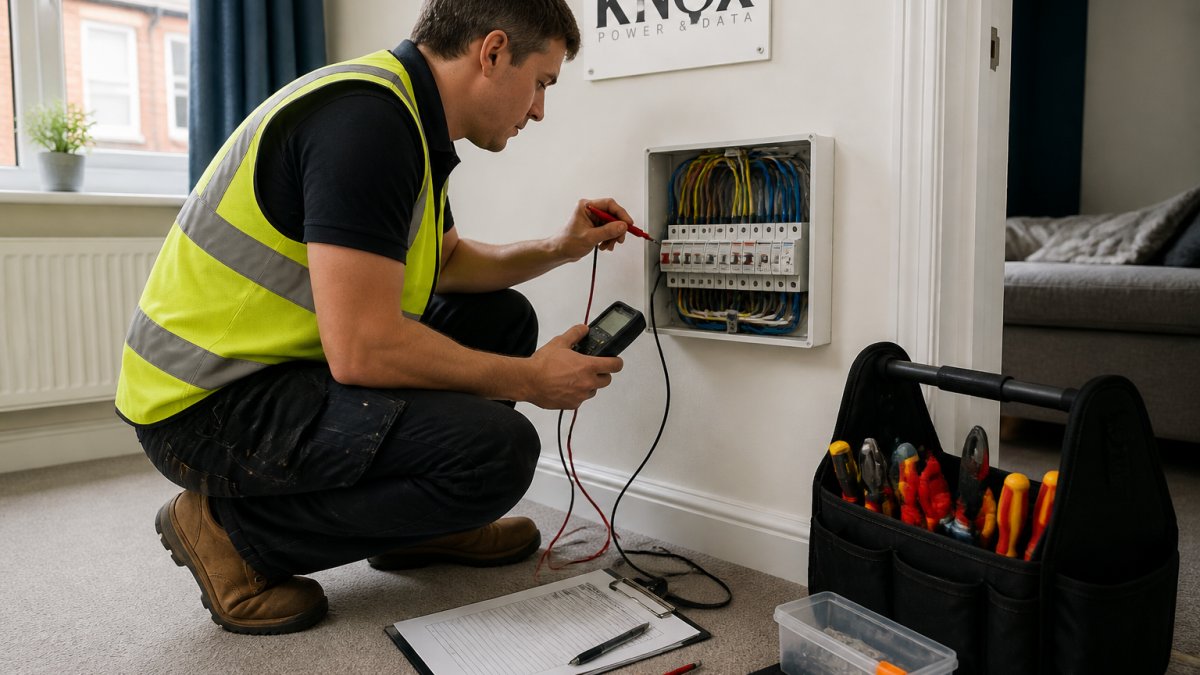
How to check the person turning up:
- Ask which competent person scheme they belong to, such as NAPIT or NICEIC
- Request their scheme membership number and verify it on the scheme's register
- Confirm they hold inspection and testing qualifications, not just installation ones
Knox Power & Data is NAPIT registered under member number 69848, and our team is qualified to BS 7671 18th Edition and inspection standards, so you can verify our competence independently.
Preparing for the Inspection and Keeping Records That Stand Up
Preparation cuts inspection time and reduces the chance of a fail. Before the electrician arrives, clear access to the consumer unit, note recent electrical work, and make sure someone can let them in.
A practical pre-inspection checklist:
- Clear the area around the consumer unit
- Gather previous EICRs and minor works certificates
- Note any sockets, lights or circuits that have played up
Keep the current EICR, any remedial certificates, and a log of the date each was issued and shared together. If a council officer asks, you should be able to produce the report and proof it was given to the tenant within minutes.
Frequently Asked Questions
How often should a landlord have an EICR carried out?
A landlord EICR is required at least every five years for privately rented property in England and Wales, and the same five-year cycle applies to private tenancies in Scotland under the Repairing Standard. The date on the previous report sets when the next one is due, and the electrician can specify a shorter interval if the installation has defects or ageing wiring. If you change tenants before that date, you still do not need a fresh report unless the existing one has expired.
Does a new tenancy mean a landlord needs a new EICR?
No. A change of tenant does not reset the clock. What matters is whether the existing report is still in date and whether it was satisfactory. You must give the new tenant a copy of the current EICR before they move in, or at the latest when the tenancy begins. A new report is only needed when the five-year interval has passed, when the report specified an earlier re-inspection date, or when the previous report was unsatisfactory and remedial work has since been completed.
How long is an EICR valid for in a rented property?
An EICR is valid for up to five years from the date of inspection, but the report itself can set a shorter re-inspection date. That date is printed on the report and is the one that counts for compliance. If the report is unsatisfactory, it is not valid for letting purposes until the required remedial work is done and the installation is confirmed as satisfactory, so the five-year period effectively restarts from the point the installation is brought up to standard.
How soon must remedial work be completed after an unsatisfactory EICR?
The regulations require remedial work to be carried out within 28 days of the report, or within the shorter period specified in the report if one is given. In practice, urgent defects such as exposed live parts, damaged consumer units or faulty earthing should be dealt with immediately, because the property should not be let with a known danger. Keep the dated invoice and any re-test certificate as proof of completion.
Electrical compliance punishes landlords who rely on memory. The five-year rule is simple, but the exceptions, the 28-day remedial deadline, and the differences between nations are where penalties creep in. Knox Power & Data provides NAPIT-registered EICR testing, remedial work, and clear certification for landlords across West Yorkshire, backed by BS 7671 18th Edition qualifications and transparent pricing. Get a quote and put your inspection schedule on a footing that stands up to scrutiny.