 how-to
Local Cat6 Installation Service Quote: 2026 Guide
Table of Contents
- What a Local Cat6 Installation Service Quote Should Include
- Commercial Data Cabling Cost Per Point: What Drives the Price
- Network Cabling Testing and Certification Standards
- Cat6 Installation Best Practices for Reliable Performance
- Step-by-Step: How to Get Your Cat6 Installation Quote
- Common Mistakes When Requesting a Cat6 Quote
- Frequently Asked Questions
Last Updated: September 18, 2026
What a Local Cat6 Installation Service Quote Should Include
A local Cat6 installation service quote is a written breakdown of the labour, materials, testing and certification needed to run structured cabling at your property. At Knox Power & Data, we issue these quotes across West Yorkshire, and the ones that hold up over time share the same structure: a clear scope, an itemised price, and a named standard the work will be tested against.
Most quotes you receive will be missing at least one of those three elements. That gap is where disputes start.
Labour, Materials and Certification Costs Explained
Every credible quote separates three cost lines rather than bundling them into one figure:
- Labour: installation time, usually priced per point or per day
- Materials: cable, outlets, patch panels, trunking and containment
- Testing and certification: the labour and equipment time to prove each link performs to spec
When a quote gives you one lump sum with no breakdown, you cannot tell whether certification is included or whether it is an optional extra added later. Ask for the split in writing.
Questions to Ask Before You Accept a Quote
Before signing anything, work through this checklist:
- Is the price per point or a fixed project total?
- Which cable category and brand is specified?
- Is testing included, and to which standard?
- Will I receive test results and a certificate on completion?
- What happens if a cable run is longer or harder than expected?
- Are containment, trunking and fire-stopping included or extra?
- What is the lead time and the payment schedule?
A quote that cannot answer these in writing is not ready to accept.
Commercial Data Cabling Cost Per Point: What Drives the Price
Commercial data cabling cost per point is driven by four things: the number of outlets, the length and difficulty of each cable run, the containment needed, and whether certification testing is included. Point count sets the baseline, but run complexity usually moves the final figure more than most buyers expect.
How Point Count and Cable Runs Affect Your Total
A point is a single terminated outlet. Ten points in one open-plan office is a straightforward job. Ten points spread across three floors, through fire compartments and around existing services, is not.
The practical variables are:
- Distance from the comms room to each outlet
- Whether cable can be run above a suspended ceiling or must be surface-mounted
- Access hours, if the site is occupied during working hours
- Whether existing containment can be reused
Ask any installer to price the runs, not just the points. A per-point figure that ignores run length is a figure that will change.
Why Site Surveys Prevent Surprise Charges
A site survey is the step that turns an estimate into a fixed quote. Without one, an installer is guessing at run lengths, containment and access, and that guess gets corrected later, usually on your invoice.
Network Cabling Testing and Certification Standards
Network cabling testing and certification standards in the UK centre on BS EN 50173 for structured cabling design and BS EN 50346 for testing installed cabling. A completed Cat6 installation should be tested link by link, with results recorded and handed over.
The testing itself covers continuity, length, wire map, attenuation, near-end crosstalk and return loss. Each link is measured against the category specification, and any link that fails is either reterminated or replaced before sign-off.
What matters for you as a buyer is the paperwork. You should receive:
- A test report for every outlet
- A certificate confirming the installation meets the specified category
- Labelled outlets and patch panel ports that match the report
Without that documentation, you have cable in a wall and no evidence it performs. If you ever sell the property or lease the unit, that evidence is what a future occupier or their IT contractor will ask for. The British Standards Institution guidance on structured cabling standards sets out why conformity to the published standard matters for installation sign-off.
Cat6 Installation Best Practices for Reliable Performance
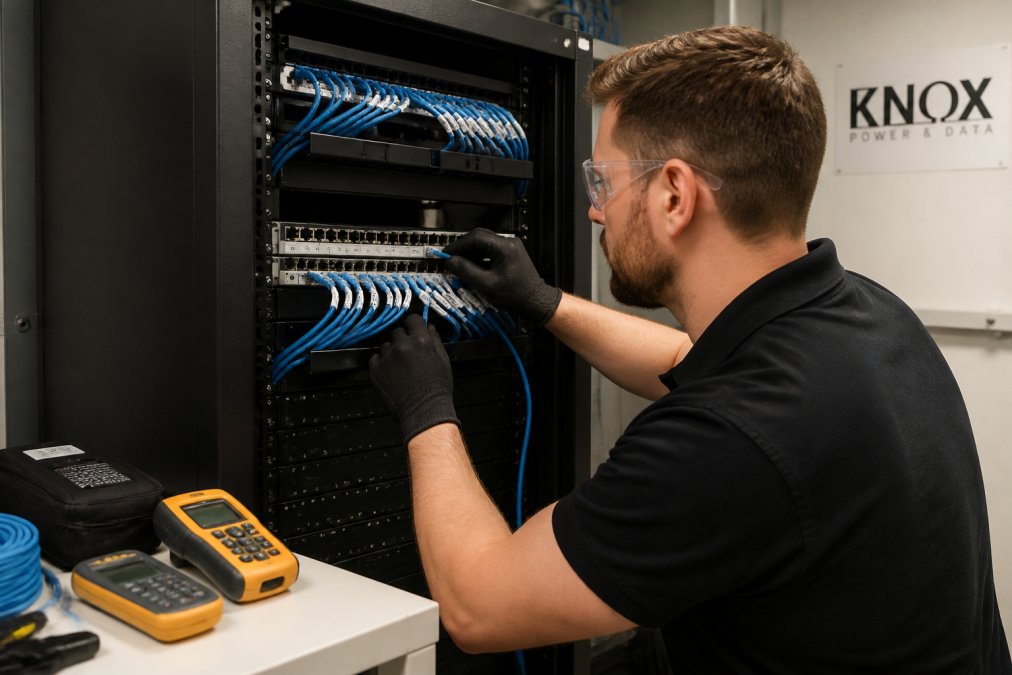
Cat6 installation best practices come down to two things: how the cable is routed and how it is terminated. Get either wrong and the link may pass a basic continuity check while failing the performance test that actually matters.
Cable Routing, Bend Radius and Separation from Power
Cat6 cable has a minimum bend radius, and exceeding it damages the twist that gives the cable its noise rejection. In practice, that means no sharp corners, no cable ties pulled tight, and no cable crushed behind a skirting board.
Separation from mains power matters just as much. Data cable run parallel to power cable for several metres will pick up interference, and the symptom is intermittent, which makes it expensive to diagnose later. Installers who know this keep data and power apart, and cross them at right angles where they must meet.
Termination, Patch Panels and Labelling
Termination is where most performance is lost. Poorly seated pairs, untwisted too far back from the connector, or a patch panel punched down to the wrong colour code will all cost you speed and stability.
Labelling is the part clients notice last and value most. A patch panel with numbered ports matching numbered outlets turns a two-hour fault-finding job into a two-minute one. Insist on it before the installer leaves site.
Step-by-Step: How to Get Your Cat6 Installation Quote
Getting a usable quote takes about a week if you follow a clear sequence. The order matters, because each step feeds the next.
- Define your requirement. Count the outlets you need and note where they go.
- Book a site survey. Have the installer walk the runs with you, not estimate from a floor plan.
- Confirm the specification. Agree the cable category, the containment approach and the testing standard in writing.
- Request an itemised quote. Labour, materials and certification as separate lines.
- Compare like for like. Check whether each quote includes testing, certification and containment.
- Ask about lead time and access. Confirm working hours and any disruption to your site.
- Accept in writing. Get the scope, price and completion date confirmed before work starts.
| Stage | What You Provide | What You Get Back | Typical Time |
|---|---|---|---|
| Requirement | Outlet count and locations | Initial indication | Same day |
| Site survey | Site access | Confirmed run lengths | 1-2 days |
| Specification | Category and standard | Written scope | 1 day |
| Quote | Nothing further | Itemised price | 2-3 days |
| Acceptance | Written approval | Scheduled start date | 1 day |
Common Mistakes When Requesting a Cat6 Quote
The most common mistake is requesting a quote over the phone. Without a survey, the installer prices a best case, and the best case rarely survives contact with the building.
Other mistakes we see regularly:
- Comparing a quote that includes certification against one that does not
- Accepting a per-point price with no cap on run length
- Leaving containment and fire-stopping out of the scope
- Not asking who owns the test results
- Choosing on price alone when the specification differs between quotes
Each of these costs money later. The fix is the same in every case: put the detail in writing before you commit.
For commercial sites, the Institution of Engineering and Technology guidance on wiring regulations is worth checking, since data cabling work often sits alongside electrical installation governed by BS 7671. Knox Power & Data holds BS 7671 18th Edition and Inspection qualifications, which means the electrical and data sides of a project can be handled by one team rather than coordinated between two.
A Cat6 installation only performs as well as the quote behind it. Vague scopes, missing certification and unpriced runs are what turn a straightforward job into a running argument.
Knox Power & Data provides structured cabling across West Yorkshire as a NAPIT-registered contractor (Member No. 69848), with combined electrical and data expertise, fully insured domestic and commercial cover, and every installation tested and certified before handover.
Frequently Asked Questions
What factors influence the cost of a Cat6 installation quote?
The main factors are the number of data points, cable run lengths, building construction (solid walls, ceilings, containment), whether containment or trunking is needed, and the level of testing and certification required. Access hours and occupied-site working can also affect labour. Because every site differs, a survey is the only way to give an accurate Cat6 installation quote. Knox Power & Data provides free, no-obligation quotes across West Yorkshire.
Do I need a NAPIT-registered electrician for data cabling?
Data cabling itself is not notifiable under Part P of the Building Regulations, so a registered electrician is not a legal requirement. However, using a NAPIT-registered installer gives you assurance that the work meets BS 7671 18th Edition where it interfaces with electrical infrastructure, and that the installer carries proper insurance and is subject to independent assessment. Knox Power & Data is NAPIT registered (Member No. 69848).
What should be included in a professional network cabling quote?
A thorough quote should list the cable category and brand, number of points, containment and trunking, patch panels, faceplates, testing and certification, and any making good. It should also state whether the price includes a full test report and as-built documentation. If a quote does not mention testing or certification, ask for it in writing before you commit. Knox Power & Data includes testing and certification as standard.
How long does a typical Cat6 office installation take?
A small office with 10 to 20 points can often be completed in one to two days. Larger commercial fit-outs with 50 or more points, containment runs and multiple comms cabinets typically take three to five days, depending on access and building constraints. Your quote should include an estimated programme so you can plan around downtime. Knox Power & Data confirms timelines after the site survey.