 ultimate-guide
Cat6 Cabling for Business: Benefits & Infrastructure Guide
Table of Contents
- What Cat6 Cabling Delivers for Business Networks
- Cat6 vs Cat5e: Why the Upgrade Matters
- Cat6 vs Cat6a Performance Comparison
- 10 Gigabit Ethernet and High-Speed Data Transmission
- Shielding, Signal Integrity, and Crosstalk Reduction
- Commercial Data Cabling Installation Standards
- Professional Data Cabling Testing and Certification
- Power over Ethernet and Future-Proofing Your Infrastructure
- Frequently Asked Questions
Last Updated: September 27, 2026
What Cat6 Cabling Delivers for Business Networks
Cat6 cabling for business delivers substantially higher bandwidth capacity, reduced signal interference, and improved reliability compared to older standards like Cat5e.
Cat6 cables support up to 10 Gigabit Ethernet over shorter distances, compared to Cat5e's 1 Gigabit limitation. For businesses managing large file transfers, cloud applications, and multiple simultaneous users, this translates directly into operational efficiency, preventing email delays, video conferencing stutters, and file upload bottlenecks.
Enhanced shielding reduces electromagnetic interference (EMI) and crosstalk between cable pairs, meaning data travels with fewer errors and less need for retransmission. Structured cabling standards ensure consistency across your infrastructure, reducing troubleshooting complexity.
The investment in Cat6 cabling for business isn't about having the fastest network; it's about building infrastructure that won't become your bottleneck as your business scales.
Cat6 vs Cat5e: Why the Upgrade Matters
Cat5e maxes out at 1 Gigabit Ethernet over 100 metres, increasingly insufficient for contemporary workloads.
Cat6 delivers 10 Gigabit Ethernet over 55 metres and maintains gigabit speeds over 100 metres. The cable includes improved insulation, tighter pair twisting, and often a physical separator between pairs to reduce crosstalk. RJ45 connectors and patch panels maintain tighter tolerances, supporting 250 MHz frequency transmission versus Cat5e's 100 MHz.
For businesses running VoIP systems, video conferencing, or accessing large databases simultaneously, Cat6 provides stability that Cat5e cannot match, decreasing packet loss, improving latency, and ensuring predictable uptime. Properly installed, Cat6 infrastructure typically outlasts the equipment it serves, making it a prudent long-term investment.
| Specification | Cat5e | Cat6 |
|---|---|---|
| Maximum Speed | 1 Gbps | 10 Gbps (55m), 1 Gbps (100m) |
| Frequency | 100 MHz | 250 MHz |
| Crosstalk Reduction | Basic | Enhanced shielding |
| EMI Protection | Standard | Improved |
| Typical Lifespan | 10-15 years | 15-20 years |
Cat6 vs Cat6a Performance Comparison
Cat6a (augmented Cat6) offers 10 Gigabit Ethernet across the full 100-metre distance, but for most commercial applications, this distinction matters less than you might expect.
Cat6a achieves 10 Gbps over 100 metres through additional shielding, thicker conductors, and stricter tolerances at 500 MHz frequency. The cost difference is substantial, and performance gains only manifest in specific scenarios: data centres with extreme throughput, facilities with severe EMI, or organisations planning 40 Gigabit Ethernet upgrades within the next decade.
For typical office environments, retail locations, and light industrial facilities, Cat6 delivers adequate performance for 10-15 years. Cat6a makes sense only if your workload is genuinely demanding or your building has significant electrical interference.
10 Gigabit Ethernet and High-Speed Data Transmission
10 Gigabit Ethernet fundamentally changes network capability, enabling 500 MB file transfers in seconds, seamless 4K video streaming, and support for 100 concurrent users.
Cat6 enables 10 Gbps over shorter runs (typically under 55 metres for server-to-switch connections), and delivers gigabit speeds over the full 100-metre distance for end-user connections.
The practical implication is that network infrastructure stops constraining productivity. Applications respond instantly, file transfers complete without delay, and video conferencing maintains consistent quality. Network downtime or degradation disrupts operations across departments.
Shielding, Signal Integrity, and Crosstalk Reduction
Crosstalk occurs when signals on one cable pair interfere with adjacent pairs, degrading data integrity and requiring retransmission. In dense cabling environments, proper shielding is essential.
Cat6 addresses this through improved pair twisting and better insulation. Many installations use shielded twisted pair (STP) construction with foil or braid shielding, which must be properly grounded at both ends. Unshielded twisted pair (UTP) Cat6 performs adequately in most environments, but STP becomes necessary in facilities with heavy machinery or dense electrical infrastructure.
Cat6's superior shielding and frequency handling reduce susceptibility to EMI from power lines, motors, and wireless equipment, resulting in fewer retransmissions, lower latency, and more consistent throughput for time-sensitive applications like VoIP.
Commercial Data Cabling Installation Standards
Professional Cat6 installation follows strict standards governing cable routing and termination. Poor installation undermines the cable's performance capabilities and is far more common than most businesses realise.
Relevant Standards and Why They Matter
Standards BS EN 50173 and BS 6701 specify maximum bend radius (25 mm), minimum separation from power cables (50 mm+), maximum run length (100 metres), and proper termination. Violations degrade performance: excessive bending increases attenuation, proximity to power lines causes crosstalk and EMI, and improper termination creates impedance mismatches causing signal reflections and data errors.
A Cat6 cable with marginal terminations may pass continuity testing but fail under load, causing intermittent packet loss manifesting as dropped VoIP calls, video freezes, or transfer timeouts. These failures are difficult to diagnose and often blamed on applications rather than infrastructure, resulting in wasted IT time and user frustration.
Structured Cabling Design and Total Infrastructure Cost
Structured cabling design should follow a hierarchical model: main distribution frames (server room) connecting to intermediate distribution frames (each floor), which connect to zone distribution areas (department patch panels), which reach individual workstations. This organisation directly impacts total cost of ownership.
Poor organisation creates cascading costs: troubleshooting becomes time-consuming without documentation, adding connections requires manual tracing, and moves/adds/changes become expensive. A 500-workstation facility with 20% annual turnover (100 moves) incurs significant labour cost without proper documentation, 30 minutes per move versus 5 minutes with organisation.
Hierarchically organised infrastructure accommodates growth by adding distribution frames without complete redesign. Chaotic layouts reach capacity limits forcing expensive remediation or replacement.
Cable Management, Documentation, and Ongoing Maintenance
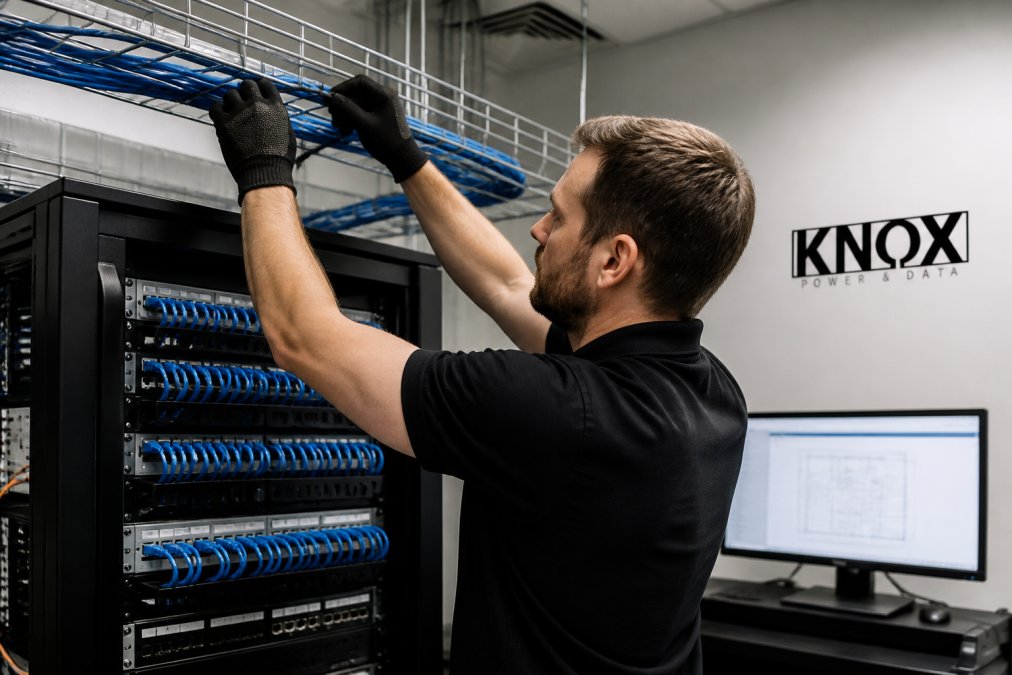
Cable management, routing, securing, and labelling, is essential for maintaining performance. Haphazard routing risks accidental damage, tight bundling exceeds bend radius limits, and unsecured cables sag and fail over time.
Professional installation includes comprehensive documentation: every cable labelled at both ends, patch panels clearly identified with port assignments, and infrastructure diagrammed showing routes and connections. This documentation is invaluable for troubleshooting, adding connections, and network modifications. Without it, each change requires detective work and risks damaging cables or creating confusion.
Evaluating Installation Quality and Long-Term Risk
Evaluate installation quotes on quality indicators beyond price. Low-cost quotes with minimal documentation, no structured design, and no testing certification are financial risks. Remediation costs typically exceed initial savings within 2-3 years.
Key quality indicators: (1) detailed site survey and structured design before quoting, (2) comprehensive testing and certification to BS 7671 18th Edition, (3) documentation and labelling included, (4) warranty covering materials and workmanship for 5-10 years. Installers skipping these steps cut corners that cost you later.
Properly installed and documented Cat6 infrastructure serves businesses effectively for 15-20 years. Poorly installed infrastructure may fail within 5-7 years, negating cost savings and creating disruption.
Professional Data Cabling Testing and Certification
Proper testing and certification verify that Cat6 infrastructure performs as specified. Many businesses cut corners here, where problems emerge months later.
Testing includes physical layer testing (continuity, termination, pair mapping, shorts) and performance validation (signal attenuation, crosstalk, return loss, propagation delay). A physically connected Cat6 cable may still fail performance tests if terminations are marginal or environmental factors degrade signal quality.
Certification requires qualified technicians to conduct tests and document results, proving your infrastructure meets Cat6 specifications. Without certification, you have no guarantee your cabling delivers Cat6 performance, and vendors will blame uncertified cabling for problems.
Knox Power & Data conducts all testing in compliance with BS 7671 18th Edition standards. This protects your investment and provides the assurance that your infrastructure performs as intended.
Power over Ethernet and Future-Proofing Your Infrastructure
Power over Ethernet (PoE) is increasingly important for modern facilities, and Cat6 cabling is fundamental to deploying PoE infrastructure effectively. PoE allows Cat6 cables to deliver both data and electrical power to connected devices, eliminating the need for separate power infrastructure for devices like access points, IP cameras, and VoIP phones.
Understanding PoE Standards and Power Budgets
Standard PoE (802.3af) delivers up to 15.4 watts per port, sufficient for many lightweight devices such as basic IP phones and older wireless access points. PoE+ (802.3at) provides up to 30 watts, enabling mid-range security cameras and modern dual-band access points. High-power variants including 802.3bt deliver up to 90 watts or more, supporting power-hungry devices like pan-tilt-zoom cameras and industrial equipment.
The critical consideration for businesses is that PoE power delivery depends on switch capability and cable quality. A Cat6 cable can technically carry PoE power, but if the cable has high resistance due to poor termination, thin conductors, or excessive length, voltage drop occurs and the device receives insufficient power. This is particularly problematic over longer runs; a PoE device 90 metres from the switch may experience 3-5 volt drops, potentially causing the device to malfunction or fail to power on entirely.
Business Applications and Infrastructure Decisions
Calculating PoE Deployment Costs and Benefits
Future-Proofing Through PoE Flexibility
Frequently Asked Questions
What are the primary performance benefits of Cat6 cabling over older standards?
Cat6 cabling supports data transfer rates up to 10 Gbps at distances up to 55 metres, compared to Cat5e's 1 Gbps limit. It operates at 250 MHz frequency versus Cat5e's 100 MHz, reducing latency and packet loss. The enhanced shielding minimises crosstalk and electromagnetic interference, delivering greater network stability and reliability for business applications like VoIP, video conferencing, and large file transfers.
How does Cat6 cabling improve network reliability for office environments?
Cat6 infrastructure reduces signal attenuation and crosstalk through superior shielding and twisted pair design, ensuring consistent throughput during peak usage. This translates to fewer dropped connections, lower latency, and improved uptime for critical business operations. Structured cabling with proper testing and certification guarantees compliance with industry standards, preventing costly network failures and maintaining productivity across your office.
What is the difference between Cat6 and Cat6a in a commercial setting?
Cat6a supports 10 Gbps transmission at distances up to 100 metres, while standard Cat6 is limited to 55 metres at full speed. Cat6a features additional shielding and operates at 500 MHz frequency, offering greater future-proofing for large commercial deployments. For smaller offices or shorter cable runs, Cat6 delivers excellent performance at lower cost; Cat6a suits enterprises requiring longer distances or maximum bandwidth headroom.
Is Cat6 cabling sufficient for supporting modern VoIP and video conferencing?
Yes. Cat6 easily handles VoIP and video conferencing demands, which typically require only 2-4 Mbps per stream. The 10 Gbps capacity and low-latency characteristics of Cat6 ensure crystal-clear voice quality and smooth video without jitter or buffering. Combined with Power over Ethernet (PoE) compatibility, Cat6 cabling can power IP phones and wireless access points simultaneously, simplifying office infrastructure.